Balance Chinese / Japanese Calligraphy Wall Scroll
You can choose from many options to create artwork with the Chinese characters / Asian symbols / Japanese Kanji for Balance on a wall scroll or portrait.
Start your project by clicking on the button next to your favorite title below...
4. Life in Harmony / Balanced Life
5. Life in Balance / Balancing Life
6. Life in Harmony / Balanced Life
7. Nature in Balance / Balanced Nature
8. The Universe in Balance / Balanced Universe
9. Yin Yang
11. Brotherly and Sisterly Love
12. Fair / Impartial
13. Fraternity
14. Honesty
15. Humble
16. Humble / Modest
17. Humble / Modesty / Humility
19. Impartial and Fair to the Brotherhood and Sisterhood of the World
20. Integrity
21. Justice / Rectitude / Right Decision
22. Modesty
24. Selflessness
25. Sisters at Heart
26. Sisterhood
27. Sisterhood / Sisters Relationship
28. Sisterhood / Sisterly Love
29. Temperance
30. Unselfish: Perfectly Impartial
Balance / Peace
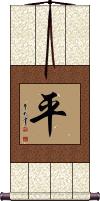
平 is a single character that means balance in Chinese but it's not too direct or too specific about what kind of balance.
Chinese people often like calligraphy art that is a little vague or mysterious. In this way, you can decide what it means to you, and you'll be right.
平 is also part of a word that means peace in Chinese, Japanese, and old Korean.
Some alternate translations of this single character include: balanced, peaceful, calm, equal, even, level, smooth, or flat.
Note that in Japanese, this just means “level” or “flat” by itself (not the best choice for balance if your audience is Japanese).
Balance / Equilibrium
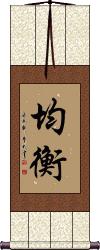
均衡 means balance or equilibrium.
This title is best for a Japanese audience where the word suggests that your life is in balance in all matters (or is a reminder for you to try and keep all matters in balance).
Harmony / Balance
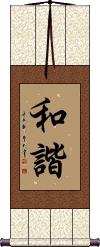
Harmony / Balance
Cho Wa
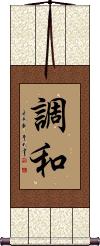
調和 is one of the several ways to express harmony in Chinese and Japanese.
Note: The first character means harmony but also suggests a musical meaning. It can also describe warriors marching in perfect cadence (in step) or to regulate something.
The second character carries the meaning of harmony and peace by itself.
Together, these characters create a word that can be defined as harmonious, to mediate, to reconcile, to compromise; mediation, temper, to mix, blend, blended, season, seasoning (getting the flavors of the food in balance), to placate, or be in harmonious proportion.
The meaning varies depending on the context. However, when hanging as a wall scroll, this will refer to the person (you) being balanced and in harmony while rational and under control simultaneously.
Life in Harmony / Balanced Life
Harmonious Life
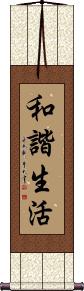
This 和諧生活 title suggests that you have, or want to get your life in balance.
The first two characters regard the idea of balance, harmony, and peace.
The second two characters mean “life.” More specifically this refers to your livelihood, career, and the daily activities that comprise your life or living. Some would translate those two characters as “one's daily existence.”
Note: We have a couple of titles for this idea. This version is more of a noun, thus "The Balanced Life" verses a verb form like "Balancing [Your] Life."
Life in Balance / Balancing Life
The art of balancing your life
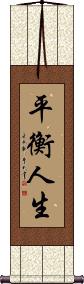
This 平衡人生 title suggests that you are actively trying to keep your life in balance.
Think of this as the action verb of seeking or having a balanced life.
The first two characters mean balance, equilibrium, or keeping things equal.
The last two characters mean “life.” Literally “human life.”
Life in Harmony / Balanced Life
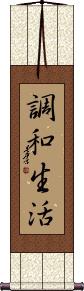
調和生活 is a Japanese title that suggests that you have, or want to get your life in balance.
The first two Kanji mean harmonious or in harmony.
The second two Kanji mean “life.” More specifically this refers to your livelihood, career, and the daily activities that comprise your life or living.
Nature in Balance / Balanced Nature
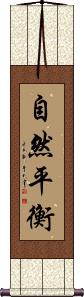
自然平衡 means “nature balanced.”
The first two characters mean nature (as in mother nature, or all biological life).
The second two characters mean balance or balanced.
Nature in Balance / Balanced Nature
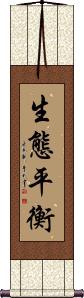
生態平衡 is a title about the way and balance of nature.
The first two characters mean nature or the way of life.
The second two characters mean balance or balanced.
Note: We have two versions of this title on our website. This is the one we recommend, as it is a little more natural (no pun intended).
Nature in Balance / Balanced Nature
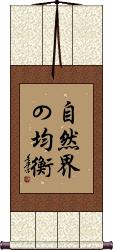
自然界の均衡 is a verbose way to say “nature in balance” in Japanese.
The first three Kanji have the meaning of “the natural world” or “the natural kingdom” (kind of like the animal kingdom but including plants and all things biological).
The third character is a Hiragana that acts to connect the two ideas here.
The last two Kanji mean equilibrium or balance.
Nature in Balance / Balanced Nature
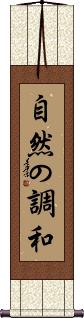
自然の調和 means “nature in harmony” in Japanese.
The first two Kanji mean nature (as in mother nature or the natural world).
The middle Hiragana is a possessive article that connects the two ideas.
The last two Kanji mean “in harmony” or “in balance.”
The Universe in Balance / Balanced Universe
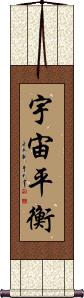
宇宙平衡 is a proverb that is simply Universe Balanced (we might say “Balanced Universe” in English).
The first two characters mean the Universe. However, in some contexts, it can mean cosmic, cosmos, or outer space.
The second two characters mean balance or balanced (can also mean equilibrium).
Yin Yang
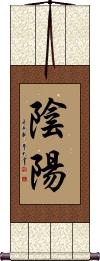
陰陽 literally means yin and yang in written form (versus the common yin-yang symbol). The first character has the element of the moon, while the second character has the element of the sun so that you can see, even in written form, they suggest the balance of opposites (of night and day). You could also translate this title as “sun and moon.”
Note: This title is often misspelled as Ying Yang instead of Yin Yang.
See Also: Taoism
Moderation / Temperance
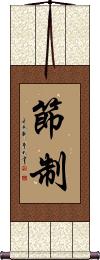
節制 means moderation or temperance in Chinese, Japanese Kanji, and old Korean Hanja.
Moderation is creating a healthy balance in your life between work and play, rest and exercise. You don't overdo or get swept away by the things you like. You use your self-discipline to take charge of your life and your time.
節制 can also be translated as sobriety or self-restraint.
This is often used as part of the Seven Heavenly Virtues to represent sobriety and/or temperance.
Brotherly and Sisterly Love
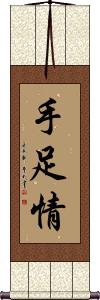
手足情 is the love between siblings.
When you love, protect, care for, and have a deep bond that only brothers or sisters can.
The actual translation is “Hand and Foot,” but the relationship between brothers or sisters is like that of hands and feet. They belong together and complete the body. Even though this says “hand and foot,” it will always be read with the brotherly and sisterly love meaning in Chinese.
Note: During the past 20 years, the “One child policy” in China is slowly making this term obsolete.
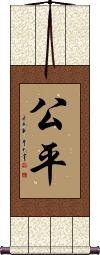
Fair / Impartial
Fraternity
University Brotherhood / House
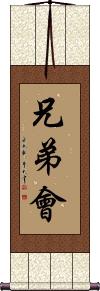
兄弟會 is the word in Chinese for a college fraternity or some other kind of fraternal order.
Literally, these characters mean “Elder brother younger brother association.” The last character can also be translated as a group, union, gathering, assembly, meeting, or conference.
Honesty
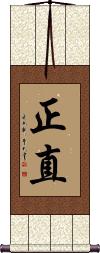
正直 or honesty is being truthful and sincere. It is important because it builds trust. When people are honest, they can be relied on not to lie, cheat or steal. Being honest means that you accept yourself as you are. When you are open and trustworthy, others can believe in you.
正直 is one of the 8 key concepts of Tang Soo Do.
Note: This entry is cross-listed as "integrity" because it also fits that definition.
 Please note that the second Kanji sometimes has an alternate form in Japanese. Let us know if you want the alternate form shown to the right.
Humble
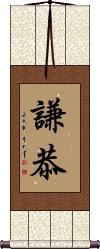
Humble / Modest
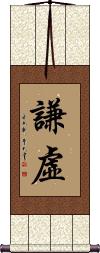
謙虛 can also be translated as humbleness or humility.
In Chinese and Korean, the first character means “modest.” The second means “empty.” Together these characters reinforce the ideas of modesty and being empty of ego.
 In Japan, they tend to use a slightly-simplified version of the second Kanji for this word. It also happens to be an alternate/simplified version used in China too. If you want to order the modern Japanese/simplified version, just click in the Kanji image shown to the right, instead of the button above.
See Also: Moderation
Humble / Modesty / Humility
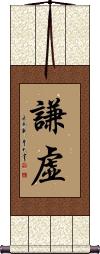
謙虚 is the most common way to say humble or modest in Japanese without a derogatory meaning (some other words suggest weakness, but this version holds a better humble meaning).
In Japanese, the first Kanji means self-effacing, humble oneself, and modesty. The second means void or emptiness.
See Also: Moderation
Humility / Being Humble
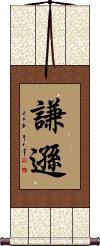
謙遜 can also be translated as being modest, humble, or unpretentious.
Being humble is considering others to be as important as yourself. You are thoughtful of their needs and willing to be of service. You don't expect others or yourself to be perfect. You learn from your mistakes. When you do great things, humility reminds you to be thankful instead of boastful.
This Humility title is also used as one of the 8 key concepts of Tang Soo Do. Often romanized as “Kyum Son.”
Also sometimes used in Japanese to express humility with an essence of modesty.
Impartial and Fair to the Brotherhood and Sisterhood of the World
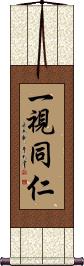
一視同仁 is how to write “universal benevolence.” This is also how to express the idea that you see all people the same.
If you are kind and charitable to everyone, this is the best way to state that virtue. It is the essence of being impartial to all mankind, regardless of social standing, background, race, sex, etc. You do not judge others, but instead, you see them eye to eye on the same level as you.
See Also: Benevolence | Compassion | Equality | Justice | Right Decision | Selflessness | Work Unselfishly for the Common
Integrity
Integrity is living by your highest values. It is being honest and sincere. Integrity helps you to listen to your conscience, do the right thing, and tell the truth. You act with integrity when your words and actions match. Integrity gives you self-respect and a peaceful heart.Please note that the second Kanji sometimes has an alternate form in Japanese. Let us know if you want the alternate form shown to the right.
Note: This entry is cross-listed as “honesty” because it also fits that definition.
Beyond Integrity, this word also means "upright" and "honest" in Chinese. Means "integrity," "honesty" or "frankness" in Japanese.
Justice / Rectitude / Right Decision
Also means: honor loyalty morality righteousness
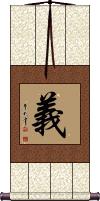
義 is about doing the right thing or making the right decision, not because it's easy but because it's ethically and morally correct.
No matter the outcome or result, one does not lose face if tempering proper justice.
義 can also be defined as righteousness, justice, morality, honor, or “right conduct.” In a more expanded definition, it can mean loyalty to friends, loyalty to the public good, or patriotism. This idea of loyalty and friendship comes from the fact that you will treat those you are loyal to with morality and justice.
義 is also one of the five tenets of Confucius's doctrine.
 There's also an alternate version of this character sometimes seen in Bushido or Korean Taekwondo tenets. It's just the addition of a radical on the left side of the character. If you want this version, click on the image to the right instead of the button above.
This is also a virtue of the Samurai Warrior
See our page with just Code of the Samurai / Bushido here
See Also: Judgment | Impartial | Confucius Tenets
Modesty
Depending on the context, 謙遜 can be translated as modesty, humbleness, or humility.
The first character means modesty, while the second means yielding. Together, it could be stated as “yielding modesty.”
See Also: Chastity | Prudence | Moderation
Prudence / Considerate
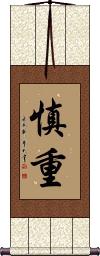
慎重 conveys the idea of being considerate, having prudence, and being thoughtful when taking action.
慎重 can also mean cautious, careful, discreet, deliberate, or taking all things into consideration.
The general meaning is shared across languages. However, in Chinese, this is more about prudence, while in Japanese, this is more about being considerate.
Chinese Catholics use this word to represent “prudence” in the list of the Seven Heavenly Virtues.

 Note: Depending on your choice of Chinese or Japanese calligraphers, the first Kanji will vary slightly.
It is technically the same character. Japanese tend to leave a space between the upper and lower portions of this particular Kanji. See sample images to the right.
Note: Depending on your choice of Chinese or Japanese calligraphers, the first Kanji will vary slightly.
It is technically the same character. Japanese tend to leave a space between the upper and lower portions of this particular Kanji. See sample images to the right.
See Also: Moderation | Modesty | Chastity
Selflessness
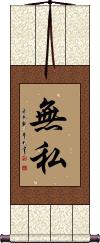
無私 would be literally translated as “none self” in Chinese, Korean, and Japanese.
It is used to express “selflessness” or “unselfish.”
無私 is a popular term for the idea of being selfless or unselfish in modern China and Japan.
This term is not as commonly used in Korea but still has good meaning.
Sisters at Heart
The love between sisters
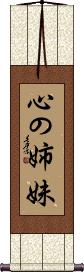
心の姉妹 is “heart of sisters,” “soul sisters,” or “sisters of the heart.”
This can be used for actual sisters to celebrate the heartfelt love they feel.
It can even be used by two women who feel a connection as if they are sisters.
Sisterhood
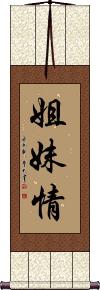
姐妹情 is one way to say “sisterhood.”
Literally, this means “sisters feeling, emotion, passion, or situation.”
Sisterhood / Sisters Relationship
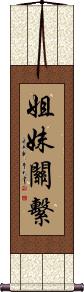
姐妹關繫 is an expression that means “sisterhood.”
Literally, this means “sisters relationship.”
Sisterhood / Sisterly Love
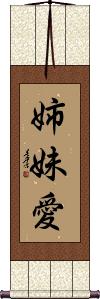
This Japanese term means “Sisterhood,” “Sisterly Love,” or “Sister Love.”
Temperance
In short, 節制 or temperance is knowing when to say “when.”
Temperance is the practice of moderation and restraint (in fact, this Asian word is often translated as moderation or restraint).
It was one of the five tenets held to be vital to society in Hellenic culture. It is also one of the Four Cardinal Virtues considered central to Christian behavior by the Catholic Church.
Note: Also considered to be one of the Seven Heavenly Virtues.
Unselfish: Perfectly Impartial
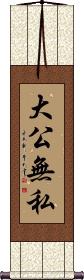
大公無私 is a Chinese proverb that comes from an old story from some time before 476 BC. About a man named Qi Huangyang, who was commissioned by the king to select the best person for a certain job in the Imperial Court.
Qi Huangyang selected his enemy for the job. The king was very confused by the selection, but Qi Huangyang explained that he was asked to find the best person for the job, not necessarily someone that he liked or had a friendship with.
Later, Confucius commented on how unselfish and impartial Qi Huangyang was by saying, “Da Gong Wu Si” which, if you look it up in a Chinese dictionary, is generally translated as “Unselfish” or “Just and Fair.”
If you translate each character, you'd have something like
“Big/Deep Justice Without Self.”
Direct translations like this leave out a lot of what the Chinese characters really say. Use your imagination, and suddenly you realize that “without self” means “without thinking about yourself in the decision” - together, these two words mean “unselfish.” The first two characters serve to drive the point home that we are talking about a concept that is similar to “blind justice.”
One of my Chinese-English dictionaries translates this simply as “just and fair.” So that is the short and simple version.
Note: This can be pronounced in Korean, but it's not a commonly used term.
See Also: Selflessness | Work Unselfishly for the Common Good | Altruism
Woman’s Association
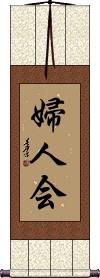
婦人會 is a Japanese title for women's group or association.
Sisterhood / Association of Women
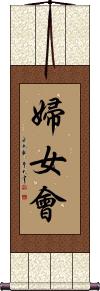
婦女會 is an expression that means “sisterhood” as in a women's association, club, or group.
The first two characters mean “women.”
The last character means to assemble, to meet, to gather, to see, union, group, or association.
Work Unselfishly for the Common Good
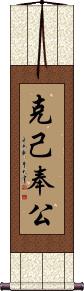
克己奉公 is a Chinese proverb that is often used to express how one should act as a government official. Most of us wish our public officials would hold themselves to higher standards. I wish I could send this scroll, along with the meaning to every member of Congress, and the President (or if I was from the UK, all the members of Parliament, and the PM)
This can also mean: “Place Strict Standards on Oneself in Public Service.”
The story behind this ancient Chinese idiom:
Cai Zun was born in China a little over 2000 years ago. In 24 AD, he joined an uprising led by Liu Xiu, who later became the emperor of the Eastern Han Dynasty.
Later, the new emperor put Cai Zun in charge of the military court. Cai Zun exercised his power in strict accordance with military law, regardless of the offender's rank or background. He even ordered the execution of one of the emperor's close servants after the servant committed a serious crime.
Cai Zun led a simple life but put great demands on himself to do all things honorably. The emperor rewarded him for his honest character and honorable nature by promoting him to the rank of General and granting him the title of Marquis.
Whenever Cai Zun would receive an award, he would give credit to his men and share the reward with them.
Cai Zun was always praised by historians who found many examples of his selfless acts that served the public interest.
Sometime long ago in history, people began to refer to Cai Zun as “ke ji feng gong.”
See Also: Unselfish | Selflessness | Altruism
Fatal error: Cannot redeclare foreignPrice() (previously declared in /home/gwest/web/chinesescrollpainting.com/public_html/includes/currencyconverter.php:22) in /home/gwest/web/orientaloutpost.com/public_html/includes/currencyconverter.php on line 22