Custom Motivation Chinese & Japanese Calligraphy Wall Scroll
We have many options to create artwork with Motivation characters on a wall scroll or portrait.
If you want to create an Motivation wall scroll, this is the place. Below you will find a few Asian symbols that express the idea of Motivation.
Motivation
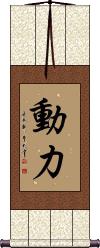
動力 can be used for motivation - it can also mean power/motion/propulsion/force. It can be anything internal or external that keeps you going.
動力 is the safest way to express motivation in Chinese. If your audience is Japanese, please see the other entry for motivation. 動力 is a word in Japanese and Korean, but it means “motive power” or “kinetic energy” (without the motivation meaning that you are probably looking for).
See Also: Enthusiasm | Passion
Motivation
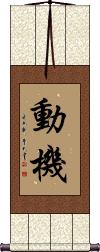
動機 is a common word for motivation in Japanese and Korean.
In Chinese, it can have some bad connotations - so it's safer if your target audience is Japanese or Korean.
Motivation
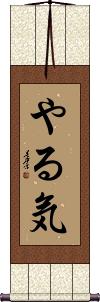
やる気 means motivation in Japanese.
It also can be translated as willingness (e.g., to do something), eagerness, inspiration, determination, totally willing, fully motivated, and high aspirations.
Note: Because this selection contains some special Japanese Hiragana characters, it should be written by a Japanese calligrapher.
See Also: Enthusiasm | Passion
Enthusiasm
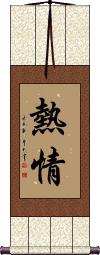
熱情 is a Chinese and Korean word for enthusiasm that can also be translated as passion (for a cause), ardency, ardor/ardour, enthusiasm, or zeal.
Enthusiasm is being warm, cheerful, happy, and full of spirit. It is doing something wholeheartedly and eagerly. When you are enthusiastic, you have a positive attitude.
In some contexts, this could mean being extremely fond of something or having a fondness for a cause or person.
This Chinese word can also be translated as "sincere and warm" or literally "warm sentiment / affection."
See Also: Passion | Commitment | Tenacity
Gung Ho
Working Together
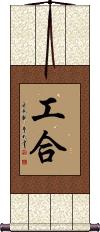
工合 is one of those Asian words that is used more in English than in the original Chinese.
Gung Ho was originally used to speak of Carlson's Raiders, a group of “Gung Ho” U.S. Marines who went on an island-hopping campaign of death during WWII.
A movie called Gung Ho came out in the mid-1940s and was later re-released in the 1950s depicting the 2nd Marine Raider Battalion, and brought this word to the mainstream.
It is still sometimes used today within the U.S. Marine Corps brotherhood to refer to a unit or group that works well together or is otherwise efficient and motivated (has good morals).
In 1986, there was a movie called Gung Ho about a Japanese company taking over an American automotive factory. They completely ignored the fact that this was a Chinese title.
It should be noted that this title actually means a condition, state, manner, or the health of something in Japanese.
Language and pronunciation notes:
Like many Asian words absorbed into common use in English, this one is drastically mispronounced. The official Romanization is “gong he” but that doesn't tell you enough. The vowel sound on the first character is like the English word “own,” now just add the g-sounds to the beginning and end. The second character is misleading, as you might think it is like the English word “he.” In reality, the vowel sound is more like the “u” in “up.”
It should also be noted that the current generation in China no longer uses or recognizes this as a common word or slogan.
Note: This can be pronounced and is a word in Japanese, though seldom used. Japanese will use a variation of "具合" instead. But still, not common.
Passion for a Cause
Depending on the context, 熱情 can mean “cordial,” “enthusiastic,” “passionate,” or “passionately.”
This version is sometimes used in Japanese, but the character order is more common in Chinese and Korean Hanja. The meaning in Japanese for this Kanji order is ardor/ardour or zeal but rarely used in modern Japan. I suggest you choose a different version of “passion” if your audience is Japanese.
See Also: Persistence | Devotion | Tenacity | Commitment
Enthusiasm / Passion for a Cause
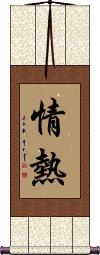
情熱 is the Japanese word that means enthusiasm or “passion for a cause.”
In some contexts, this could mean being extremely fond of something or having a fondness for a cause or person.
Can also be translated as passion, zeal, ardor/ardour, or fervor.
Note: This word (or character order) is not natural in Chinese. However, a typical Chinese person can guess this is a Japanese or Korean word and understand the intended meaning. This selection is best if your audience is Japanese or old-school Korean.
See Also: Persistence | Devotion | Tenacity | Commitment
Strong-Willed / Strong of Heart
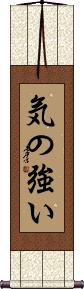
気の強い means strong-willed or strong of heart in Japanese.
Here's the character breakdown of this Japanese title:
気 (ki) spirit; mind; heart; nature; motivation; intention; feelings; essence.
の (no) possessive particle.
強い (tsuyoi) strong; powerful; mighty; potent; resistant; resilient; durable.
Note: Because this selection contains some special Japanese Hiragana characters, it should be written by a Japanese calligrapher.
Fatal error: Cannot redeclare foreignPrice() (previously declared in /home/gwest/web/chinesescrollpainting.com/public_html/includes/currencyconverter.php:22) in /home/gwest/web/orientaloutpost.com/public_html/includes/currencyconverter.php on line 22