Many custom options...


And formats...



Baseball in Chinese / Japanese...
Buy a Baseball calligraphy wall scroll here!
Personalize your custom “Baseball” project by clicking the button next to your favorite “Baseball” title below...
Baseball
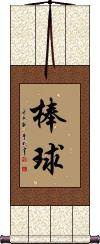
棒球 is the Chinese title for the sport of baseball.
Baseball
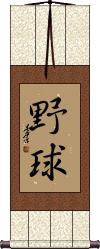
野球 is the Japanese title for the sport of baseball.
Cardinals
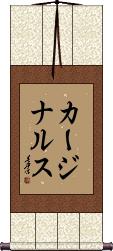
This is the Japanese name for the Cardinals (US baseball team).
Note: Because this title is entirely Japanese Katakana, it should be written by a Japanese calligrapher.
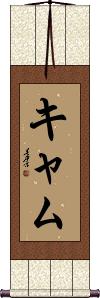
This is an alternate version of the name Kam in Japanese.
This is the Japanese name of baseball player Kam Mickolio.
Note: Because this title is entirely Japanese Katakana, it should be written by a Japanese calligrapher.
Giant
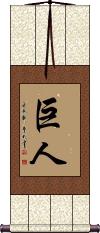
巨人 can mean giant or great person (great man or woman) in Chinese, Japanese Kanji, and old Korean Hanja.
巨人 is also the short name of the Tokyo Giants baseball team.
Sometimes the Japanese female name Mito.
Resilient in the Face of Adversity
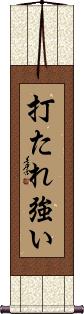
打たれ強い is often used as a martial arts term.
It means being able to take a lot of punishment or being able to take a hit. In Japanese baseball, it can also refer to the pitcher's ability to keep his cool when the batter gets a hit. 打たれ強い is generally about being resilient and strong in the face of criticism or adversity.
Note: Because this selection contains some special Japanese Hiragana characters, it should be written by a Japanese calligrapher.
Ikiru / To Live
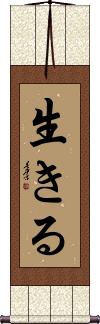
生きる is a Japanese title that means to live, to exist, to make a living, to subsist, to come to life, or to be enlivened.
生きる is also the title of a 1952 Japanese movie that uses the translated English title of “To Live.”
This term, when used in the context of baseball, and some Japanese games such as “go,” can mean “safe.”
Note: Because this selection contains some special Japanese Hiragana characters, it should be written by a Japanese calligrapher.
Crisis equals Danger plus Opportunity?
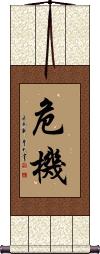
危機 means crisis in Chinese and Japanese.
Separately, the first character here does mean “danger” or “to endanger,” and the second character can mean “opportunity.”
However, I want to debunk a myth that was propagated by some westerners who did not have a clear understanding of Asian languages...
While often, Chinese/Japanese/Korean compound words (words of two or more characters) are the sum of their parts, this is not always the case. The compound is often understood with a completely different meaning than the two characters individually.
Many have said that the Chinese/Japanese/Korean word for Crisis is made up of the characters for “danger” and “opportunity.” 危機 is true when phrased this way.
However, it's not absolutely correct to say that “danger + opportunity = crisis” in Asian cultures.
English example:
If I tell you that...
Bovine creature + Guy behind the plate in baseball = Locomotive train protection

...you would think I was mad. But consider that “cow + catcher = cowcatcher,” which is the device that used to be found on steam engines to protect them if they hit an animal on the tracks. When we hear the word “cowcatcher,” we don't separate the words into their individual meanings (necessarily).
The same is true with the word for crisis in Chinese/Japanese/Korean. While you can separate the characters, few Asian people would automatically do so in their minds.
The final answer:
It is a half-truth to say, “danger plus opportunity equals crisis” in Chinese/Japanese/Korean. Use this statement and concept with caution.
Also, the second character can mean “secret” or “machine,” depending on context so I guess you have to say “a dangerous machine = crisis” or “danger + a secret = crisis.” Both of these are only slightly more ridiculous than the first premise.
PS: 危機 is probably not a great word for a scroll unless you have a special use for it.
Fatal error: Cannot redeclare foreignPrice() (previously declared in /home/gwest/web/chinesescrollpainting.com/public_html/includes/currencyconverter.php:22) in /home/gwest/web/orientaloutpost.com/public_html/includes/currencyconverter.php on line 22