Many custom options...


And formats...



Change in Chinese / Japanese...
Buy a Change calligraphy wall scroll here!
Personalize your custom “Change” project by clicking the button next to your favorite “Change” title below...
1. Change
3. Move On / Change Way of Thinking
4. A Wise Man Changes His Mind
5. Mark the boat to find the lost sword / Ignoring the changing circumstances of the world
6. Dynamic
8. New Life
10. New Life
11. New Beginning
12. Changing Oneself / Self Reformation
13. New Beginning
Change
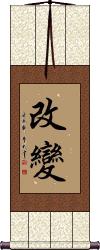
改變 can mean to change, become different, or transform.
This can refer to the changing world or a person who changes their attitude or something about themselves.
 Note: An alternate version of the second character is used in Japanese. This is actually an old alternate Chinese form which is seldom seen in China anymore. If you want this version, please click on the Kanji shown to the right instead of the "Select and Customize" button.
Wind of Change
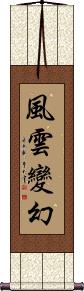
風雲變幻 is a Chinese proverb that means “wind of change” or “changeable situation.”
The first character, 風, means wind, but when combined with the second character, 風雲, you have weather, winds and clouds, nature, or the elements. Colloquially, this can refer to an unstable situation or state of affairs.
The last two characters, 變幻, mean change or fluctuate.
Move On / Change Way of Thinking
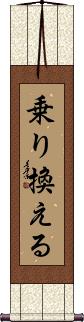
乗り換える is the Japanese way to say “move on.” This can also be translated as “to change one's mind,” “to change methods,” or “to change one's way of thinking.” For instance, if you changed your love interest or political ideology, you might describe the act of that change with this title.
Colloquially in Japan, this is also used to describe the act of transferring trains or changing from one bus or train to another.
Note: Because this selection contains some special Japanese Hiragana characters, it should be written by a Japanese calligrapher.
A Wise Man Changes His Mind (but a fool never will)
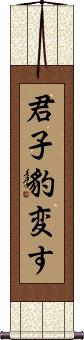
君子豹変す is a Japanese proverb that suggests that a wise man is willing to change his mind, but a fool will stubbornly never change his.
The first word is 君子 (kunshi), a man of virtue, a person of high rank, a wise man.
The second word is 豹変 (hyouhen), sudden change, complete change.
The last part, す (su), modifies the verb to a more humble form.
The “fool” part is merely implied or understood. So if wise and noble people are willing to change their minds, it automatically says that foolish people are unwilling to change.
Mark the boat to find the lost sword / Ignoring the changing circumstances of the world
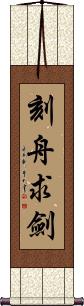
刻舟求劍 is an originally-Chinese proverb that serves as a warning to people that things are always in a state of change.
Thus, you must consider that and not depend on the old ways or a way that may have worked in the past but is no longer valid.
This idiom/proverb comes from the following story:
A man was traveling in a ferry boat across a river. With him, he carried a treasured sword. Along the way, the man became overwhelmed and intoxicated by the beautiful view and accidentally dropped his prized sword into the river. Thinking quickly, he pulled out a knife and marked on the rail of the boat where exactly he had lost his sword.
When the boat arrived on the other side of the river, the man jumped out of the boat and searched for his sword right under where he'd made the mark. Of course, the boat had moved a great distance since he made the mark, and thus, he could not find the sword.
While this man may seem foolhardy, we must take a great lesson from this parable: Circumstances change, so one should use methods to handle the change. In modern China, this is used in business to mean that one should not depend on old business models for a changing market.
This proverb dates back to the Spring and Autumn period (770–476 BC) of the territory now known as China. It has spread and is somewhat known in Japan and Korea.
Dynamic
Moving / Motion / Ever-Changing
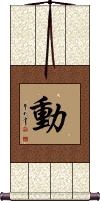
動 is the only Chinese/Japanese/Korean word that can encompass the idea of “dynamic” into one character.
動 can also mean:
to use; to act; to move; to change; motion; stir.
In the Buddhist context, it means: Movement arises from the nature of wind which is the cause of motion.
The key point of this word is that it represents motion or always moving. Some might say “lively” or certainly the opposite of something that is stagnant or dead.
Note: In Japanese, this can also be a female given name, Yurugi.
New Beginning
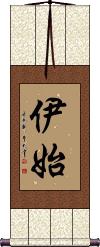
伊始 is a short version of “new beginning” or simply “beginning” in Chinese characters.
You can also translate this as “from this moment on,” “starting now,” or “henceforth.”
In the day-to-day speech, this word can apply to starting a new job, beginning a new career, entering a new chapter of your life, or taking a new position (in politics, scholarship, etc.).
New Life
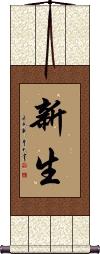
新生 literally means “new life” or “new birth” in Chinese, Japanese Kanji, and old Korean Hanja.
Depending on the context, this word can also mean newborn, new student, rebirth, new birth, or nascent.
In Japanese, this can be the given name Wakaki.
Note: This is not the most common word selection for a calligraphy wall scroll. But if you’re a westerner, you can bend the rules a bit.
New Beginning
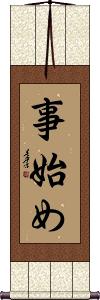
事始め is a Japanese word that means taking up a new line of work or the beginning of new things.
In another context, it can refer to starting the preparations for New Year's festivities or resuming work after the New Year's vacation.
New Life
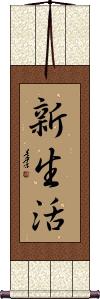
This literally means “new life” or “new livelihood” in Japanese Kanji.
新生活 is most appropriate if you are starting a new career or otherwise are starting a new chapter in your life or a new beginning.
Note: This is not the most common word selection for a calligraphy wall scroll. But if you’re a westerner, you can bend the rules a bit.
New Beginning
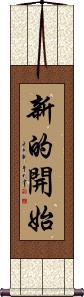
新的開始 literally means “new beginning” in Chinese characters.
The character means “new.”
The second is a possessive article connecting the ideas of new & beginning.
The last two characters can mean “to begin,” “beginning,” “to start,” “initial,” “commencement,” or “initiation.”
Changing Oneself / Self Reformation
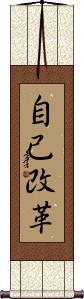
自己改革 is a Japanese title that refers to one who changes themselves or improves themselves by reforming their lives.
Another way to translate it is “A person who changes their attitude or something about themselves.”
New Beginning
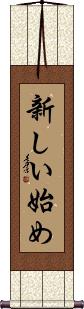
新しい始め is a verbose Japanese phrase that means “new beginning.”
The first three characters mean new, novel, fresh, recent, latest, up-to-date, or modern.
The last two characters mean beginning, start outset, opening, or origin.
Note: Because this selection contains some special Japanese Hiragana characters, it should be written by a Japanese calligrapher.
New Beginning
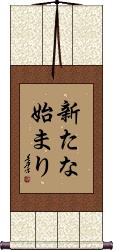
新たな始まり is a Japanese word that means “new beginning” or “new start.”
Here's the character breakdown:
新た (arata) = new; fresh; novel; newly; freshly; or this can be like the prefix “re-” like “re-start” or “reset.”
な (na) is kind of a connecting article. This glues “new” to “beginning.”
始まり (hajimari) = origin; beginning.
Note: Because this selection contains some special Japanese Hiragana characters, it should be written by a Japanese calligrapher.
Fatal error: Cannot redeclare foreignPrice() (previously declared in /home/gwest/web/chinesescrollpainting.com/public_html/includes/currencyconverter.php:22) in /home/gwest/web/orientaloutpost.com/public_html/includes/currencyconverter.php on line 22