Many custom options...


And formats...



Diamond in Chinese / Japanese...
Buy a Diamond calligraphy wall scroll here!
Personalize your custom “Diamond” project by clicking the button next to your favorite “Diamond” title below...
Diamond
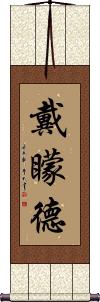
戴矇德 is the transliteration to Mandarin Chinese for the name Diamond.
I suggest you use a word that means diamond, rather than this one that sounds like diamond.
Diamond
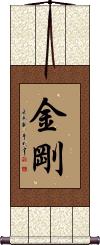
金剛 is a common way to call diamonds in Chinese and Japanese.
Traditionally, there were not that many diamonds that made their way to Asia, so this word does not have the deep cultural significance that it does in the west (thanks mostly to De Beers' marketing). Therefore, this word was kind of borrowed from other uses.
This title can also refer to vajra (a Sanskrit word meaning both thunderbolt and diamond that originally refers to an indestructible substance); hard metal; pupa of certain insects; Vajrapani, Buddha's warrior attendant; King Kong; adamantine; Buddhist symbol of the indestructible truth.
Stay Strong / Indestructible / Unbreakable
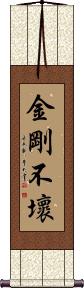
金剛不壞 is originally a Buddhist term for “The diamond indestructible.”
Sometimes, it's written 金剛不壞身, The diamond-indestructible body.
Outside that context, it still means firm and solid, sturdy and indestructible, unshakable, or adamantine (a mythological indestructible material).
 Note: If you order this from the Japanese master calligrapher, the last Kanji will look like the one shown to the right.
Vajrayana
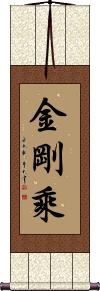
This is the title for Vajrayāna Buddhism in Chinese and Japanese.
Vajrayāna is the diamond vehicle or adamantine vehicle.
Sometimes referred to as 密教 or esoteric Buddhism.
Adamantine / King Kong
金剛 can translate as adamantine from Chinese, Japanese, and old Korean.
Other meanings and translations can include diamond, thunderbolt, Indra's indestructible weapon, a Buddhist symbol of the indestructible truth, Vajra (a mythical weapon), guardian deity, hardness, indestructibility, power, the least frangible of minerals.
The Chinese pronunciation of “Jīn Gāng” became the loanword used in English as “King Kong.” You can see King Kong as the indestructible ape guardian deity depending on how you read the story.
Fatal error: Cannot redeclare foreignPrice() (previously declared in /home/gwest/web/chinesescrollpainting.com/public_html/includes/currencyconverter.php:22) in /home/gwest/web/orientaloutpost.com/public_html/includes/currencyconverter.php on line 22