Many custom options...


And formats...



Free Spirit in Chinese / Japanese...
Buy a Free Spirit calligraphy wall scroll here!
Personalize your custom “Free Spirit” project by clicking the button next to your favorite “Free Spirit” title below...
Free Spirit
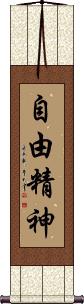
The first two characters mean freedom or liberty.
The second two characters mean spirit, heart, mind, or soul.
Together, 自由精神 is a title that is very similar to the English term “free spirit.”
See Also: Freedom | Independence
Free Spirit
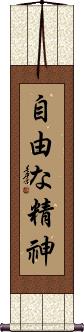
自由な精神 is very similar to the English term “free spirit.”
The first two characters mean freedom or liberty.
The middle character is a connecting Hiragana which is needed for Japanese grammar.
The last two characters mean spirit, heart, mind, or soul.
See Also: Freedom | Independence
To Be Free / Freedom
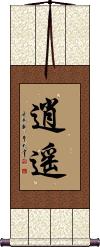
逍遙 means freedom in Chinese characters.
This has a well-written meaning for a wall scroll. What I mean by that is while there is a way to say “freedom” orally, this word seems more appropriate for calligraphy. This can also be translated as “free and unfettered” in Chinese.
Note: In Korean and Japanese, this means one who rambles, saunters, or strolls (this entry is best if your audience is Chinese).
Free Will
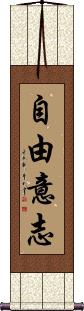
自由意志 is a concept that has existed for thousands of years that humans can understand right and wrong, then make a decision one way or the other (thus affecting their fate).
Sources such as Confucius, Buddhist scriptures, the Qur'an, and the Bible all address this idea.
As for the characters shown here, the first two mean free, freedom, or liberty. The last two mean “will.”
Can be romanized from Japanese as jiyū-ishi, jiyuu-ishi, and sometimes jiyuu-ishii.
It's 자유의지 or jayuu-yiji in Korean and zìyóu yìzhì in Chinese.
See Also: Freedom | Strong Willed | Fate
Freedom / Liberty
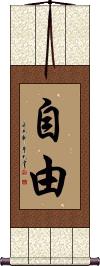
自由 is a common word to express the idea of freedom in both Chinese and Japanese.
This word is the essence of “being free” but also acts as the suffix to create words like freestyle swimming, free trade, civil liberties, free will, freedom fighter, religious freedom, and liberal.
Old, But More Vigorous in Spirit
Age is just a number
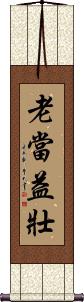
老當益壯 is a Chinese proverb that means “old but vigorous” or “hale and hearty despite the years.”
Said of someone who is more spirited when he/she grows older.
The story behind this Chinese proverb:
In the Eastern Han Dynasty, there was a man named Ma Yuan. He had been planning to herd animals on the frontier since he was young. When he grew up, Ma became a minor official of a county.
Once, he was sending some prisoners to another location. He felt pity for them, so he set them free, and then he fled to another county in the north. He herded animals there, and thus his dream came true. He always said: “If you want to be a great man, the poorer you are, the firmer in spirit you have to be; the older you are, the more spirited you should be.”
Later, when he was even older, Ma Yuan became a famous general of the Eastern Han Dynasty and contributed to many battles.
Fatal error: Cannot redeclare foreignPrice() (previously declared in /home/gwest/web/chinesescrollpainting.com/public_html/includes/currencyconverter.php:22) in /home/gwest/web/orientaloutpost.com/public_html/includes/currencyconverter.php on line 22