Many custom options...


And formats...



Go With the Flow in Chinese / Japanese...
Buy a Go With the Flow calligraphy wall scroll here!
Personalize your custom “Go With the Flow” project by clicking the button next to your favorite “Go With the Flow” title below...
2. Life Energy / Spiritual Energy
3. Aijou-Ryu
5. Mugai-Ryu
9. Uechi-Ryu
10. Jin Shin Jyutsu
12. No Worries
Go With The Flow
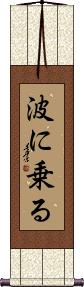
波に乗る is a Japanese proverb that means to go with the flow or to go with the times.
Note: Because this selection contains some special Japanese Hiragana characters, it should be written by a Japanese calligrapher.
Go With The Flow
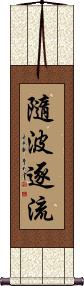
隨波逐流 is a Chinese proverb that means to drift with the waves and go with the flow.
This can be positive or negative, as it can also be used to mean following the crowd blindly.
Life Energy / Spiritual Energy
Chi Energy: Essence of Life / Energy Flow
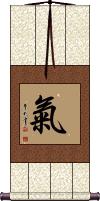
This 氣 energy flow is a fundamental concept of traditional Asian culture.
氣 is romanized as “Qi” or “Chi” in Chinese, “Gi” in Korean, and “Ki” in Japanese.
Chi is believed to be part of everything that exists, as in “life force” or “spiritual energy.” It is most often translated as “energy flow” or literally as “air” or “breath.” Some people will simply translate this as “spirit,” but you must consider the kind of spirit we're talking about. I think this is weighted more toward energy than spirit.
The character itself is a representation of steam (or breath) rising from rice. To clarify, the character for rice looks like this: 
Steam was apparently seen as visual evidence of the release of “life energy” when this concept was first developed. The Qi / Chi / Ki character is still used in compound words to mean steam or vapor.
The etymology of this character is a bit complicated. It's suggested that the first form of this character from bronze script (about 2500 years ago) looked like these samples: 

However, it was easy to confuse this with the character for the number three. So the rice radical was added by 221 B.C. (the exact time of this change is debated). This first version with the rice radical looks like this: 
The idea of Qi / Chi / Ki is really a philosophical concept. It's often used to refer to the “flow” of metaphysical energy that sustains living beings. Yet there is much debate that has continued for thousands of years as to whether Qi / Chi / Ki is pure energy or consists partially or fully of matter.
You can also see the character for Qi / Chi / Ki in common compound words such as Tai Chi / Tai Qi, Aikido, Reiki, and Qi Gong / Chi Kung.
In the modern Japanese Kanji, the rice radical has been changed into two strokes that form an X.
 The original and traditional Chinese form is still understood in Japanese, but we can also offer that modern Kanji form in our custom calligraphy. If you want this Japanese Kanji, please click on the character to the right instead of the “Select and Customize” button above.
More language notes: This is pronounced like “chee” in Mandarin Chinese, and like “key” in Japanese.
This is also the same way to write this in Korean Hanja where it is Romanized as “gi” and pronounced like “gee” but with a real G-sound, not a J-sound.
Though Vietnamese no longer use Chinese characters in their daily language, this character is still widely known in Vietnam.
See Also: Energy | Life Force | Vitality | Life | Birth | Soul
Aijou-Ryu
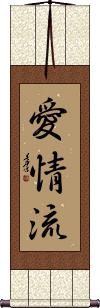
This is the title Aijō-Ryū, Aijou-Ryu or Aijou-Ryuu meaning “style of love and affection” or “flow of love” in Japanese.
Chowa-Ryu Jujitsu
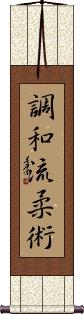
調和流柔術 is the title for Chowa-Ryu Jujitsu.
This roughly translates as harmonious-flow Jujitsu.
The first two characters are sometimes romanized as chōwa, chouwa, chowa, or cho-wa.
Mugai-Ryu

無外流 is the name Mugai-Ryu in Japanese Kanji.
無外流 means “Without Outward Flow” or “Outer Nothingness School” and is a Japanese koryū martial art school.
Forgive and Forget
Water Under the Bridge
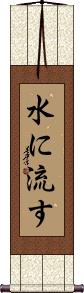
水に流す is a Japanese proverb that suggests that “water continues to flow.”
It's similar to our English phrase, “Water under the bridge.” The perceived meaning is, “Forgive and forget.”
I have also seen this translated as “Don't cry over spilled milk.”
Note: Because this selection contains some special Japanese Hiragana characters, it should be written by a Japanese calligrapher.
Koryu Bujutsu
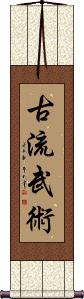
古流武術 is the title “Ko-ryū Bujutsu” which basically means “old school martial arts” or “ancient flow martial arts.”
This is more a Japanese than a Chinese martial arts term but would be understood in Chinese as well.
The Way of the Wave
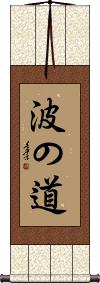
波の道 is the simple way to write “The Way of the Wave” in Japanese.
I added this at the request of several customers. 波の道 is not a very common Japanese phrase.
波 = Wave
の = Of
道 = Way
The word order is the opposite of English. Most Japanese phrases that end in “の道” are translated to English as “The Way of...”
Technically, you could write “波道” as a shorter version of “The Way of the Wave.” However, without context, 波道 can mean channel or suggest a path to redirect ocean flow.
Uechi-Ryu
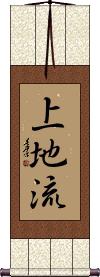
上地流 or Uechi-Ryū is the short name for a traditional style of Okinawan karate.
Uechi-Ryū is named after its creator, Kanbun Uechi. Uechi was an Okinawan man who left at the age of 19 for China to study Chinese martial arts and medicine.
The meaning of this title is “Uechi Flow,” “Uechi Style,” or “Uechi School.” Although, the name 上地 or Uechi can mean “higher stages of practice” in the Buddhist context. Therefore, you can stretch the meaning to be “Higher-Stages-of-Practice Style.”
Jin Shin Jyutsu
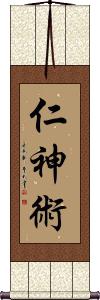
仁神術 is Jin Shin Jyutsu or Jin Shin Jutsu.
This is a practice of calming the mind and clearing the flow of Qi energy in the body. Jin Shin Jyutsu has some commonality with the practice of Reiki.
A good translation of 仁神術 would be “Benevolent Spirit Method.”
We can break that down into all of the possible meanings:
仁 = benevolence (esp. as a virtue of Confucianism), consideration, compassion, humanity, charity, kindness, or virtue.
神 = deity, soul, spirit, mysterious, psyche, god, divinity, spiritual powers, deva, divine, spiritual, or supernatural.
術 = way, method, means, art, trick, or plan. The correct romaji for this 術 Kanji should be “jutsu.” However, in martial arts, this is often written “jitsu” but in this case, “jyutsu” became common.
Wu Wei / Without Action
Daoist / Taoist Tenet
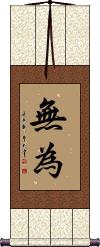
無為 or “Wu Wei” is a Daoist (Taoist) tenet that speaks to the idea of letting nature take its course.
Some will say it's about knowing when to take action and when not to. In reality, it's more about not going against the flow. What will happen is controlled by the Dao (Tao), for which one who follows the Dao will not resist or struggle against.
You can think of 無為 as the Chinese way to express “laissez-faire.”
There is a lot more to this concept, but if you are looking for this entry, you already know the expanded concept.
Warning: Outside of the Daoist context, this means idleness or inactivity (especially in Japanese, where not everyone knows this as a Daoist concept, though it does pair well with the Japanese concept of Wabi-Sabi).
No Worries
My Australian friends always say, “No worries, mate.” It's caught on with me, though I drop the “mate” part since it confuses my fellow Americans.
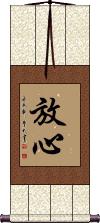
If you would like to express the idea of “no worries,” 放心 is the best and most natural way to say it in Chinese.
The characters you see to the left can be translated as “put your mind at rest” or “to be at ease.” You could literally translate “no worries,” but it doesn't “flow” like this simple Chinese version.
For your info, the first character means to release, to free, to let go, to relax, or to rest. The second character means your heart or your mind.
Note that in Japanese and Korean, this holds the similar meaning of “peace of mind” but can also mean absentmindedness or carelessness, depending on context.
Fatal error: Cannot redeclare foreignPrice() (previously declared in /home/gwest/web/chinesescrollpainting.com/public_html/includes/currencyconverter.php:22) in /home/gwest/web/orientaloutpost.com/public_html/includes/currencyconverter.php on line 22