Many custom options...


And formats...



Not what you want?
Try other similar-meaning words, fewer words, or just one word.
Inner Wisdom in Chinese / Japanese...
Buy an Inner Wisdom calligraphy wall scroll here!
Personalize your custom “Inner Wisdom” project by clicking the button next to your favorite “Inner Wisdom” title below...
1. Inner Wisdom
2. Inner Beauty / Inner Wisdom
3. Wisdom
4. Wisdom comes from Experience
5. Great Lotus Wisdom - Samadhi Wisdom
6. Experience is the Mother of Wisdom
7. Wisdom
8. Great Wisdom
9. Great Wisdom
10. Seeker of Wisdom
12. Seeker of Wisdom
13. Seeking Wisdom
14. Great Illumination of Wisdom
15. Wisdom and Insight of the Buddha
16. Mystic Lotus Wisdom of Amitabha
18. Wisdom
19. When Three People Gather, Wisdom is Multiplied
20. Wisdom Lotus
23. Wisdom comes from Experience
24. Power of Understanding and Wisdom
26. Intuitive Wisdom / Inner Light
29. Serenity Prayer
31. An Open Book Benefits Your Mind
32. A Wise Man Changes His Mind
33. Bodhi - Awakening Enlightenment
34. You May Learn from Victory, You Will Learn from Failure
35. When Three People Gather, One Becomes a Teacher
36. Confucius: Universal Education
38. You May Learn from Victory, You Will Learn from Failure
39. The Five Tenets of Confucius
40. Each Time You Stumble and Fall, You Gain Experience and Wisdom
42. Open the Minds of the Next Generation To Stimulate Thinking
44. Example is Better than Precept
45. Awareness
46. Failure is the Mother of Success
47. Keiran
48. Knowledge of Ultimate Truth
51. Light / Bright
52. Learn New Ways From Old / Onkochishin
53. Dharma Gate
55. 1. Right Understanding / Right Perspective / Right View / Perfect View
56. 2. Right Resolve / Right Thought / Right Intention / Perfect Resolve
57. Gem
59. Light / Bright and Promising Future
Inner Wisdom
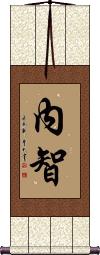
內智 is a Buddhist term that means “inner wisdom.”
Inner Beauty / Inner Wisdom
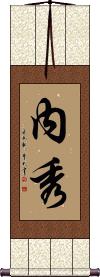
內秀 is an interesting word in Chinese that simultaneously means inner beauty and inner wisdom.
Some will translate it as “intelligent but unassuming.”
It's about having amazing abilities or traits on the inside which are not immediately obvious on the outside.
Wisdom
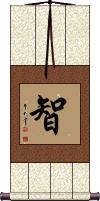
智 is the simplest way to write wisdom in Chinese, Korean Hanja, and Japanese Kanji.
Being a single character, the wisdom meaning is open to interpretation, and can also mean intellect, knowledge or reason, resourcefulness, or wit.
智 is also one of the five tenets of Confucius.
智 is sometimes included in the Bushido code but is usually not considered part of the seven key concepts of the code.
See our Wisdom in Chinese, Japanese and Korean page for more wisdom-related calligraphy.
See Also: Learn From Wisdom | Confucius
Wisdom comes from Experience
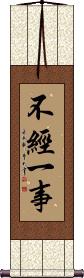
不經一事 means “You can't gain knowledge without practical experience.”
This is the short form (first half) of a longer Chinese proverb. These 4 characters remind you that wisdom only comes from experience.
Great Lotus Wisdom - Samadhi Wisdom
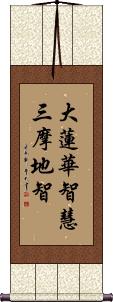
大蓮華智慧三摩地智 is the title for “The wisdom of the great lotus, samādhi-wisdom.”
This is also the penetrating wisdom of Amitābha.
Experience is the Mother of Wisdom
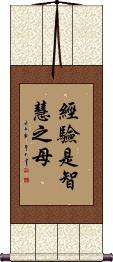
It's been said that wisdom comes from good judgment, and good judgment comes from experience, while experience comes from a series of times when you used bad judgment.
經驗是智慧之母 is a Chinese proverb that makes the simplest connection between experience and wisdom.
See Also: Failure is the Mother of Success | Wisdom | Learn From Wisdom
Wisdom
(All-Knowing)
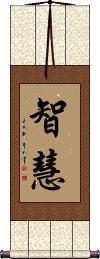
Beyond wisdom, 智慧 can be translated as knowledge, sagacity, sense, and intelligence.
The first character means “wise” or “smart,” and the second character means “intelligence.”
Note: 智慧 is used commonly in Chinese and is a less-common word in Japanese and Korean. If your audience is Japanese, I suggest our other Japanese wisdom option.
This means intellect or wisdom in Japanese too but is a more unusual way to write this word (though both versions are pronounced the same in Japanese).
See Also: Learn From Wisdom
Great Wisdom
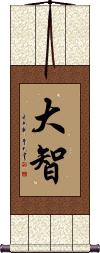
大智 is a Zen Buddhist title that means supreme wisdom, great wisdom, Buddha-wisdom, omniscience, or transcendental wisdom.
Great Wisdom
Prajñā
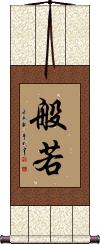
般若 means great wisdom or wondrous knowledge.
In the Buddhist context, this is prajna or prajñā, to know, to understand, to have the wisdom required to attain enlightenment.
Since this is a wisdom that transcends the realm of logic, the pure, absolute wisdom beyond the reach of words and concepts, it is not obtained through learning but is realized for the first time through a religious experience.
Seeker of Wisdom
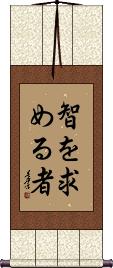
智を求める者 means “seeker of wisdom” in Japanese.
To break it down:
智 is wisdom.
を is a particle that connects wisdom to the next idea.
求める is a transitive verb that means to want, to wish for, to ask for, to seek, to search for, to look for, or to pursue.
者 is a literary way to write “person.”
Note: Because this selection contains some special Japanese Hiragana characters, it should be written by a Japanese calligrapher.
Door of Great Wisdom
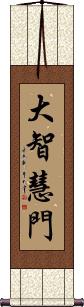
大智慧門 is the title for “The Great Wisdom Door,” or “The Gate to Great Wisdom.”
This refers to a portal to all wisdom and knowledge in Buddhism.
Seeker of Wisdom
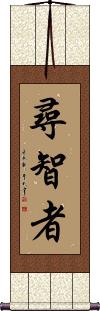
尋智者 is a Chinese title that means “Seeker of Wisdom.”
It's a little ambiguous, as you can also read this as “Seeking a Wise Person.”
Whether you are the person seeking wisdom or in the process of seeking a wise person (you will probably gain wisdom from the wise) this short phrase should suit your needs.
Seeking Wisdom
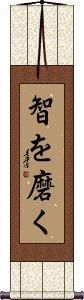
智を磨く is an old obscure Japanese phrase that means to refine, cultivate, or improve one's wisdom.
This is the mantra of one who is a seeker of wisdom. They will always want to polish, shine, refine, improve, and expand their knowledge and understanding.
Note: Because this selection contains some special Japanese Hiragana characters, it should be written by a Japanese calligrapher.
Great Illumination of Wisdom
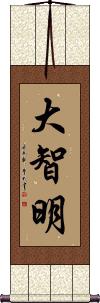
大智明 is a Zen Buddhist title that means the great illumination of wisdom.
This refers to wisdom so bright that it shines through obviously to all in its presence.
Wisdom and Insight of the Buddha
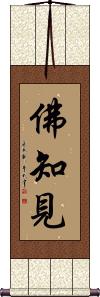
This title represents the wisdom and insight of the Buddha, or the penetrative power of Buddha's wisdom, or vision.
佛知見 is a term derived from the Lotus Sutra, perhaps up to 1900 years ago.
Mystic Lotus Wisdom of Amitabha
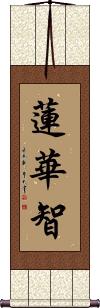
蓮華智 is the lotus or mystic wisdom of Amitābha.
It's one of the five kinds of wisdom in Buddhism.
The Wisdom of the Many
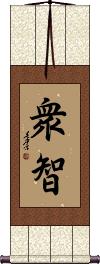
衆智 is a Japanese word that means the wisdom of the many.
Wisdom
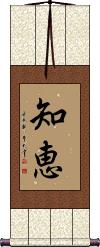
The simple translation of 知惠 is wisdom, but the more expanded version is “to know all things in their entirety.”
The first Kanji represents “to know” or “to realize.” Combined, these two Kanji mean “learn, know, and understand completely.”
Note: While vaguely understood in Chinese, this is only a real word in Japanese.
 Ancient Japanese/Korean version: This is also a word in old Korean Hanja, with a slight difference in the last character - if you want that version (which is also the ancient Japanese version) please click on the character to the right, instead of the button above.
When Three People Gather, Wisdom is Multiplied
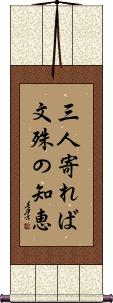
三人寄れば文殊の知恵 literally means “when three people meet, wisdom is exchanged.”
Some will suggest this means when three people come together, their wisdom is multiplied.
That wisdom part can also be translated as wit, sagacity, intelligence, or Buddhist Prajna (insight leading to enlightenment).
In the middle of this proverb is “monju,” suggesting “transcendent wisdom.” This is where the multiplication of wisdom ideas comes from.
Note: This is very similar to the Chinese proverb, "When 3 people meet, one becomes a teacher."
Note: Because this selection contains some special Japanese Hiragana characters, it should be written by a Japanese calligrapher.
Wisdom Lotus
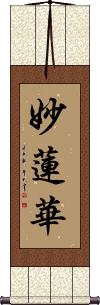
妙蓮華 means the wonderful lotus and the symbol of the pure wisdom of Buddha.
This lotus is unsullied in the midst of the impurity of the world.
Wisdom / Intelligence
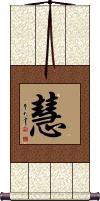
Wisdom / Intelligence
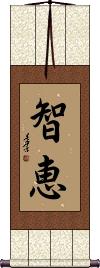
智恵 is a Japanese word that means wisdom; wit; sagacity; sense; intelligence.
In the Buddhist context, this is prajna (insight leading to enlightenment).
This can also be the Japanese female given name Norie.
Wisdom / Intelligence
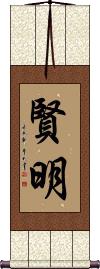
賢明 is a Japanese word that refers to wisdom, intelligence, and prudence.
賢明 was originally a Chinese word that referred to a wise person or enlightened ruler. It means wise and able, sagacious now in China.
Wisdom / Brilliance
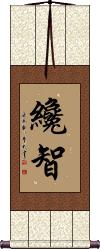
In Chinese, 纔智 means “ability and wisdom” or “ability and intelligence.”
纔智 can also be defined as brilliance or genius.
In Japanese, 纔智 takes on a meaning more of “wit and intelligence.”
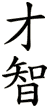 Note that the ancient/traditional form is shown above. After WWII, in both Japan and China, the first character was simplified. If you want this reformed/simplified version, just click on the characters to the right, instead of the button above. This is a good choice if your audience is Japanese.
Wisdom comes from Experience
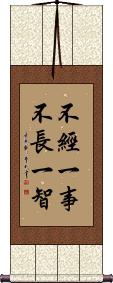
You can translate this 不经一事不长一智 Chinese proverb in a couple of ways.
The first is: You cannot gain knowledge without practice.
The second, and perhaps more popular way is: Wisdom comes from experience.
It literally means if you are inattentive to your affairs or situations you encounter, you will not gain or grow any wisdom or intellect.
Power of Understanding and Wisdom
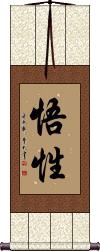
悟性 means the power of understanding and insight in Chinese.
It is often associated with Neo-Confucianism. In that regard, it means to realize, perceive, or have the perception of man's true nature. It can also mean finding your soul, the soul of others, or the soul of the world. Some will translate this simply as the state of being “savvy.”
In Japanese, this is often translated as wisdom and understanding.
Learn from Wisdom
(When you see a wise person, try to be like them)
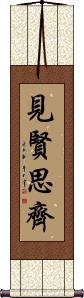
When you meet a wise person, you should learn from them and be inspired to become as wise as they are.
見賢思齊 is a pretty long proverb in English, but in Chinese, it's only four characters.
However, in Chinese, the deeper meaning often surpasses the dictionary definition of each character.
In this case, you should seek wise people to learn from throughout your life...
Always try to learn enough to become equal to them. It also suggests that learning and seeking wisdom is a non-ending cycle.
See Also: Knowledge
Intuitive Wisdom / Inner Light
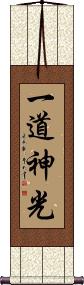
一道神光 is a Buddhist term that means “inner light,” or “intuitive wisdom.”
This actually reads, “[the] one path/way [of] spiritual light.” It implies that your spirit knows the way, and will light the path for you.
Fudo Myo-o / Wisdom King
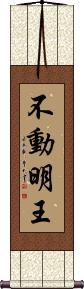
不動明王 is the fierce form of the Buddha Vairocana, and the most important of the Myō-ō or Ming Wang class of deities.
Romanized as Fudō Myō-ō, in Japanese Buddhism or Bùdòng Míngwáng / Pu-Tung Ming-Wang in Chinese Buddhism,
Originally Acala/Achala (अचल “The Immovable”), Acalanātha (अचलनाथ “Immovable Lord”) or Āryācalanātha (आर्याचलनाथ, “Noble Immovable Lord”).
In English, this deity is sometimes called “Wisdom King.”
Wisdom from Hard Knocks
The school of hard knocks
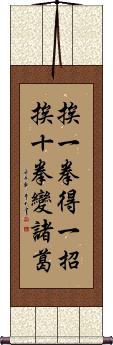
挨一拳得一招挨十拳變諸葛 is a Chinese proverb that literally translates as: Receive one blow, [and one] learns a lesson; Receive ten blows, [and one] becomes a great Zhuge [Liang].
You must first understand that a man named Zhuge Liang was one of the great strategists and philosophers in Chinese history. He's known as a man of great wisdom.
Figuratively, this phrase means:
One can learn much from failure or “hard knocks.”
Serenity Prayer
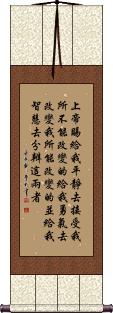
This is the serenity prayer, as used by many 12-step programs and support groups.
In Chinese, this says:
God grant me the serenity to accept the things I cannot change, the courage to change the things I can, and the wisdom to know the difference.
Serenity Prayer
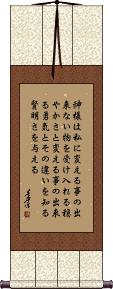
This is a Japanese version of the serenity prayer, as used by many 12-step programs and support groups.
In Japanese, this says:
God grant me the serenity to accept the things I cannot change, the courage to change the things I can, and the wisdom to know the difference.
Note: Because this selection contains some special Japanese Hiragana characters, it should be written by a Japanese calligrapher.
Intelligence / Intellect
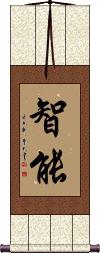
These two characters mean intelligence or intelligent.
The first character means wisdom, intellect, or knowledge.
The second means ability, talent, skill, capacity, capable, able, and can even mean competent.
Together, 知能 can mean “capacity for wisdom,” “useful knowledge,” or even “mental power.” Obviously, this translates more clearly into English as “intelligence.”
Note: This is not the same word used to mean “military intelligence.” See our other entry for that.
 In modern Japan, they tend to use a version of the first character without the bottom radical. If your audience for this artwork is Japanese, please click on the Kanji to the right instead of the button above.
An Open Book Benefits Your Mind
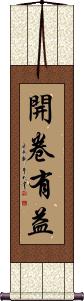
There are several ways to translate this ancient proverb. Translated literally and directly, it says, “Open roll has/yields benefit.”
To understand that, you must know a few things...
First, Chinese characters and language have deeper meanings that often are not spoken but are understood - especially with ancient texts like this. Example: It's understood that the “benefit” referred to in this proverb is to the reader's mind. Just the last character expresses that whole idea.
Second, Chinese proverbs are supposed to make you think and leave a bit of mystery to figure out.
Third, for this proverb, it should be noted that roll = book. When this proverb came about (about two thousand years ago), books were rolls of bamboo slips strung together. The first bound books like the ones we use today did not come about until about a thousand years after this proverb when they invented paper in China.
開卷有益 is a great gift for a bookworm who loves to read and increase their knowledge. Or for any friend that is or wants to be well-read.
Some other translations of this phrase:
Opening a book is profitable
The benefits of education.
A Wise Man Changes His Mind (but a fool never will)
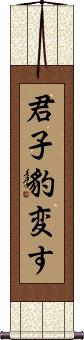
君子豹変す is a Japanese proverb that suggests that a wise man is willing to change his mind, but a fool will stubbornly never change his.
The first word is 君子 (kunshi), a man of virtue, a person of high rank, a wise man.
The second word is 豹変 (hyouhen), sudden change, complete change.
The last part, す (su), modifies the verb to a more humble form.
The “fool” part is merely implied or understood. So if wise and noble people are willing to change their minds, it automatically says that foolish people are unwilling to change.
Bodhi - Awakening Enlightenment
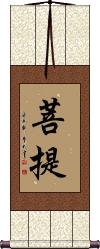
The Bodhi or 菩提 is the moment of completion in Buddhism.
It is when all things become known and you have completed your journey to enlightenment.
The reference is to the Bodhi tree where Siddhartha Gautama (the legendary man who established the Buddhist religion) achieved enlightenment. Sometimes this is referred to as “the tree of enlightenment,” but if you want the full version with the character for a tree at the end, please see the Bodhi Tree entry.
See Also: Buddhism | Buddha | Nirvana | Enlightenment
You May Learn from Victory, You Will Learn from Failure
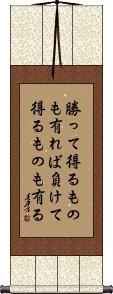
You may learn when everything goes right but the lessons learned when everything goes wrong are more vivid and lead to long-lasting wisdom.
Another way to look at this: One cannot always depend on past successes to guarantee future success but one can always learn from lessons drawn from failure.
Note: Because this selection contains some special Japanese Hiragana characters, it should be written by a Japanese calligrapher.
When Three People Gather, One Becomes a Teacher
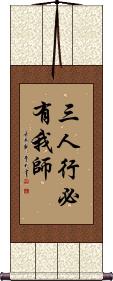
三人行必有我师 means “when three people meet, one becomes the teacher.”
This famous Chinese philosophy suggests that when people come together, they can always learn from each other.
One person must be the teacher and others learn. And in turn, the others become the teachers of the knowledge they possess.
It is important to remember that we all have something to teach, and we all have something to learn as well.
Confucius: Universal Education
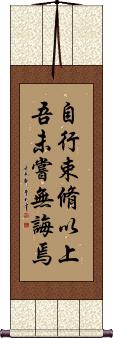
自行束脩以上吾未尝无诲焉 means, for anyone who brings even the smallest token of appreciation, I have yet to refuse instruction.
Another way to put it is: If a student (or potential student) shows just an ounce of interest, desire, or appreciation for the opportunity to learn, a teacher should offer a pound of knowledge.
This quote is from the Analects of Confucius.
This was written over 2500 years ago. The composition is in ancient Chinese grammar and phrasing. A modern Chinese person would need a background in Chinese literature to understand this without the aid of a reference.
The Ease of the Scholar
Quote from Confucius
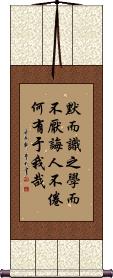
默而识之学而不厌诲人不倦何有于我哉 is a quote from the Analects of Confucius that translates as:
To quietly recite and memorize the classics,
to love learning without tiring of it,
never be bored with teaching,
How could these be difficult for me?
This is a suggestion that for a true scholar, all of these things come with ease.
This was written over 2500 years ago. The composition is in ancient Chinese grammar and phrasing. A modern Chinese person would need a background in Chinese literature to understand this without the aid of a reference.
You May Learn from Victory, You Will Learn from Failure
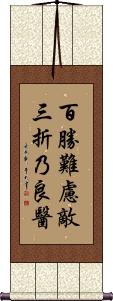
百胜难虑敌三折乃良医 is a Chinese proverb that literally translates as: [Even a general who has won a] hundred victories [may be] hard put to see through the enemy's [strategy], [but one who has] broken [his] arm three [times] [will] be a good doctor.
Figuratively, this means: One cannot always depend on past successes to guarantee future success but one can always learn from lessons drawn from failure.
See Also: Failure - Mother of Success | Experience - Mother of Success | Fall Down 7 Times Get Up 8 | Hard Knocks
The Five Tenets of Confucius
The Five Cardinal Rules / Virtues of Confucius
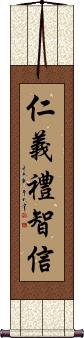
仁義禮智信 are the core of Confucius's philosophy.
Simply stated:
仁 = Benevolence / Charity
義 = Justice / Rectitude
禮 = Courtesy / Politeness / Tact
智 = Wisdom / Knowledge
信 = Fidelity / Trust / Sincerity
Many of these concepts can be found in various religious teachings. It should be clearly understood that Confucianism is not a religion but should instead be considered a moral code for a proper and civilized society.
This title is also labeled “5 Confucian virtues.”
 If you order this from the Japanese calligrapher, expect the middle Kanji to be written in a more simple form (as seen to the right). This can also be romanized as "jin gi rei satoshi shin" in Japanese. Not all Japanese will recognize this as Confucian tenets but they will know all the meanings of the characters.
See Also: Confucius Teachings | Ethics
Each Time You Stumble and Fall, You Gain Experience and Wisdom
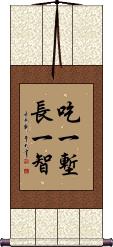
吃一塹長一智 is a Chinese proverb that means “Fall into a moat, and you will gain wisdom from the experience.”
It really suggests that the failures, troubles, frustrations, and setbacks that you encounter in your life are actually helping you to find wisdom. Some would also translate this proverb as “Learn from your mistakes” or “Learn from your experience.”
If you are studying Chinese, you will recognize the first character as “eat,” but in this case, it means to “experience” (as used in this proverb, it is suggesting that you have fallen into a moat and/or had a hard time crossing it).
Translated character by character, this whole proverb is, “Experience one moat, gain one wisdom/knowledge.”
Note: This can be pronounced in Korean, but it's not a commonly used phrase.
Learning is Eternal
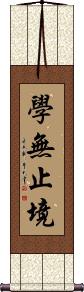
This Chinese philosophy tells of how we continue to learn throughout our lives.
This proverb can be translated in a few ways such as “Study has no end,” “Knowledge is infinite,” “No end to learning,” “There's always something new to study,” or “You live and learn.”
The deeper meaning: Even when we finish school we are still students of the world gaining more knowledge from our surroundings with each passing day.
See Also: An Open Book Benefits Your Mind | Wisdom | Learn From Wisdom
Open the Minds of the Next Generation To Stimulate Thinking
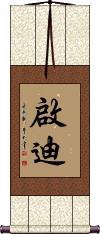
This word is often used to describe the idea of opening the minds of the young or the new generation.
See Also: Wisdom | Learning is Eternal | Learn From Wisdom
Perception of Knowledge
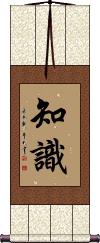
知識 has the very strong meaning of “knowledge” and, in some contexts, “learning.”
The first character represents “to know” or “to realize.”
The second character alone refers to the ability to “recognize” or “realize” and can also be used to mean “knowing.”
See Also: Wisdom | Learn From Wisdom
Example is Better than Precept
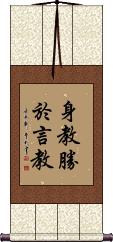
Tell somebody how to do something and they might get it.
Show them how to do it, and they will master it in no time.
身教勝於言教 can also be translated as “Behavior teaches more than words.”
See Also: Wisdom
Awareness
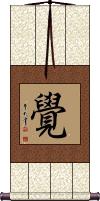
覺 can mean to feel; to figure out; thinking; awake; aware; bodhi; knowing; understanding; enlightenment; illumination; apprehend; perceive; realize.
覺 is a character that is impossible to define in a single word.
This term is often associated with Buddhism where it's understood to be: Illumination, enlightenment, or awakening in regard to the real in contrast to the seeming. However, it can also refer to enlightenment in regard to morality and evil.
Notes:
In Japanese, this can be the personal name Satoru.
In certain context, and only when pronounced as "jiao" in Chinese, it can refer to a nap, sleep or the state of sleeping. However, as a single character on a wall scroll, everyone will read this with the awareness or enlightenment context.
By no means is this the only way to write enlightenment. In fact, you should only choose this character if you are looking more for a word meaning awareness.
See Also: Enlightenment | Wisdom | Knowledge
Failure is the Mother of Success
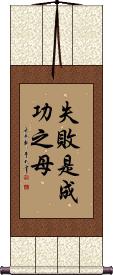
失败是成功之母 is a Chinese and Korean proverb that means “Every failure that you experience is a chance to learn from it and find success.”
Knowing what does not work is just as important as finding out what does work.
See Also: Experience is the Mother of Wisdom
Failure is the Mother of Success
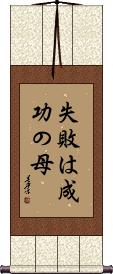
失敗は成功の母 is a Japanese proverb that means exactly what you think.
Every failure that you experience is a chance to learn from it and find success.
Knowing what does not work is just as important as finding out what does work.
Note: This is the Japanese version of an ancient Chinese proverb.
Note: Because this selection contains some special Japanese Hiragana characters, it should be written by a Japanese calligrapher.
See Also: Experience is the Mother of Wisdom
Keiran
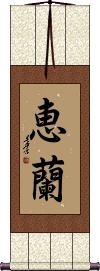
This is the Japanese female given name Keiran.
This kind of means “wisdom orchid” or “fragrance of wisdom.”
Knowledge of Ultimate Truth
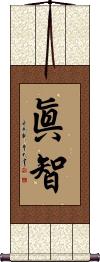
眞智 can mean the wisdom or knowledge of ultimate truth.
眞智 is also the absolute knowledge of the non-thing or that which is immaterial. This makes more sense when you consider that true wisdom includes the knowledge of both the real and unreal, or what is material and immaterial.
In Japan, 眞智 (Masatoshi) can also be a given name.
Realization and Knowledge
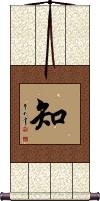
知 means realization or true knowing.
This can also translate as to know, to be aware, wisdom, or higher knowledge.
From older Buddhist ideas, this can represent विद्या (Vidyā or Vidya) or ज्ञान (Jñāna or Jnana) and even the combination Sanskrit word विज्ञान (Vijñāna or Vijnana) which can translate as wisdom arising from perception or knowing.
However, 知 should be distinguished as true knowing versus having a relative understanding or 會.
Shikin Haramitsu Daikomyo
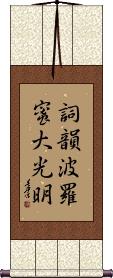
詞韻波羅蜜大光明 are the Japanese Kanji characters that romanize as “Shikin Haramitsu Daikōmyō.”
This is a complicated proverb. I'm actually going to forgo writing any translation information here. You can figure it out via Google search and at sites like Paramita and the Perfection of Wisdom or
Fecastel.Wordpress.com::Shikin Haramitsu Daikōmyō
Light / Bright
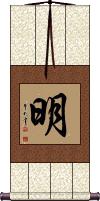
明 means light, bright, clear, clarity, to understand, or wise.
In Chinese, this can refer to the Ming Dynasty (1368-1644) where it can also be the surname Ming.
In Japanese, this can be romanized many different ways when used as surnames or given names. 明 is a partial list of those names: Meishuu, Mei, Min, Myoujin, Myou, Hinata, Haru, Toshi, Tooru, Sayaka, Saya, Satoshi, Asumi, Akera, Akemine, Akesaki, Ake, Akuru, Akiraka, and Akira.
In the Buddhist context, this represents vidyā (knowledge). To expand that, Buddhists understand this to mean bright, clear, enlightenment, wisdom, or to understand. It represents Buddha-wisdom and its revelation; also the manifestation of a Buddha's light or effulgence.
Learn New Ways From Old / Onkochishin
New ideas coming from past history
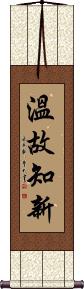
溫故知新 is a proverb from Confucius that is used in Chinese, Japanese, and Korean cultures.
It can be translated in several ways:
Coming up with new ideas based on things learned in the past.
Examine things of the past, and obtain new knowledge.
Developing new ideas based on the study of the past.
Gain new insights through restudying old issues.
Understand the present by reviewing the past.
Learning from the past.
Review the old and know the new.
Taking a lesson from the past.
Taking a lesson from the wisdom of the ancients.
Follow the old ways.
The direct translation would be, “By asking old things, know new things.”
The Character meanings breakdown this way:
溫故 = ask old
知新 = know new
Explained: To learn new things that are outside of your experience, you can learn from old things of the past. You can find wisdom in history.
 VS.
VS. 
Note: Japanese use a variant of the first Kanji in modern times.
Therefore if you order this from a Japanese calligrapher, expect the first Kanji to look like 温 instead of 溫.
In addition to 温故知新 as mentioned above, this is sometimes written as 温古知新 in Japan.
Dharma Gate
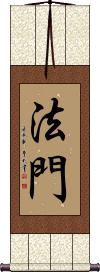
This is the Dharma Gate, The Gate to Enlightenment, or Dharmaparyāya.
The doctrines, or wisdom of Buddha is regarded as the door to enlightenment.
Tetsu / Wise Sage
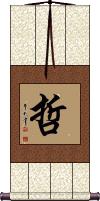
哲 is a Japanese name that is often romanized as Tetsu.
The meaning of the character can be: philosophy; wise; sage; wise man; philosopher; disciple; sagacity; wisdom; intelligence.
哲 can also be romanized as: Yutaka; Masaru; Hiroshi; Tooru; Tetsuji; Choru; Satoru; Satoshi; Akira; Aki.
1. Right Understanding / Right Perspective / Right View / Perfect View
Samyag Dristhi / Samyag Drsti / Samma Ditthi
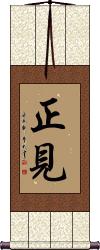
正見 is one of the Noble Eightfold Paths of Buddhism. Right View, along with the Right Thought, constitutes the path to Wisdom.
To get to the correct view of the world, you must first understand and follow Four Noble Truths.
Note: This term is exclusively used by devout Buddhists. It is not a common term, and is remains an unknown concept to most Japanese and Chinese people.
See Also: Buddhism | Enlightenment | Noble Eightfold Path
2. Right Resolve / Right Thought / Right Intention / Perfect Resolve
Samyak Samkalpa / Samma Sankappa
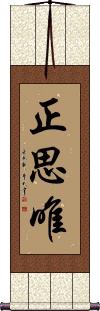
正思唯 is one of the Noble Eightfold Paths of Buddhism. Right Thought, along with the Right View, constitute the path to Wisdom.
In Buddhism, Right Thought, in simple terms, means to free yourself from having ill will towards anyone or anything. It also suggests that you remain harmless to other living creatures.
This can also be defined as “Resolve in favor of renunciation, goodwill, and non-harming of sentient beings.”
 There is an ancient/alternate version of the third character for this selection. You can see that alternation third character to the right. If you want your selection to use that older character, just click on the character to the right, instead of the button above.
Note: This term is exclusively used by devout Buddhists. It is not a common term, and is remains an unknown concept to most Japanese and Chinese people.
See Also: Buddhism | Enlightenment | Noble Eightfold Path
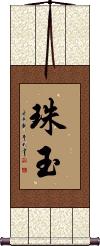
珠玉 is a Chinese, Japanese Kanji, and old Korean Hanja word meaning gem.
Beyond just the word gem, this can refer to pearls and jades, jewels, clever remarks, beautiful writing, gems of wisdom, genius, or an outstanding person.
If your name is Gem, this is a nice way to represent your name in 3 Asian languages. Though the pronunciation will be far from Gem, the meaning of gem is really nice.
Note: In Japanese, this is sometimes used as the female given name, Tama.
Joushiki Wo Koeru
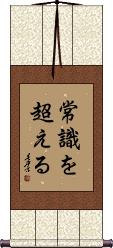
This Japanese phrase, “常識を超える” or “Jōshiki Wo Koeru” means “beyond common sense.”
常識 alone can be translated as “common sense,” “good sense,” “common knowledge”,“general knowledge,” “common practice,” “accepted practice,” or “social etiquette.”
The rest of the phrase indicates exceeding, overtaking, surpassing, transcending, or an idea of going beyond something.
More ways to translate this whole phrase:
Over what was known.
Surpassing common sense.
Beyond the ordinary.
Going beyond conventional knowledge.
Beyond conventional wisdom.
Note: Because this selection contains some special Japanese Hiragana characters, it should be written by a Japanese calligrapher.
Light / Bright and Promising Future
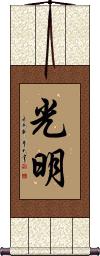
光明 is a nice way to say “light” in Chinese and old Korean Hanja.
This is because the word also suggests a bright future or refers to someone who is very promising (great future potential).
The first character means light or bright.
The second character means bright and clear (in this context).
This word appears in most Japanese dictionaries, but it is not the most common Japanese Kanji word for light (more commonly used for the name Mitsuharu).
In old Korean Hanja, this can also mean brightness or brilliance.
In the context of Buddhism, this means “Light emanating from a Buddha or Bodhisattva, symbolizing their wisdom and compassion.”
Daodejing / Tao Te Ching - Chapter 33
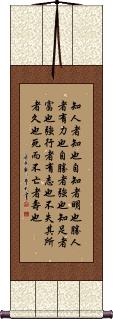
This is referred to as passage or chapter 33 of the Dao De Jing (often Romanized as “Tao Te Ching”).
These are the words of the philosopher Laozi (Lao Tzu).
To know others is wisdom;
To know oneself is acuity/intelligence.
To conquer others is power,
To conquer oneself is strength.
To know contentment is to have wealth.
To act resolutely is to have purpose.
To stay one's ground is to be enduring.
To die and yet not be forgotten is to be long-lived.
To understand others is to be knowledgeable;
To understand yourself is to be wise.
To conquer others is to have strength;
To conquer yourself is to be strong.
To know when you have enough is to be rich.
To go forward with strength is to have ambition.
To not lose your place is to be long-lasting.
To die but not be forgotten -- that's true long life.
He who is content is rich;
He who acts with persistence has will;
He who does not lose his roots will endure;
He who dies physically but preserves the Dao
will enjoy a long after-life.
Notes:
During our research, the Chinese characters shown here are probably the most accurate to the original text of Laozi. These were taken for the most part from the Mawangdui 1973 and Guodan 1993 manuscripts which pre-date other Daodejing texts by about 1000 years.
Grammar was a little different in Laozi’s time. So you should consider this to be the ancient Chinese version. Some have modernized this passage by adding, removing, or swapping articles and changing the grammar (we felt the oldest and most original version would be more desirable). You may find other versions printed in books or online - sometimes these modern texts are simply used to explain to Chinese people what the original text really means.
This language issue can be compared in English by thinking how the King James (known as the Authorized version in Great Britain) Bible from 1611 was written, and comparing it to modern English. Now imagine that the Daodejing was probably written around 403 BCE (2000 years before the King James Version of the Bible). To a Chinese person, the original Daodejing reads like text that is 3 times more detached compared to Shakespeare’s English is to our modern-day speech.
Extended notes:
While on this Biblical text comparison, it should be noted, that just like the Bible, all the original texts of the Daodejing were lost or destroyed long ago. Just as with the scripture used to create the Bible, various manuscripts exist, many with variations or copyist errors. Just as the earliest New Testament scripture (incomplete) is from 170 years after Christ, the earliest Daodejing manuscript (incomplete) is from 100-200 years after the death of Laozi.
The reason that the originals were lost probably has a lot to do with the first Qin Emperor. Upon taking power and unifying China, he ordered the burning and destruction of all books (scrolls/rolls) except those pertaining to Chinese medicine and a few other subjects. The surviving Daodejing manuscripts were either hidden on purpose or simply forgotten about. Some were not unearthed until as late as 1993.
We compared a lot of research by various archeologists and historians before deciding on this as the most accurate and correct version. But one must allow that it may not be perfect, or the actual and original as from the hand of Laozi himself.
Wise and Virtuous
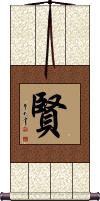
賢 is used to refer to being a wise, trustworthy, and virtuous person. But it also contains the ideas of intelligence, genius, scholarship, virtue, sage, saint, good, and excellent in character.
賢 is used in Chinese, Japanese Kanji, and old Korean Hanja. Also used in a Buddhist context with the same meaning.
Note: Can also be the male given name, Masaru, in Japanese.
Fatal error: Cannot redeclare foreignPrice() (previously declared in /home/gwest/web/chinesescrollpainting.com/public_html/includes/currencyconverter.php:22) in /home/gwest/web/orientaloutpost.com/public_html/includes/currencyconverter.php on line 22