Many custom options...


And formats...



Know Your Enemy Know Yourself and You Cannot Lose in Chinese / Japanese...
Buy a Know Your Enemy Know Yourself and You Cannot Lose calligraphy wall scroll here!
Personalize your custom “Know Your Enemy Know Yourself and You Cannot Lose” project by clicking the button next to your favorite “Know Your Enemy Know Yourself and You Cannot Lose” title below...
Know Your Enemy, Know Yourself, and You Cannot Lose
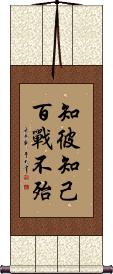
知彼知己百戰不殆 is from Sun Tzu's (Sunzi's) Art of War. It means that if you know and understand the enemy, you also know yourself, and thus with this complete understanding, you cannot lose.
This proverb is often somewhat directly translated as “Know the enemy and know yourself, and you can fight a hundred battles without defeat.”
It can also be translated as “If you know both yourself and your enemy, you can come out of hundreds of battles without danger,” or “Know your enemy, know yourself, and your victory will not be threatened.”
Know Your Enemy, Know Yourself, and Win 100 Battles
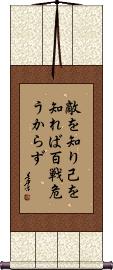
敵を知り己を知れば百戦危うからず is the longer/full Japanese version of this proverb. This means “Know your enemy, know yourself, and you will not fear a hundred battles.”
Others will translate this as “Know thy enemy, know thyself, yields victory in one hundred battles.”
Note: Because this selection contains some special Japanese Hiragana characters, it should be written by a Japanese calligrapher.
Know Thy Enemy, Know Thyself
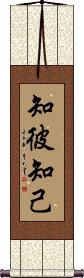
This proverb is from Sun Tzu's (Sunzi's) Art of War.
It means that if you know and understand the enemy, you also know yourself. Four secondary characters come after this in the Art of War (not included here) which suggests you cannot lose a battle when you follow this philosophy.
In a very literal and somewhat-boring way, this can also be translated as “Estimate correctly one's strength as well as that of one's opponent.”
Know Thy Enemy, Know Thyself
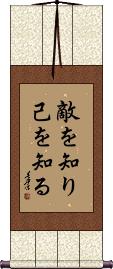
敵を知り己を知る is the Japanese version of “know your enemy, know yourself.”
There is a longer version of this proverb that adds, “...and you can win 100 battles.”
Note: Because this selection contains some special Japanese Hiragana characters, it should be written by a Japanese calligrapher.
Hunt Foxes with Stealth, Hunt Wolves in the Open
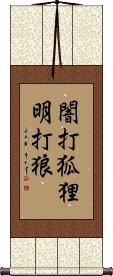
闇打狐狸明打狼 is a Chinese proverb that translates as: Hunt foxes stealthily, [and] hunt wolves openly [just as they do].
Figuratively, this means:
Different opponents require different appropriate strategies.
This is a suggestion that you should know your enemy and know that each enemy is different, therefore requires a specialized approach (attack).
See Also: Art of War Military
Fatal error: Cannot redeclare foreignPrice() (previously declared in /home/gwest/web/chinesescrollpainting.com/public_html/includes/currencyconverter.php:22) in /home/gwest/web/orientaloutpost.com/public_html/includes/currencyconverter.php on line 22