Many custom options...


And formats...



Paz in Chinese / Japanese...
Buy a Paz calligraphy wall scroll here!
Personalize your custom “Paz” project by clicking the button next to your favorite “Paz” title below...
1. Paz
3. Inner Peace / Silence / Serenity
6. Inner Bliss and Peace from Meditation
10. Peace / Peaceful
11. Reach Peace and Calm Through Meditation
12. Peaceful Heart / Peace of Mind / Calm Mind
14. Great Peace
15. Faith Love Peace
16. Inner Peace
17. Live in Peace and Contentment
18. Patience Yields Peace of Mind
19. Peace and Love
20. Spiritual Peace / Enlightened Peace
22. World Peace
24. Worldwide Peace
25. House Of Peace
26. Peace of Mind
27. Achieve Inner Peace; Find Deep Understanding
29. Worldwide Wish for Peace and Prosperity
31. Eternal Peace and Happiness
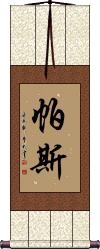
帕斯 is the transliteration to Mandarin Chinese for the Latin / Spanish name Paz.
Balance / Peace
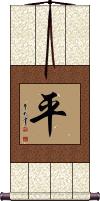
平 is a single character that means balance in Chinese but it's not too direct or too specific about what kind of balance.
Chinese people often like calligraphy art that is a little vague or mysterious. In this way, you can decide what it means to you, and you'll be right.
平 is also part of a word that means peace in Chinese, Japanese, and old Korean.
Some alternate translations of this single character include: balanced, peaceful, calm, equal, even, level, smooth, or flat.
Note that in Japanese, this just means “level” or “flat” by itself (not the best choice for balance if your audience is Japanese).
Inner Peace / Silence / Serenity
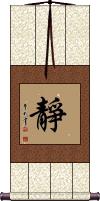
靜 is the simplest way to convey the meaning of inner peace and serenity.
靜 is often translated as “serenity.” It can also be used to express the ideas of still, calm, serene, quiet, silent, stillness, not moving, or tranquility.
In the old days, Chinese, Japanese, or Korean people might hang a wall scroll with this character in their reading room to bring about a sense of peace in the room.
 While they once used the same character form in Japan, they now use a slightly-simplified version in modern Japan (after WWII). This version is shown to the right, and can be selected for your wall scroll by clicking on that Kanji instead of the button above.
See Also: Peace
Peace / Harmony
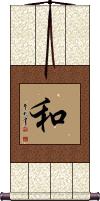
和 is the simplest form of peace and harmony.
和 can also be translated as the peaceful ideas of gentle, mild, kind, and calm. With a more harmonious context, it can be translated as union, together with, on good terms with, or on friendly terms.
Most people would just translate this character as peace and/or harmony. 和 is a very popular character in Asian cultures - you can even call it the “peace symbol” of Asia. In fact, this peace and harmony character was seen repeatedly during the opening ceremony of the 2008 Olympic Games in Beijing (a major theme of the games).
In old Chinese poems and literature, you might see this used as a kind of "and." As in two things summed together. As much as you could say, "the sun and moon," you could say "the sun in harmony with the moon."
See Also: Inner Peace | Patience | Simplicity
Eternal Peace
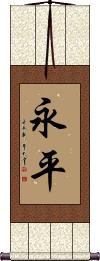
永平 is a way to write “eternal peace” in Chinese and Japanese.
This may also refer to Yongping county in Dali Bai autonomous prefecture. 永平 is also a Japanese surname that romanizes as Nagahira.
Inner Bliss and Peace from Meditation
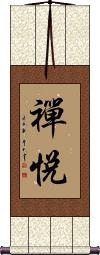
禪悅 is a title that refers to the inner bliss and peace you can achieve from meditation.
This term transcends a few religions, including Taoism and Buddhism. It can also be translated as “joy of the mystic trance” or simply “meditative bliss.”
Amazing that such a complex idea can be expressed in just two Chinese characters. Note that the first character is Chan/Zen (Chinese/Japanese), which means “meditation” in both languages.
Peace and Good Health
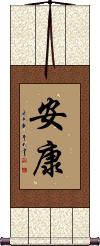
安康 means just what it says. It's a word that expresses both the idea of being at peace and healthy at the same time.
Note: 安康 is a bonafide word in Chinese and Korean, and the characters will at least make sense in Japanese.
Peace and Tranquility
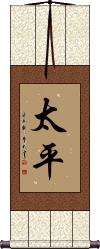
太平 means “peace and tranquility” or “peace and security” in Chinese, Japanese Kanji, and old Korean Hanja.
The literal translation would be “very balanced” or “very peaceful.”
The first character means very, much, too much, or extremely.
The second character means balanced, peaceful, calm, equal, even, level, or smooth.
Peace and Tranquility
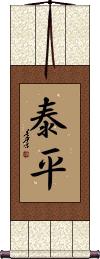
泰平 means peace and/or tranquility in Japanese and Korean (also understood but not as common in Chinese).
Peace of Mind
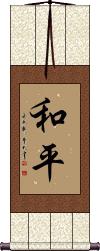
和平 is the Chinese order for these two characters, which means peace but can also be translated as amicability, specifically, or mildness. 和平 is often translated as a simple way to say “peace of mind.” This combination is used in Korean Hanja to mean “peace and harmony.”
Alone, the first character means peace and harmony.
The second character means balance when read by itself.
Note: 和平 are often seen in the opposite order in Japanese with the same meaning (You'll sometimes find them in this order in Japan, so either way is OK).
Peace / Peaceful
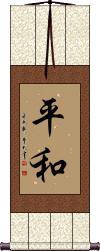
平和 is the Japanese and Korean order of these characters used most often to express the idea of peace, tranquility, and harmony.
It's just the reverse order of the Chinese. In this order in Chinese, it means takes the “mild” definition rather than “peace.” In Korean, the combination keeps the same meaning in either order.
The second character also means balance, so there is an element of harmony and balance along with peace.
Reach Peace and Calm Through Meditation
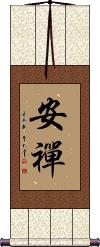
安禪 creates a title that means to reach peace and calm through meditation.
安禪 is an excellent wall scroll for your relaxation or meditation room.
This is also a Buddhist-related term that encompasses the idea of entering into dhyana meditation.
This is also used in Japanese, but in modern times, the second character has changed, so it's 安禅 now. If you want the modern Japanese version, just choose a Japanese calligrapher, and let me know when you place your order.
Peaceful Heart / Peace of Mind / Calm Mind
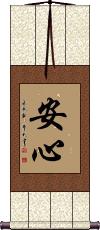
安心 can be defined as relief, peace of mind, feeling at ease, to be relieved, to set one's mind at rest, and easiness.
安心 is a nice word that encompasses great meanings within just two characters. Some of the other meanings include pacifying, settling the mind, and peace of mind. It's also the idea of feeling a sense of security, safety, and confidence in your state of well-being.
This can be used by everyone, but some consider it to be a Buddhist concept (You'll find it in your Zen dictionary).
Note: Can be romanized as Anshin or Anjin in Japanese.
Stable - Mind at Peace
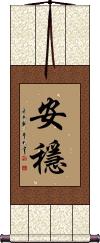
安穩 can mean a steady, stable, sedate, and calm mind.
Other translations include “body and mind at rest,” or “peace and comfort.”
Great Peace
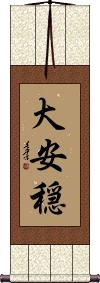
大安穏 means great peace, great repose, nirvanic peace, or great tranquility.
Faith Love Peace
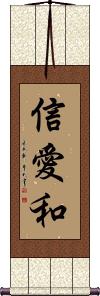
信愛和 is a word list that reads, “Faith Love Peace.”
This is not a natural phrase in Chinese or Japanese, as it lacks a subject, verb, or object. But if this is what you want, here it is.
Inner Peace
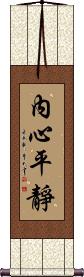
內心平靜 is a Chinese and Japanese phrase that is a direct translation of the western idea of inner peace.
The first two characters contain the idea of “heart,” “innermost being,” or “deep in the/your inner mind.”
The last two characters mean “tranquil” and “serene.”
I have seen this phrase used as “inner peace” for art prints and even on the side of coffee cups. But I think the translation is too literal. It feels like a direct translation from English rather than a nicely composed Chinese or Japanese phrase. See my other entries for “inner peace.”
See Also: Serenity | Simplicity | Peace
Live in Peace and Contentment
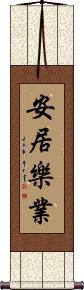
安居樂業 is the Chinese, Japanese Kanji, and old Korean Hanja proverb for “living in peace and working happily,” or “to live in peace and be content with one's occupation.”
Patience Yields Peace of Mind
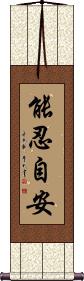
This ancient Chinese proverb can be translated as “Patience brings peace of mind,” “One who has patience finds peace,” and a few other ways.
Peace and Love
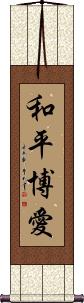
和平博愛 is the Chinese and Japanese way to express “Peace and Love.”
These are two separate words, so the calligrapher will put a slight space between the first two characters, which mean peace, and the last two, which represent universal love. This space is not shown on the sample character images for this phrase.
A special note: Word lists may seem okay in English but feel strange in Chinese and Japanese. We don't offer too many of them but this one is often-requested and feels okay in Chinese and Japanese, though a bit uncommon in Korean.
Spiritual Peace / Enlightened Peace
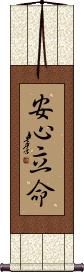
These Japanese Kanji, 安心立命, can be translated as “religious enlightenment” or “spiritual peace gained through faith.”
Other dictionaries define as “spiritual peace and enlightenment” or “keeping an unperturbed mind through faith.”
My Buddhist dictionary defines it as “spiritual peace and realization of enlightenment.”
In the Zen school, this is about settling one's body and life; attaining complete peace, and establishing one's course of life in accord with the ultimate reality.
Warrior for Peace
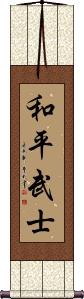
和平武士 means “Warrior for Peace” (a warrior who fights for peace) in Chinese.
Note this is not the same thing as a “peaceful warrior.”
See Also: Peace
World Peace
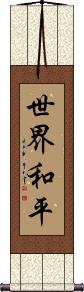
世界和平 is the Chinese title for “world peace.”
World Peace
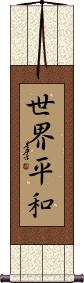
世界平和 is the Japanese title for “world peace” or “peace of the world.”
The Whole World at Peace
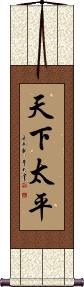
This proverb can be translated as the whole world at peace, peace and prosperity, peaceful and tranquil, peace reigns over the land, times of peace, peace and tranquillity, peaceful world, or from the Greek, times of halcyon.
Sometimes (rarely) written as 天下泰平 (variant 3rd character).
Worldwide Peace
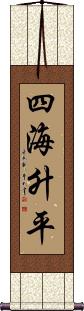
四海升平 literally means “all four oceans at peace,” which is a way to express “world peace.”
House Of Peace

和平之家 is the title “House Of Peace” in Chinese.
Peace of Mind
(five-character version)
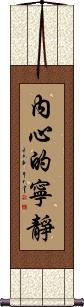
內心的寧靜 is the long way to express the idea of “peace of mind” in Chinese.
The first two characters mean heart or “innermost being.”
The middle character is a connecting modifier.
The last two characters mean peace, tranquility, or serenity.
Some may also translate this as “inner peace,” but I like our other inner-peace options for that idea.
This kind of makes sense in Korean but will have an archaic read - even by those who can understand Korean Hanja.
Achieve Inner Peace; Find Deep Understanding
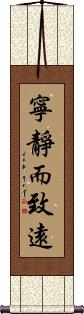
寧靜而致遠 is five characters from a longer ten-character proverb composed by Zhuge Liang about 1800 years ago.
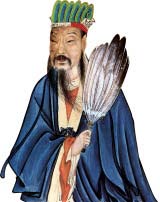
诸葛亮 Zhuge Liang
The proverb means “Your inner peace/tranquility/serenity will help you see or reach far (into the world).”
The last word means “far” but the deeper meaning is that you will surpass what you can currently see or understand. Perhaps even opening up vast knowledge and understanding of complex ideas.
Peace, Love, Happiness
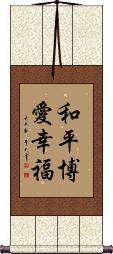
和平博愛幸福 is a word-list that means “peace, love, happiness,” in Chinese.
Word lists like this are not commonly-seen in China. Phrases with subject, verb, and object, or just single words are more natural for calligraphy artwork.
Worldwide Wish for Peace and Prosperity
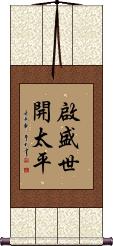
啟盛世開太平 means “To bring flourishing peace and security to the world (our current era).”
It's a wish that a new door leading to peace and prosperity could be opened to mankind.
Character and word breakdown:
啟 to open; to start; to initiate; to enlighten or awaken.
盛世 a flourishing period; period of prosperity; a golden age.
開 to open; to start; to turn on.
太平 peace and security; peace and tranquility; peace; tranquility.
I don't like to do breakdowns like this, as the words altogether create their unique meaning (encompassed in the main title above).
Peace, Love, Happiness
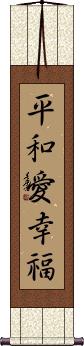
平和, 愛, 幸福 means “peace, love, happiness” in Japanese.
This is a word list, which is not the most natural kind of composition in Japanese (usually there is a subject, object, and verb - or a single word).
Eternal Peace and Happiness

永恆和平與幸福 means “Eternal Peace And Happiness” in Chinese.
A Life of Serenity Yields Understanding
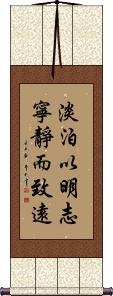
淡泊以明志寧靜而致遠 is a kind of complex ten-character proverb composed by Zhuge Liang about 1800 years ago.
This is a Chinese proverb that means “Leading a simple life will yield a clear mind, and having inner peace will help you see far (into the world).”
What I have translated as “simple life” means NOT being materialistic and NOT competing in the rat race.
The last word means “far” but the deeper meaning is that you will surpass what you can currently see or understand. Perhaps even the idea of opening up vast knowledge and understanding of complex ideas.
The whole phrase has a theme that suggests if you are NOT an aggressive cut-throat person who fights his way to the top no matter how many people he crushes on the way, and instead seek inner peace, you will have a happier existence and be more likely to understand the meaning of life.
See Also: Serenity
Patience Brings Peace of Mind
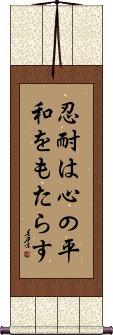
忍耐は心の平和をもたらす means “patience brings peace of mind,” in Japanese.
Note: Because this selection contains some special Japanese Hiragana characters, it should be written by a Japanese calligrapher.
Fatal error: Cannot redeclare foreignPrice() (previously declared in /home/gwest/web/chinesescrollpainting.com/public_html/includes/currencyconverter.php:22) in /home/gwest/web/orientaloutpost.com/public_html/includes/currencyconverter.php on line 22