Many custom options...


And formats...



Pride in Chinese / Japanese...
Buy a Pride calligraphy wall scroll here!
Personalize your custom “Pride” project by clicking the button next to your favorite “Pride” title below...
Pride
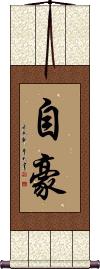
自豪 is used to convey “feeling a sense of pride.”
This can be the pride you feel in yourself or the sense of pride in belonging to a certain group, team, or organization.
Pride
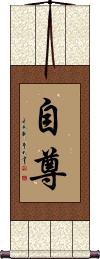
自尊 can mean “pride,” “self-respect,” or “self-esteem.” The first character means “oneself,” and the second can mean revered, valuable, precious, noble, exalted, honorable, or simply “pride.”
I have also seen this two-character word translated as “amour propre,” self-regard, and self-pride.
自尊 is universal between Chinese, Japanese Kanji, and Korean Hanja written languages. It may also be understood in old Vietnamese (they once used Chinese characters as well).
Prideful Mind / Self-Respecting Heart
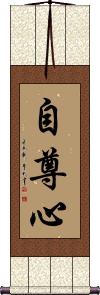
自尊心 is a Japanese and Korean word that means “pride” or “self-respect.”
The first Kanji/Hanja means oneself. The second can mean revered, valuable, precious, noble, or exalted. And the last Kanji/Hanja means heart, mind, and/or spirit.
While these characters make sense and hold the same general meaning in Chinese, this is not a normal Chinese word. This selection should only be used if your audience is Japanese or Korean.
See Also: Respect | Pride | Self-Reliance | Self-Control | Self-Discipline
Pride Goes Before a Fall
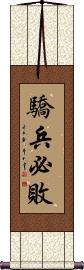
This literally means an arrogant army is bound to lose.
The meaning is similar to “pride goes before a fall.”
Others may translate this as “defeat is inevitable for an overconfident army,” “being arrogant and overconfident inevitably leads to defeat,” or “pride comes before a fall.”
Proud / Pride / Lofty-Minded
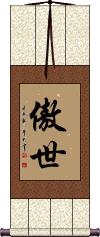
傲世 is a word used to describe someone that is very proud and holds themselves above others but with a valid (earned) reason to do so.
傲世 is what you would use to describe the way a mighty general of ancient China like Cao Cao acted or a more modern person like General Patton carried himself.
If you hang this word on your wall, it suggests that you hope to achieve that same level of pride from accomplishment.
Self-Respect / Self-Esteem
自尊 means self-respect or self-esteem in Chinese, Korean and Japanese. It can also mean “pride in oneself.”
Note: Japanese sometimes put the character for the heart after these two. However, this two-character word is universal between all three languages (which is often better since more than a third of the world's population can read this version as a native word).
Fatal error: Cannot redeclare foreignPrice() (previously declared in /home/gwest/web/chinesescrollpainting.com/public_html/includes/currencyconverter.php:22) in /home/gwest/web/orientaloutpost.com/public_html/includes/currencyconverter.php on line 22