Many custom options...


And formats...



Proud of One’s Name in Chinese / Japanese...
Buy a Proud of One’s Name calligraphy wall scroll here!
Personalize your custom “Proud of One’s Name” project by clicking the button next to your favorite “Proud of One’s Name” title below...
If you would like your name in Chinese calligraphy and it does not appear below, please contact me, and I'll transliterate and add your name to our website database for you.
Proud Of One’s Name
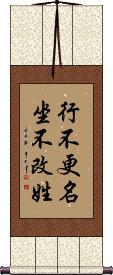
行不更名坐不改姓 is a Chinese proverb that means “I am who I am (and I'm not ashamed).”
Figuratively, it means to be proud of one's name and stand by one's actions.
Proud / Pride / Lofty-Minded
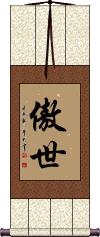
傲世 is a word used to describe someone that is very proud and holds themselves above others but with a valid (earned) reason to do so.
傲世 is what you would use to describe the way a mighty general of ancient China like Cao Cao acted or a more modern person like General Patton carried himself.
If you hang this word on your wall, it suggests that you hope to achieve that same level of pride from accomplishment.
Pride
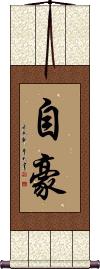
自豪 is used to convey “feeling a sense of pride.”
This can be the pride you feel in yourself or the sense of pride in belonging to a certain group, team, or organization.
Frugal
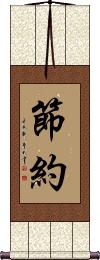
節約 is the Chinese, Japanese Kanji, and old Korean Hanja meaning to economize, to conserve (resources), economical, frugal, or saving.
If you are frugal and proud, this can be the calligraphy for you.
Obaidori / Oubaitori
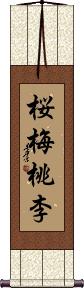
Ōbaidōri or Oubaitori means cherry, apricot, peach, and plum blossoms.
While these four different blossoms look very similar at first glance, they all bloom differently and have their own distinct shapes and smells. Yet despite their differences, each and every blossom is proud and beautiful in its own way.
Active Duty
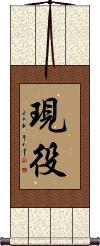
現役 is a simple way to say “active duty.”
When I got off active duty in the Marines, I suddenly discovered that everyone on active duty seemed very proud of that fact. These Japanese / Chinese characters are offered to those servicemen with that pride.
Please note that there is a longer yet more natural phrase that means “Active Duty Soldier” or literally “Active Duty Military Person” - see the next entry...
1 Corinthians 13:4-8
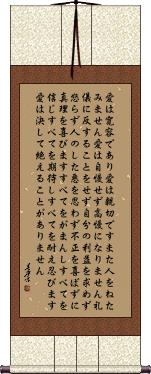
Here is 1st Corinthians 13:4-8 (just the first sentence of verse 8) in Japanese.
In the familiar NIV, this would read:
Love is patient, love is kind. It does not envy, it does not boast, it is not proud.
It does not dishonor others, it is not self-seeking, it is not easily angered, it keeps no record of wrongs.
Love does not delight in evil but rejoices with the truth.
It always protects, always trusts, always hopes, always perseveres.
Love never fails...
The Japanese text is from the 新改訳聖書 (Shinkaiyaku) or New Japanese Bible. Popular among most Protestant denominations in modern Japan.
Note: Because this selection contains some special Japanese Hiragana characters, it should be written by a Japanese calligrapher.
Corinthians 13:4

愛は忍耐強い。愛は情け深い。ねたまない。愛は自慢せず、高ぶらない。is 1st Corinthians 13:4 in Japanese.
In English, this reads:
1st Corinthians 13:4 (KJV) Charity suffereth long, and is kind; charity envieth not; charity vaunteth not itself, is not puffed up...
1st Corinthians 13:4 (NIV) Love is patient, love is kind. It does not envy, it does not boast, it is not proud.
1st Corinthians 13:4 (Basic English) Love is never tired of waiting; love is kind; love has no envy; love has no high opinion of itself, love has no pride.
If you want a big “love” character written above the verse on your artwork, just make a note in the “special instructions” tab when you are customizing your artwork. There is no extra charge for that service on this special verse.
Note: Because this selection contains some special Japanese Hiragana characters, it should be written by a Japanese calligrapher.
Glory and Honor
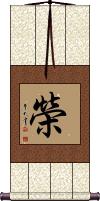
榮 relates to giving someone a tribute or praise.
It's a little odd as a gift, so this may not be the best selection for a wall scroll.
I've made this entry because this character is often misused as “honorable” or “keeping your honor.” It's not quite the same meaning, as this usually refers to a tribute or giving an honor to someone.
榮 is often found in tattoo books incorrectly listed as the western idea of personal honor or being honorable. Check with us before you get a tattoo that does not match the meaning you are really looking for. As a tattoo, this suggests that you either have a lot of pride in yourself or that you have a wish for prosperity for yourself and/or your family.
 In modern Japanese Kanji, glory and honor look like the image to the right.
There is a lot of confusion about this character, so here are some alternate translations for this character: prosperous, flourishing, blooming (like a flower), glorious beauty, proud, praise, rich, or it can be the family name “Rong.” The context in which the character is used can change the meaning between these various ideas.
In the old days, this could be an honor paid to someone by the Emperor (basically a designation by the Emperor that a person has high standing).
To sum it up: 榮 has a positive meaning; however, it's a different flavor than the idea of being honorable and having integrity.
Corinthians 13:4
All you need to know about LOVE
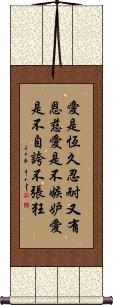
愛是恆久忍耐又有恩慈愛是不嫉妒愛是不自誇不張狂 is 1st Corinthians 13:4 in Chinese.
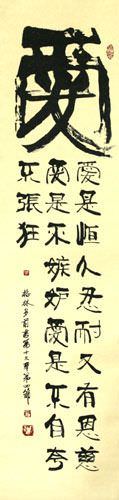
With large “love” character added.
In English, this reads:
1st Corinthians 13:4 (KJV) Charity suffereth long, and is kind; charity envieth not; charity vaunteth not itself, is not puffed up...
1st Corinthians 13:4 (NIV) Love is patient, love is kind. It does not envy, it does not boast, it is not proud.
1st Corinthians 13:4 (Basic English) Love is never tired of waiting; love is kind; love has no envy; love has no high opinion of itself, love has no pride.
The Chinese translation follows the love meaning, rather than the King James' use of “charity.” I was a little confused when writing this description with the significant differences between the NIV vs. KJV translations. After speaking to a Greek scholar about this, it would seem that the KJV has an almost errant translation with the use of “charity” in place of “love.”
We used the most popular Christian Chinese Bible, which is the Chinese Union Version (CUV). The CUV was first published in 1919. We use this so that the Chinese translation would be as accurate and standard as possible. Any Chinese Christian worth their salt will easily be able to identify this verse when they see these characters.
If you want a big “love” character written above the verse on your artwork, just make a note in the “special instructions” tab when you are customizing your artwork. There is no extra charge for that service on this special verse.
You may want to check our...
Your name on a Chinese calligraphy scroll page
Your name on a Japanese calligraphy scroll page
...for a list of almost 5000 names.
Fatal error: Cannot redeclare foreignPrice() (previously declared in /home/gwest/web/chinesescrollpainting.com/public_html/includes/currencyconverter.php:22) in /home/gwest/web/orientaloutpost.com/public_html/includes/currencyconverter.php on line 22