Many custom options...


And formats...



Sky Void in Chinese / Japanese...
Buy a Sky Void calligraphy wall scroll here!
Personalize your custom “Sky Void” project by clicking the button next to your favorite “Sky Void” title below...
1. Sky / Ether / Void / Emptiness / Unreality
3. Sky / Void
4. True Emptiness Yields Transcendent Existence
5. Nothingness
Sky / Ether / Void / Emptiness / Unreality
(Used in Japanese version of five elements)
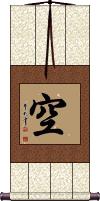
空 is a single character that means empty, void, hollow, vacant, vacuum, blank, nonexistent, vacuity, voidness, emptiness, non-existence, immateriality, unreality, the false or illusory nature of all existence, and being unreal.
In the Buddhist context, this relates to the doctrine that all phenomena and the ego have no reality but are composed of a certain number of skandhas or elements, which disintegrate. The void, the sky, space. The universal, the absolute, complete abstraction without relativity. The doctrine further explains that all things are compounds, or unstable organisms, possessing no self-essence, i.e. are dependent, or caused, come into existence only to perish. The underlying reality, the principle of eternal relativity, or non-infinity, i.e. śūnya, permeates all phenomena making possible their evolution.
From Sanskrit and/or Pali, this is the translation to Chinese and Japanese of the title śūnya or śūnyatā.
In Japanese, when pronounced as “ron” (sounds like “roan”) this can be a given name. It should be noted that this Kanji has about 5 different possible pronunciations in Japanese: kuu, kara, sora, ron, and uro. 空 is also an element in the Japanese version of the five elements.
Nothingness / Empty / Void
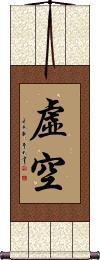
虛空 means empty space, empty sky, or void.
In the Buddhist context, it can mean “emptiness of the material world.” This can also be used as an adjective to modify other words with a meaning of unreal or insubstantial.
Sky / Void
虛空 means void, hollow, empty, space, sky, atmosphere, heaven, or ether.
虛空 is the Chinese and Japanese version of the Sanskrit word ākāśa (or akasa / akash) which, beyond the sky or space meaning can be the immaterial universe behind all phenomena in the Buddhist context.
True Emptiness Yields Transcendent Existence
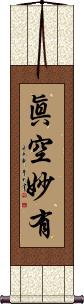
According to Soothill 眞空妙有 means:
The true void is the mysteriously existing, truly void, or immaterial, yet transcendentally existing.
眞空妙有 is the state of being nonexistent after removing all errant worldly influences. 眞空妙有 is achieved when all forms of existence are seen for their real nature.
Nothingness
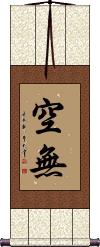
空無 is “nothingness” in a Buddhist context.
The first character means empty but can also mean air or sky (air and sky have no form).
The second character means have not, no, none, not, or to lack.
Together these characters reinforce each other into a word that means “absolute nothingness.”
I know this is a term used in Buddhism, but I have not yet figured out the context in which it is used. I suppose it can be the fact that Buddhists believe that the world is a non-real illusion, or perhaps it's about visualizing yourself as “nothing” and therefore leaving behind your desire and worldliness.
Buddhist concepts and titles often have this element of ambiguity or, rather, “mystery.” Therefore, such ideas can have different meanings to different people, and that's okay. If you don't get it right in this lifetime, there will be plenty more lifetimes to master it (whatever “it” is, and if “it” really exists at all).
Soothill defines this as “Unreality, or immateriality, of things, which is defined as nothing existing of independent or self-contained nature.”
Five Elements
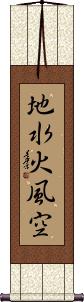
地水火風空 is the specifically-Japanese version of the five elements.
This is a little different than the ancient or original Chinese version.
The elements are written in this order:
1. Earth / Terra / Ground
2. Water
3. Fire
4. Wind / Air
5. Sky / Emptiness / Void / Ether
Note: This set of Kanji can also be romanized as “ji sui ka fuu kuu,” “jisuikafuukuu,” or “jisuikafuku.”
These can also be written in the order 地火風水空 (chi ka sui fuu kuu). Let me know when you place your order if you want the Kanji to be in this character order.
Nothing / Nothingness
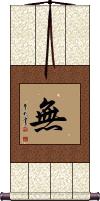
無 is the simple way to express “nothing.”
However, this single character leaves a bit of mystery as to what you might really mean if you hang it as a wall scroll. I'm not saying that's a bad thing; as you can decide what it means to you, and you won't be wrong if you stay within the general context.
More info: 無 is usually used as a suffix or prefix for Chinese and Japanese words (also old Korean). It can be compared to “un-” or “-less” in English. It can also mean “not to have,” no, none, not, “to lack,” or nothingness.
Sky / Air / Ether / Space
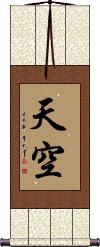
天空 means sky in most contexts but it can also refer to air, space, the heavens, or ether.
The Three Truths
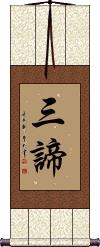
三諦 is a Buddhist term that means “threefold truth” or “three dogmas.”
The three truths are:
1. All things are void (卽空).
2. All things are temporary (卽假).
3. All things are in the middle state between these two (卽中).
Humble / Modesty / Humility
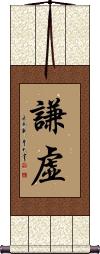
謙虚 is the most common way to say humble or modest in Japanese without a derogatory meaning (some other words suggest weakness, but this version holds a better humble meaning).
In Japanese, the first Kanji means self-effacing, humble oneself, and modesty. The second means void or emptiness.
See Also: Moderation
Five Element Dojo

This is the title “5 Element Dojo” in Japanese Kanji.
Sometimes, the five elements are expressed in Japanese as 五大 (Godai) (earth, water, fire, wind, void) instead of the Chinese/Traditional 五行 (Gogyo) (wood, fire, water, earth, metal), so you might want 五大道場 instead. Let me know when ordering if that is the case.
Godai / Five Elements
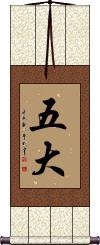
五大 is the Japanese title for the five elements.
In Japan, the five elements differ slightly from the original Chinese. Therefore, in Japanese philosophy, you have earth, water, fire, wind, and void (space).
The meaning of the first character is 5, but the second character means great or large. Some translate this as the five majors. 大 is only understood as “elements” when you have 五 in front of it.
In Buddhism, this can be short for 五大明王, or the five great and wise kings.
Kyojitsu: Falsehood and Truth
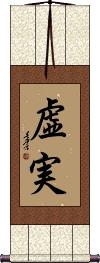
虚実 is a Japanese word that means “falsehood [and] truth” or “fiction [and] fact.”
This concept is used in warfare, gameplay, and martial arts strategies. 虚実 can be a strategy of real and/or deceptive moves. This gets to some Sun Tzu Art of War stuff where in warfare a strategic move is either a real and serious move or it is a deceptive blow.
Let's explore each character in more depth:
虚 was originally written 虛 (there is a very subtle difference in the strokes at the bottom of the character) and means unpreparedness, falsehood, emptiness, void, abstract theory, empty or unoccupied, diffident or timid, false, humble or modest, virtual, or in vain.
In the Buddhist context, 虛 represents the Pali/Sanskrit word “śūnya,” meaning empty, vacant, unreal, unsubstantial, untrue, space, humble, or in vain.
In ancient Eastern/Chinese astronomy, 虛 represents the “Emptiness” constellation (one of the 28 mansions in the sky).
実 was originally 實 in Chinese (they currently write it as 实 in Simplified Chinese) with the meaning, truth, reality, sincerity, honesty, fidelity, and substance.
The Buddhist context is similar, adding real, true, honest, really, solid, definitely, sincere, solid, fixed, full, to fill, fruit, kernel, verily, in fact, the supreme fact, or ultimate reality to the definition.
Fatal error: Cannot redeclare foreignPrice() (previously declared in /home/gwest/web/chinesescrollpainting.com/public_html/includes/currencyconverter.php:22) in /home/gwest/web/orientaloutpost.com/public_html/includes/currencyconverter.php on line 22