Many custom options...


And formats...



Treasure in Chinese / Japanese...
Buy a Treasure calligraphy wall scroll here!
Personalize your custom “Treasure” project by clicking the button next to your favorite “Treasure” title below...
1. Treasure
2. Protect Guard Treasure Cherish
4. Three Treasures of Chinese Medicine
5. Cherish
6. Precious
7. Time is more valuable than Jade
9. The farts of others stink, but one’s own smells sweet
10. Baby
11. Red Envelope
Treasure
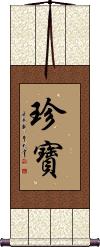
In Chinese, 珍寶 means treasure, something you value highly, or something very precious to you.
In Japanese, 珍寶 has a meaning like “rare treasure.”
珍 can mean a precious thing or treasure. 寶 can mean a jewel or gem, a treasure, or simply precious. Together these two characters reinforce each other into a word that clearly means treasure.
Treasure
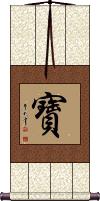
寶 means precious thing or treasure.
This can also mean precious, a gem, a pearl, or anything valuable.
 The version of this character shown to the left is the traditional Chinese and ancient/traditional Japanese version. In modern Japan and China, this character has been simplified. This simplified version is shown to the right. If you want this modern Japanese/simplified version, just click the Kanji on the right, instead of the button above. If your audience is Chinese or Korean, I recommend the ancient/traditional form. Only consider the simplified form if your audience is younger Japanese people.
Treasure
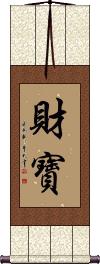
財寶 is the Japanese word meaning “treasure” or “money and valuables.”
The first character means “property,” “money,” “wealth,” or “assets.” The second character means “treasure,” “wealth,” or “valuables” in Japanese. Together these two characters reinforce each other into a word that clearly means treasure in Japanese.
財寶 is also a word meaning “money and valuables” in Chinese but more of a daily use word - not as appropriate for a wall scroll if your audience is Chinese.
The second character shown to the left is the ancient/traditional Japanese version. In modern Japan, this character has been simplified. This simplified version is shown to the right. If you want this modern Japanese/simplified version, just click the Kanji on the right, instead of the button above.
Protect Guard Treasure Cherish
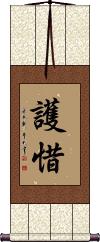
護惜 is a Zen Buddhist word that means to protect, guard, treasure, and/or cherish.
Precious / Treasure
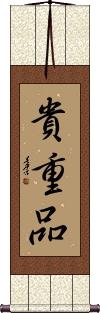
貴重品 means precious or treasured as an adjective or as a noun, valuables or treasures in Japanese.
貴重品 exists in the Korean dictionary but is rarely if ever, used in Korea.
Three Treasures of Chinese Medicine
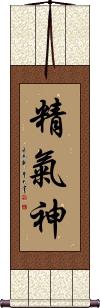
精, 氣, 神 are the characters jing, qi, and shen.
As a set, these three characters are known in English as the treasures of traditional Chinese medicine, the treasures of Qi Gong, or the three treasures of Taoism / Daoism.
Sometimes this set is titled 三寶 (sānbǎo) or “three treasures,” but here, we're writing each treasure out.
Here's how these characters are perceived in this context...
Jing: nutritive essence; refined; perfected; pure
Qi: vitality; energy; force; breath; vigor
Shen: spirit; soul; mind; being
To keep it simple, you can use “essence, vitality, and spirit” to define these.
Cherish
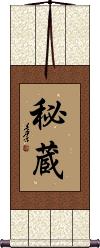
秘蔵 means to cherish, treasure, or prize in Japanese.
Cherish
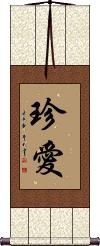
珍愛 means to cherish, to treasure, or to love dearly in Chinese.
Precious
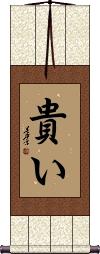
This Japanese word means precious, valuable, priceless, noble, exalted, or sacred.
Time is more valuable than Jade
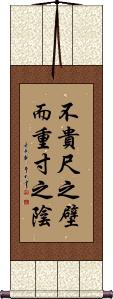
不贵尺之壁而重寸之阴 literally translates as: Treasure not a foot long [piece of] jade, [rather] treasure an inch of time.
Figuratively, this suggests that time is the most important/valuable thing in life.
Love and Protect
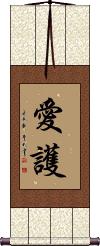
愛護 is the Chinese and Japanese Kanji for cherish, to treasure, to take care of, to love and protect, to provide loving protection, or tender care.
The farts of others stink, but one’s own smells sweet
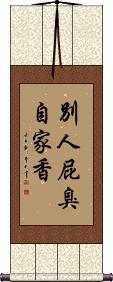
别人屁臭自家香 literally translates as:
Other people's flatulence stinks, [but] one's own is fragrant.
Figuratively, this means:
Some people criticize defects in others that they (seem to) treasure in themselves.
Baby
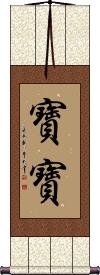
寶寶 is how Chinese people express “baby.”
The word is composed of the same character twice, and therefore literally means “double precious” or “double treasure.”
This would be a nice wall scroll to put either inside or by the door of your baby's room (not on the door, as wall scrolls swing around wildly when hung on doors that open and close a lot).
Red Envelope
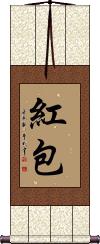
紅包 literally means “red treasure.”
Depending on the context, it can also mean “money wrapped in red as a gift,” “a bonus payment,” “a kickback,” or “a bribe.”
However, most of the time, this is an innocent gift of money in a red envelope that is given from an elder relative to a youngster. This usually happens during the Chinese New Year. It can also happen in preparation for or during a wedding in China.
紅包 is pronounced “Hong Bao” (with an “oh” vowel sound on hong) in Mandarin Chinese. Filipino Chinese call it “Ang Pao.” There are a few other variations.
Daodejing / Tao Te Ching - Excerpt
Excerpt from Chapter 67
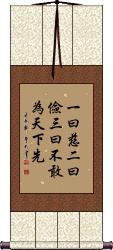
一曰慈二曰儉三曰不敢為天下先 is an excerpt from the 67th Chapter of Lao Tzu's (Lao Zi's) Te-Tao Ching (Dao De Jing).
This is the part where the three treasures are discussed. In English, we'd say these three treasures are compassion, frugality, and humility. Some may translate these as love, moderation, and lack of arrogance. I have also seen them translated as benevolence, modesty, and “Not presuming to be at the forefront in the world.” You can mix them up the way you want, as translation is not really a science but rather an art.
I should also explain that the first two treasures are single-character ideas, yet the third treasure was written out in six characters (there are also some auxiliary characters to number the treasures).
If Lao Tzu's words are important to you, then a wall scroll with this passage might make a great addition to your home.
There is one single thread binding my Way together
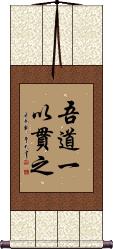
吾道一以貫之 is a phrase from the Analects of Confucius that translates as “My Way has one thread that runs through it.”
Other translations include:
My Way is penetrated by a single thread.
There is one single thread binding my Way together.
My Way is run through with a unifying thread.
My Way is Consistent.
And sometimes poetic license is taken, and it is translated as:
My Way is the only one; I'll treasure it and stick to it with humility until the end.
After this was said, some 2500+ years ago, another disciple of Confucius clarified the meaning by stating, “Our master's Way is to be loyal and have a sense of reciprocity.”
In Japanese, this is purported to be romanized as “Waga michi ichi wo motte kore wo tsuranuku,” though some will argue the true pronunciation.
Note: Sometimes written 吾道以一貫之 instead of 吾道一以貫之 with no difference in meaning.
Fatal error: Cannot redeclare foreignPrice() (previously declared in /home/gwest/web/chinesescrollpainting.com/public_html/includes/currencyconverter.php:22) in /home/gwest/web/orientaloutpost.com/public_html/includes/currencyconverter.php on line 22