Many custom options...


And formats...



Wing Chun in Chinese / Japanese...
Buy a Wing Chun calligraphy wall scroll here!
Personalize your custom “Wing Chun” project by clicking the button next to your favorite “Wing Chun” title below...
Wing Chun
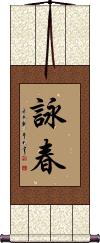
詠春 is a martial arts technique that has an oral history (versus a written one) so very little can be said for sure about its origins.
Wing Chun (or Wing Cheun) is a Chinese martial art that emphasizes short combat strokes.
The characters 詠春 literally mean “Singing Spring” (as in springtime).
If you are wondering, the spelling and pronunciation of this martial arts style in English come from the Cantonese pronunciation of these characters. The second character sounds similar in both Mandarin and Cantonese, but the first is quite different.
Note: This title can be pronounced in Japanese, but only a Japanese practitioner of Wing Chun would recognize or understand this title. It is not considered a Japanese word or martial art at all.
Wing Chun Fist
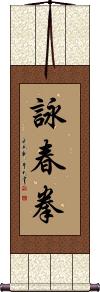
詠春拳 is the title for the “Wing Chun” school of martial arts but with the addition of the character for “fist” at the end. So this is “Wing Chun Fist” or literally “Singing Spring Fist.”
There are lots of alternate Cantonese romanizations for this, such as “Wing Chun Kuen,” “Wing Tsun Cheun,” “Eng Chun Pai,” and “Wing Ceon Kyun.” The characters are the same; just the lack of a standard Cantonese romanization means that people make up their own based on what they think it sounds like.
Wing Chun Fist Maxims
Wing Chun Kuen Kuit
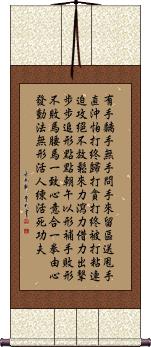
This text is the chant or poem of Wing Chun.
I call it a “chant” because it was meant to be a somewhat rhythmic poem to help practitioners memorize many aspects of Wing Chun.
1 有手黐手,無手問手
2 來留區送, 甩手直沖
3 怕打終歸打, 貪打終被打
4 粘連迫攻, 絕不放鬆
5 來力瀉力, 借力出擊
6 步步追形, 點點朝午
7 以形補手, 敗形不敗馬
8 腰馬一致, 心意合一
9 拳由心發, 動法無形
10 活人練活死功夫
You will see this referred to as “Wing Chun Kuem Kuit.” This Cantonese romanization is popular in the west (and there is no official way to romanize Cantonese, so many variations exist). In Mandarin, it would be, “Yong Chun Quan Jue.” The last character (kuit or kyut from Cantonese, jue or chüeh from Mandarin) kind of means “secrets of the art.” It's a short way to write 口訣, meaning “mnemonic chant” or “rhyme for remembering.”
In the west (especially in the military), we often use acronyms to remember things. There are no initials to make acronyms in Chinese, so in ancient times, chants like this are used to remember vast amounts of information.
I will presume you already know the meaning of the 10 maxims, so I will skip that to keep this calligraphy entry from getting too large.
Some think 练拳者必记 is the title but that just says, “(When) training (the) fist, people should remember:.” Therefore, I've not included that in the calligraphy. However, you can put a note in the special instructions if you want it added.
Note: On a traditional calligraphy wall scroll, the characters will be written in vertical columns, starting from the right, and proceeding left.
Note: This is an except and variation from a huge 口訣. These 10 maxims are used extensively in Wing Chun training, and you’ll find them all over the internet. Just know there is a much longer version out there, along with several variations and excepts like this one. If you know of, or want a different version, just contact me, and I will add it for you.
Wing Chun Fist Maxims (Part 1)
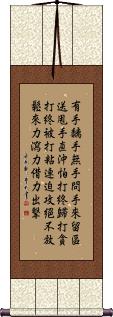
A customer asked me to split these Wing Chun maxims into two parts, so he could order a couplet. I thought this was a good idea, so it's been added here.
1 有手黐手,無手問手
2 來留區送, 甩手直沖
3 怕打終歸打, 貪打終被打
4 粘連迫攻, 絕不放鬆
5 來力瀉力, 借力出擊
A couplet is a set of two wall scrolls that start and finish one phrase or idea. Often, couplets are hung with the first wall scroll on the right side, and the second on the left side of a doorway or entrance. The order in Chinese is right-to-left, so that's why the first wall scroll goes on the right as you face the door.
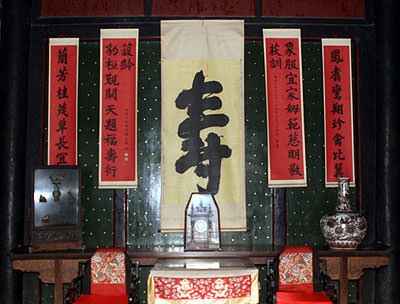
Of course, couplets can also be hung together on a wall. Often they can be hung to flank an altar, or table with incense, or even flanking a larger central wall scroll. See an example here from the home of Confucius
Be sure to order both parts 1 and 2 together. One without the other is like Eve without Adam.
Wing Chun Kung Fu
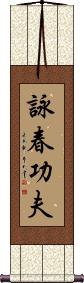
詠春功夫 is Wing Chun Kung Fu.
The first two characters literally mean “Singing Spring” (as in springtime).
The last two are “Kung Fu” (high skill).
Tai Chi Wing Chun Kung Fu
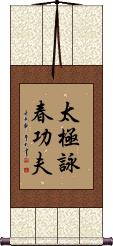
太極詠春功夫 is the title Tai Chi Wing Chun Kung Fu.
Please note that it can be romanized in a variety of ways such as:
Tai Chi Ving Tsun Kung Fu
Tai Qi Yong Chun Gong Fu
Taai Gik Wing Ceon Gung Fu
Be sure this is the right title for what you are looking for before you order.
Wing Chun Fist Maxims (Part 2)
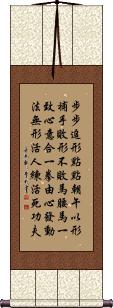
A customer asked me to split these Wing Chun maxims into two parts, so he could order a couplet.
It thought this was a good idea, so it's been added here.
6 步步追形, 點點朝午
7 以形補手, 敗形不敗馬
8 腰馬一致, 心意合一
9 拳由心發, 動法無形
10 活人練活死功夫
Be sure to order both part 1 and part 2 together. They need to be a matched set. It will be incomplete as a single wall scroll. Also, each wall scroll is handmade, so if you order them separately, weeks or months apart, they will vary a little by length, shade of paper, etc.
Sticky Hands / Chi Sau
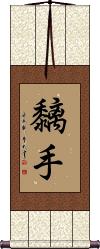
The first character means “wood glue” or can be understood as “sticky” or “sticking.”
The second character means “hand” (or “hands”).
This term can be romanized as “Chi Sau,” “Chi Sao,” or from Mandarin, “Chi Shou.”
黐手 is a concept that comes from the Wing Chun (AKA: Ving Tsun, Wing Tsun, or Yong Chun) style of martial arts. If you are looking for this term, chances are, you already know the meaning within the context of Wing Chun.
Black Flag Gate / Hek Ki Boen
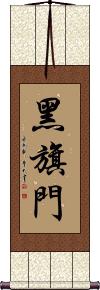
黑旗門 is often romanized as “Hek Ki Boen” in Cantonese, this is the title for a certain branch school of Wing Chun or Eng Chun martial arts.
Si Gung
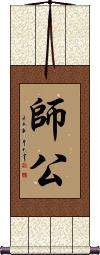
This is a term for “teacher” that is primarily used in Wing Chun martial arts schools.
In very old Buddhist context this can be “thaumaturge” meaning a worker of wonders and/or performer of miracles.
Southern Praying Mantis
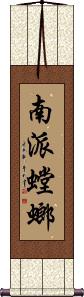
南派螳螂 can be translated literally as “Southern School Praying Mantis” or “Southern Style Praying Mantis.”
Despite its name, the Southern Praying Mantis style of Chinese martial arts is unrelated to the Northern Praying Mantis style. Southern Praying Mantis is instead related most closely to fellow Hakka styles such as Dragon and more distantly to the Fujian family of styles that includes Fujian White Crane, Five Ancestors, and Wing Chun.
This style of martial arts focuses more on fighting skills rather than aesthetics.
Of course, you already knew that if you were looking for this term.
Note: This title can be pronounced and does have meaning in Korean but only to Koreans familiar with Chinese martial arts.
Fatal error: Cannot redeclare foreignPrice() (previously declared in /home/gwest/web/chinesescrollpainting.com/public_html/includes/currencyconverter.php:22) in /home/gwest/web/orientaloutpost.com/public_html/includes/currencyconverter.php on line 22