Many custom options...


And formats...



Yam in Chinese / Japanese...
Buy a Yam calligraphy wall scroll here!
Personalize your custom “Yam” project by clicking the button next to your favorite “Yam” title below...
Switched to secondary search mode due to lack of results using primary.
These secondary results may not be very accurate. Try a different but similar meaning word or phrase for better results. Or...
Look up Yam in my Japanese Kanji & Chinese Character Dictionary(My dictionary is a different system then the calligraphy search you just tried)
If you want a special phrase, word, title, name, or proverb, feel free to contact me, and I will translate your custom calligraphy idea for you.
1. Akiyama
3. Ghanshyam
4. Maryam
6. Miyamoto
10. Shayama
11. Toyama-Ryu
12. Yam
13. Yamada
14. Yamavakedma
15. Yambol
16. Yami
17. Yamila
18. Yamileth
Akiyama
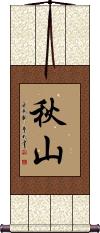
This is the surname and place name Akiyama in Japanese.
It can be read in Chinese but would be understood to be a Japanese name (no meaning in Chinese).
Asayama Ichiden-Ryu
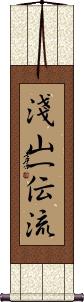
浅山一伝流 or Asayama Ichiden-ryū is a Japanese koryū martial art founded in the late Muromachi period by Asayama Ichidensai Shigetatsu.
Ghanshyam
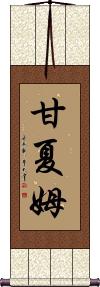
甘夏姆 is the name Ghanshyam in Chinese (Mandarin).
Ghanshyam
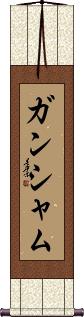
ガンシャム is the name Ghanshyam in Japanese Katakana.
Note: Because this title is entirely Japanese Katakana, it should be written by a Japanese calligrapher.
Maryam
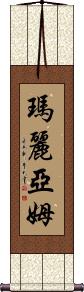
瑪麗亞姆 is the name Maryam in Chinese (Mandarin).
Maryam
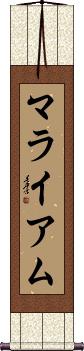
マライアム is the name Maryam in Japanese (Katakana).
Note: Because this title is entirely Japanese Katakana, it should be written by a Japanese calligrapher.
Midori Yama Budokai

This is the title Midori Yama Budokai in Japanese.
Note: Because this selection contains some special Japanese Hiragana characters, it should be written by a Japanese calligrapher.
Miyamoto
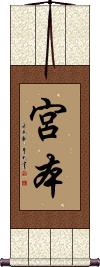
宮本 is a Japanese surname that romanizes as Miyamoto.
宮本 is not the only Miyamoto, so make sure this is the correct Kanji for your name before you order.
Namo Shakyamuni Buddha
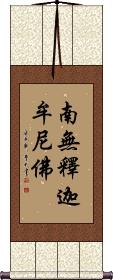
南無釋迦牟尼佛 is a Buddhist chant or prayer of respect to the Shakyamuni Buddha.
Some will translate this as the Buddhist vow.
The first two characters, 南無, are sometimes translated as “amen”; others will translate it as “belief in” or “homage to.”
To expand on this, 南無 can also mean “taking of refuge in” while representing devotion or conviction. 南無 as with most religious concepts or words, different people or denominations will have varying definitions.
Sanchi / Yamaji
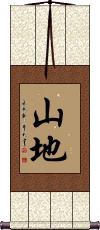
山地 means mountainous region, hilly area, or hilly country in Chinese, Japanese, and Korean.
山地 is also a Japanese surname that romanizes as Yamaji or Sanchi.
Note: This is not the only Japanese name that romanizes as Yamaji or Sanchi. Make sure this is the right one before you order.
Shakyamuni / The Buddha
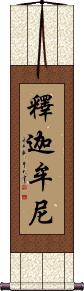
釋迦牟尼 is a transliteration of “Shakyamuni” or “Sakyamuni” in Chinese, Japanese, and old Korean.
The perceived meaning of the name is roughly translated as “Sage of the Sakyas.”
This same Buddha is also known as “Siddhartha Gautama,” “Gotama Buddha,” “Tathagata,” or simply, “The Supreme Buddha.”
Shakyamuni is the legendary man and prince who eventually established the Buddhist religion.
Note: Occasionally Romanized as “Siddhattha Gotama.”
This combination of characters is sometimes seen and used in South Korea and Japan as well (with the same meaning).
Note: 釋迦牟尼 came from the Sanskrit शाक्यमुनि and can also be romanized with diuretics as Śākyamuni.
Shakyamuni / The Buddha
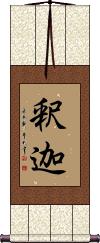
釈迦 is the way to write Shakyamuni in Japanese.
It's just two Kanji, the first is a simplified version of the one used in Chinese for Shakyamuni, and the second one is identical to the Chinese.
This refers to the Buddha (Siddhartha Gautama, 563 BCE-483 BCE) also known as Sakyamuni and Gautama Buddha.
This has a very good meaning in Japanese but is an odd selection for a wall scroll. It appears here more for reference.
Shayama
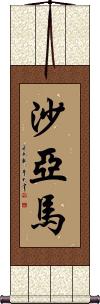
沙亞馬 is the name Shayama in Chinese (Mandarin).
Shayama
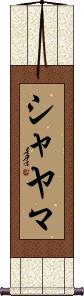
シャヤマ is the name Shayama in Japanese Katakana.
Note: Because this title is entirely Japanese Katakana, it should be written by a Japanese calligrapher.
Toyama-Ryu

戸山流 or Toyama-Ryu is a relatively modern Japanese swordsmanship style (gendai budo) developed in the early 20th century at the Toyama Military Academy in Japan.
It was designed to efficiently train Imperial Japanese Army officers in swordsmanship, with a focus on practical application for battlefield use.
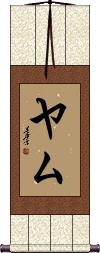
ヤム is the name Yam in Japanese Katakana.
Note: Because this title is entirely Japanese Katakana, it should be written by a Japanese calligrapher.
Yamada

山田 is the name surname Yamada in Japanese Kanji.
Yamavakedma

ヤマバケドマ is the name Yamavakedma in Japanese Katakana.
Note: Because this title is entirely Japanese Katakana, it should be written by a Japanese calligrapher.
Yambol
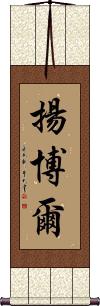
揚博爾 is the name Yambol in Chinese (Mandarin).
Yambol
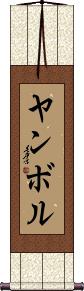
ヤンボル is the name Yambol in Japanese (Katakana).
Note: Because this title is entirely Japanese Katakana, it should be written by a Japanese calligrapher.
Yami
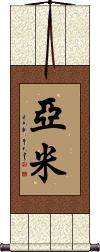
亞米 is the name Yami in Chinese (Mandarin).
Yamila
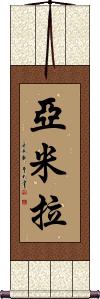
亞米拉 is the transliteration to Mandarin Chinese for the Latin / Spanish name Yamila.
Yamila
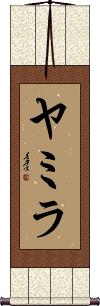
ヤミラ is the name Yamila in Japanese.
Note: Because this title is entirely Japanese Katakana, it should be written by a Japanese calligrapher.
Yamileth
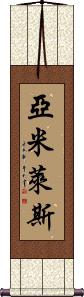
亞米萊斯 is the name Yamileth in Chinese (Mandarin).
Yamileth
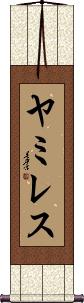
ヤミレス is the name Yamileth in Japanese (Katakana).
Note: Because this title is entirely Japanese Katakana, it should be written by a Japanese calligrapher.
Fatal error: Cannot redeclare foreignPrice() (previously declared in /home/gwest/web/chinesescrollpainting.com/public_html/includes/currencyconverter.php:22) in /home/gwest/web/orientaloutpost.com/public_html/includes/currencyconverter.php on line 22