Many custom options...


And formats...



Daodejing Chapter 33 in Chinese / Japanese...
Buy a Daodejing Chapter 33 calligraphy wall scroll here!
Personalize your custom “Daodejing Chapter 33” project by clicking the button next to your favorite “Daodejing Chapter 33” title below...
Daodejing / Tao Te Ching - Chapter 9
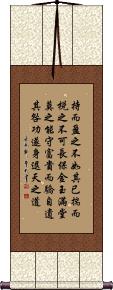
This text is the ninth chapter of the Daodejing / Tao Te Ching.
The text reads:
持而盈之、不如其已。揣而梲之、不可長保。 金玉滿堂、莫之能守。 富貴而驕、自遺其咎。 功遂身退、天之道。
This classical Chinese passage comes from the Mawangdui (馬王堆帛書) text.
To hold until full is not as good as stopping.
An oversharpened sword cannot last long.
A room filled with gold and jewels cannot be protected.
Boasting of wealth and virtue brings your demise.
After finishing the work, withdraw.
持而盈之不如其已揣而梲之不可長保金玉滿堂莫之能守富貴而驕自遺其咎功遂身退天之道 is the Way of Heaven.
Dr. Muller's translation of all 81 Daodejing chapters
Daodejing / Tao Te Ching - Chapter 1
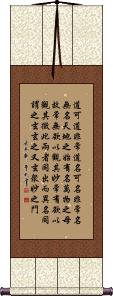
This text is the first chapter of the Daodejing / Tao Te Ching.
The text reads:
道可道、非常道。名可名、非常名。 無名天地之始 有名萬物之母。故常無欲以觀其妙、常有欲以觀其徼。此兩者同出而異名。同謂之玄。玄之又玄、衆妙之門。
This classical Chinese passage comes from the Mawangdui (馬王堆帛書) text.
The Way that can be followed is not the eternal Way.
The name that can be named is not the eternal name.
The nameless is the origin of heaven and earth
While naming is the origin of a myriad of things.
Therefore, always desireless, you see the mystery
Ever desiring, you see the manifestations.
These two are the same—
When they appear they are named differently.
This sameness is the mystery,
Mystery within mystery;
The door to all marvels.
Dr. Muller's translation of all 81 Daodejing chapters
Daodejing / Tao Te Ching - Chapter 54
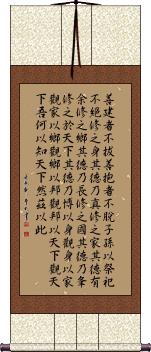
This is the Mawangdui version of Daodejing chapter 54.
By its virtue alone can one generation after another carry on the ancestral sacrifice.
Apply it to yourself, and by its power, you will be freed from dross.
Apply it to your household, and your household shall thereby have abundance.
Apply it to the village, and the village will be made secure.
Apply it to the kingdom, and the kingdom shall thereby be made to flourish.
Apply it to an empire, and the empire shall thereby be extended.
Therefore just as through oneself, one may contemplate Oneself;
So through the household one may contemplate the Household;
And through the village, one may contemplate the Village;
And through the kingdom, one may contemplate the Kingdom;
And through the empire, one may contemplate the Empire.
How do I know that the empire is so? By this.
What is firmly rooted cannot be pulled out;
What is tightly held in the arms will not slip loose;
Through this, the offering of sacrifice by descendants will never come to an end.
Cultivate it in your person, and its virtue will be genuine;
Cultivate it in the family, and its virtue will be more than sufficient;
Cultivate it in the hamlet, and its virtue will endure;
Cultivate it in the state, and its virtue will abound;
Cultivate it in the empire, and its virtue will be pervasive.
Hence look at the person through the person;
Look at the family through the family;
Look at the hamlet through the hamlet;
Look at the state through the state;
Look at the empire through the empire.
How do I know that the empire is like that?
By means of this.
Daodejing / Tao Te Ching - Chapter 81
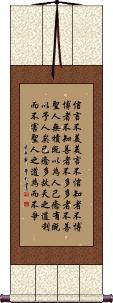
信言不美美言不信知者不博博者不知善者不多多者不善聖人無積既以為人己癒有既以予人矣已癒多故天之道利而不害聖人之道為而不爭 is the Mawangdui version of Daodejing chapter 81.
Credible words are not eloquent;
Eloquent words are not credible.
The wise are not erudite;
The erudite are not wise.
The adept are not all-around;
The all-around are not adept.
The sages do not accumulate things.
Yet the more they have done for others,
The more they have gained themselves;
The more they have given to others,
The more they have gotten themselves.
Thus, the way of tian (heaven) is to benefit without harming;
The way of sages is to do without contending.
Sincere words are not showy;
showy words are not sincere.
Those who know are not “widely learned";
those “widely learned” do not know.
The good do not have a lot;
Those with a lot are not good.
The Sage accumulates nothing.
Having used what he had for others,
he has even more.
Having given what he had to others,
what he has is even greater.
Therefore, the Way of Heaven is to benefit and not cause any harm,
The Way of Man is to act on behalf of others and not to compete with them.
True words aren't charming,
charming words aren't true.
Good people aren't contentious,
contentious people aren't good.
People who know aren't learned,
learned people don't know.
Wise souls don't hoard;
the more they do for others the more they have,
the more they give the richer they are.
The Way of heaven provides without destroying.
Doing without outdoing
is the Way of the wise.
Daodejing / Tao Te Ching - Chapter 33
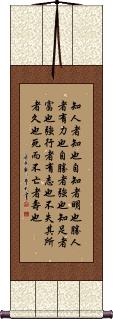
This is referred to as passage or chapter 33 of the Dao De Jing (often Romanized as “Tao Te Ching”).
These are the words of the philosopher Laozi (Lao Tzu).
To know others is wisdom;
To know oneself is acuity/intelligence.
To conquer others is power,
To conquer oneself is strength.
To know contentment is to have wealth.
To act resolutely is to have purpose.
To stay one's ground is to be enduring.
To die and yet not be forgotten is to be long-lived.
To understand others is to be knowledgeable;
To understand yourself is to be wise.
To conquer others is to have strength;
To conquer yourself is to be strong.
To know when you have enough is to be rich.
To go forward with strength is to have ambition.
To not lose your place is to be long-lasting.
To die but not be forgotten -- that's true long life.
He who is content is rich;
He who acts with persistence has will;
He who does not lose his roots will endure;
He who dies physically but preserves the Dao
will enjoy a long after-life.
Notes:
During our research, the Chinese characters shown here are probably the most accurate to the original text of Laozi. These were taken for the most part from the Mawangdui 1973 and Guodan 1993 manuscripts which pre-date other Daodejing texts by about 1000 years.
Grammar was a little different in Laozi’s time. So you should consider this to be the ancient Chinese version. Some have modernized this passage by adding, removing, or swapping articles and changing the grammar (we felt the oldest and most original version would be more desirable). You may find other versions printed in books or online - sometimes these modern texts are simply used to explain to Chinese people what the original text really means.
This language issue can be compared in English by thinking how the King James (known as the Authorized version in Great Britain) Bible from 1611 was written, and comparing it to modern English. Now imagine that the Daodejing was probably written around 403 BCE (2000 years before the King James Version of the Bible). To a Chinese person, the original Daodejing reads like text that is 3 times more detached compared to Shakespeare’s English is to our modern-day speech.
Extended notes:
While on this Biblical text comparison, it should be noted, that just like the Bible, all the original texts of the Daodejing were lost or destroyed long ago. Just as with the scripture used to create the Bible, various manuscripts exist, many with variations or copyist errors. Just as the earliest New Testament scripture (incomplete) is from 170 years after Christ, the earliest Daodejing manuscript (incomplete) is from 100-200 years after the death of Laozi.
The reason that the originals were lost probably has a lot to do with the first Qin Emperor. Upon taking power and unifying China, he ordered the burning and destruction of all books (scrolls/rolls) except those pertaining to Chinese medicine and a few other subjects. The surviving Daodejing manuscripts were either hidden on purpose or simply forgotten about. Some were not unearthed until as late as 1993.
We compared a lot of research by various archeologists and historians before deciding on this as the most accurate and correct version. But one must allow that it may not be perfect, or the actual and original as from the hand of Laozi himself.
Fatal error: Cannot redeclare foreignPrice() (previously declared in /home/gwest/web/chinesescrollpainting.com/public_html/includes/currencyconverter.php:22) in /home/gwest/web/orientaloutpost.com/public_html/includes/currencyconverter.php on line 22