Many custom options...


And formats...



Goodness in Chinese / Japanese...
Buy a Goodness calligraphy wall scroll here!
Personalize your custom “Goodness” project by clicking the button next to your favorite “Goodness” title below...
Goodness
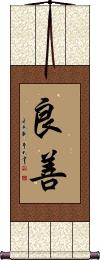
良善 means good or goodness.
This can also be the name Ryōzen in Japanese.
Goodness / Kind-Hearted
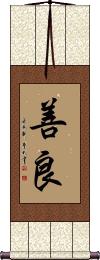
善良 is a word that means good and honest, kind-hearted, goodness, excellence, and/or virtue.
Truth Goodness and Beauty
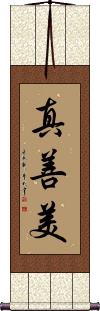
真善美 means truth, goodness, and beauty in Chinese and Japanese.
These can also be read as “the true, the good, and the beautiful.”
In Japanese, this can be the female given name Mazemi or the personal name Shinzenbi.
Ultimate Goodness of Water
Quote from Lao Tzu
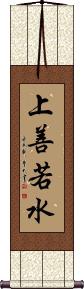
上善若水 is a quote that is sometimes presented as “Be like water.”
However, this is an ancient quote from the great philosopher Lao Tzu. It suggests that the ultimate goodness and purity (in the world) is water. Many take this as a suggestion to be like pure/good water.
Goodness / Good Deed
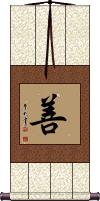
善 means goodness, virtue, good deed, charitable, benevolent, well-disposed, nice, pleasant, kind, or simply, “good.”
善 is the kind of good that applies to someone's good character, or a good person in general.
Referring to someone with this word means that they have a well-aimed moral compass, and are charitable, giving, wise, and honest. Basically, this is a blanket statement for every good trait a human can have or all the things that make someone good.
In another context, it can mean to improve or perfect something or refer to someone who is good at something.
Good Heart
A heart of kindness, benevolence, and virtuous intentions
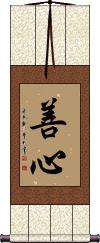
善心 literally reads “Good Heart” but is used to refer to the ideas of kindness, benevolence, philanthropy, virtuous intentions, moral sense, and conscience.
Some will also translate this as the morality of mind (as the character for the heart is often used to mean mind).
In Japanese, this can be the given name Yoshinaka.
Good Conduct
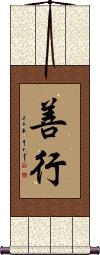
善行 means good actions, good deeds, good conduct, or benevolence.
This can be the given name Yoshiyuki in Japanese.
Work Unselfishly for the Common Good
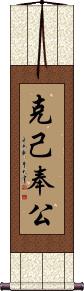
克己奉公 is a Chinese proverb that is often used to express how one should act as a government official. Most of us wish our public officials would hold themselves to higher standards. I wish I could send this scroll, along with the meaning to every member of Congress, and the President (or if I was from the UK, all the members of Parliament, and the PM)
This can also mean: “Place Strict Standards on Oneself in Public Service.”
The story behind this ancient Chinese idiom:
Cai Zun was born in China a little over 2000 years ago. In 24 AD, he joined an uprising led by Liu Xiu, who later became the emperor of the Eastern Han Dynasty.
Later, the new emperor put Cai Zun in charge of the military court. Cai Zun exercised his power in strict accordance with military law, regardless of the offender's rank or background. He even ordered the execution of one of the emperor's close servants after the servant committed a serious crime.
Cai Zun led a simple life but put great demands on himself to do all things honorably. The emperor rewarded him for his honest character and honorable nature by promoting him to the rank of General and granting him the title of Marquis.
Whenever Cai Zun would receive an award, he would give credit to his men and share the reward with them.
Cai Zun was always praised by historians who found many examples of his selfless acts that served the public interest.
Sometime long ago in history, people began to refer to Cai Zun as “ke ji feng gong.”
See Also: Unselfish | Selflessness | Altruism
The Foundation of Good Conduct
Quote from Confucius
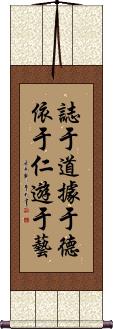
This proverb, 志于道据于德依于仁游于艺, from the Analects of Confucius translates as:
Resolve yourself in the Dao/Tao/Way.
Rely on Virtue.
Reside in benevolence.
Revel in the arts.
According to Confucius, these are the tenets of good and proper conduct.
This was written over 2500 years ago. The composition is in ancient Chinese grammar and phrasing. A modern Chinese person would need a background in Chinese literature to understand this without the aid of a reference.
Fatal error: Cannot redeclare foreignPrice() (previously declared in /home/gwest/web/chinesescrollpainting.com/public_html/includes/currencyconverter.php:22) in /home/gwest/web/orientaloutpost.com/public_html/includes/currencyconverter.php on line 22