Many custom options...


And formats...



San Soo Kung Fu in Chinese / Japanese...
Buy a San Soo Kung Fu calligraphy wall scroll here!
Personalize your custom “San Soo Kung Fu” project by clicking the button next to your favorite “San Soo Kung Fu” title below...
See also: Martial Arts Words and Phrases
4. Bruce Lee
5. Kung / Gong
7. Hung Gar
14. Kung Fu San Soo / San Shou
16. Shaolin
18. Inner Strength
20. Monkey Fist
21. Neijing
22. The Five Animals
23. Wu Xing Fist
24. Shaolin Chuan / Shao Lin Quan
25. Wudang Fist
26. Warrior Essence / Warrior Spirit / Martial
27. Drunken Monkey
28. Kajukenbo Slogan
29. Monkey Fist
30. Crouching Tiger Hidden Dragon
31. Drunken Fist
32. Shaolin Temple
33. Jackie Chan
34. Five Families / Tsoi Li Hoi Fut Hung
35. Kenpo / Kempo / Quan Fa / Chuan Fa
36. Strong bones come from hard knocks
37. Black Belt
38. Tang Soo Do / Tang Hand Way
41. Sword
San Soo Kung Fu
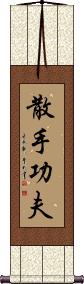
散手功夫 is San Soo Kung Fu.
Sometimes you will see this in the order 功夫散手 (Kung Fu San Soo). Either version is OK.
It's like “Kung Fu of San Soo” vs. “San Soo Kung Fu” if you put it in English terms. San Soo is the adjective either way in Chinese.
Wing Chun Kung Fu
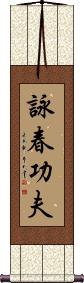
詠春功夫 is Wing Chun Kung Fu.
The first two characters literally mean “Singing Spring” (as in springtime).
The last two are “Kung Fu” (high skill).
Lau Gar Kung Fu
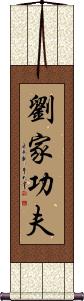
劉家功夫 are the characters for the Lau Gar Kung Fu style of martial arts.
The romanization of “Lau Gar” comes from Cantonese. “Kung Fu” is the common romanization for English from the Mandarin “Gōng Fu” or Cantonese “Gung Fu” pronunciations.
Lau gar = Lau family.
Bruce Lee
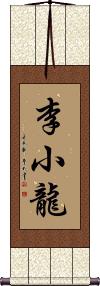
李小龍 is the real full name of Bruce Lee.
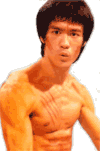 Many people have no idea that Bruce Lee had a “real” Chinese name. In Mandarin and Cantonese, he is known as “Lǐ XiǎoLóng” and “Léi SíuLùng” respectively.
He kept his family name pronunciation (Li = Lee). 李 is a common family name that also means “plum.”
His given name 小龍 (Xiao-Long), literally means “little dragon.” 李小龍 is why you often see the character for dragon associated with Bruce Lee on various posters etc.
For a pronunciation lesson, the “X” in Romanized Mandarin is pronounced like a “sh” sound but with your tongue at the bottom of your mouth. The vowel sound in “Long” is like the English “oh,” not like the “ah” sound in the English word “long.”
If you are a big Bruce Lee fan, you should know this information, and you should have this wall scroll hanging in your room or martial arts studio.
Note: Japanese use these same Chinese characters / Kanji to write Bruce Lee's real name (with different pronunciation - which is a bit like how the name “Bruce Lee” sounds in English).
See Also: Kung Fu | Martial Arts
Kung / Gong
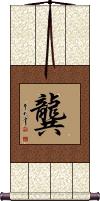
龔 is a Chinese surname that can be romanized as Gong or Kung.
From most of China, it would be Gong, but from Cantonese, it is often romanized as Kung.
In Korean, this could be a surname that romanizes as Gong or Kong and is now written as 공.
The original meaning of the character was something like, “to provide.”
Shaolin Kung Fu
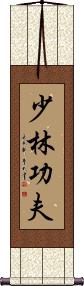
The Shaolin monks of China have been practicing the art of Kung Fu for thousands of years.
少林功夫 is the full title, “Shao Lin Kung Fu.”
Hung Gar
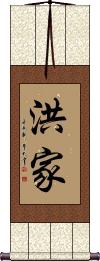
洪家 is the martial arts title Hung Ga or Hung Gar.
The first character means flood, big, immense, or great but it can also be the surname, Hong or Hung.
The last character means family or home.
This can also be read as “The Hung Family” or “The Hung Household.” This title is mostly associated with a style of Kung Fu.
Kung Fu Panda
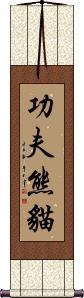
This is the title Kung Fu Panda in Chinese.
Kung / Gong / Mitsugi
Surname
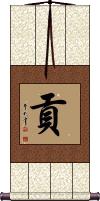
貢 is a Chinese surname that can romanize as Gong from Mandarin or Kung from Cantonese.
In Japan, this can be the surname or given name Mitsugi.
The meaning of this is tribute or gifts.
Drunken Monkey Kung Fu
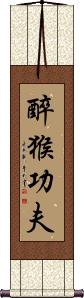
醉猴功夫 is the title for Drunken Monkey Kung Fu (Gong Fu).
The martial arts style was inspired by the novel, “Journey to the West.”
See Also: Monkey Fist
Qi Gong / Chi Kung
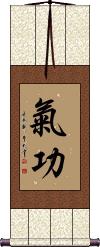
氣功 or Qigong is the title of a technique that is somewhere between medical practice, meditation, and in some cases, religion.
The definition is blurred depending on which school of Qigong you are following. In some cases, it is even incorporated with martial arts.
Some people (even Chinese people) mix this title with Tai Chi (Tai Qi) exercises.
Lately, in China, people will claim to practice Tai Chi rather than Qigong because the Qigong title was recently used as a cover for an illegal pseudo-religious movement in China with the initials F.G. or F.D. (I can not write those names here for fear of our website being banned in China).
You can learn those names and more here: Further info about Qigong
If you are wondering why I wrote “Qi Gong” and “Chi Kung” as the title of this calligraphy entry, I should teach you a little about the various ways in which Chinese can be Romanized. One form writes this as “Chi Kung” or “Chikung” (Taiwan). In the mainland and elsewhere, it is Romanized as “Qi Gong” or “Qigong.” The pronunciation is the same in Taiwan, mainland, and Singapore Mandarin. Neither Romanization is exactly like English. If you want to know how to say this with English rules, it would be something like “Chee Gong” (but the “gong” has a vowel sound like the “O” in “go”).
Romanization is a really confusing topic and has caused many Chinese words to be mispronounced in the west. One example is “Kung Pao Chicken,” which should actually be more like “Gong Bao” with the “O” sounding like “oh” for both characters. Neither the Romanization system in Taiwan nor the Mainland is perfect, in my opinion, and leads to many misunderstandings.
In modern Japan, you may see this written as 気功, but the original 氣功 is still recognized. If you need the Japanese version, please contact me.
Tai Chi Wing Chun Kung Fu
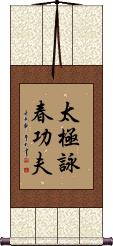
太極詠春功夫 is the title Tai Chi Wing Chun Kung Fu.
Please note that it can be romanized in a variety of ways such as:
Tai Chi Ving Tsun Kung Fu
Tai Qi Yong Chun Gong Fu
Taai Gik Wing Ceon Gung Fu
Be sure this is the right title for what you are looking for before you order.
Laughing Dragon Kung Fu
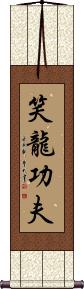
笑龍功夫 is the title for a Martial Arts studio (custom-made at by request of the owner of the studio).
Kung Fu San Soo / San Shou
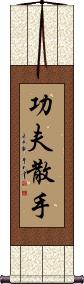
功夫散手 is a martial arts title.
Oddly, there are multiple ways two spell/romanize this in English, but in Chinese, it's written exactly the same.
Technically, the Mandarin romanizes as “gong fu san shou,” for which you'll sometimes see it written “kung fu san shou” (k'ung is an old romanization for a word that sounds like gong with a vowel sound like “oh”).
There is another martial arts style that spells this “Kung Fu San Soo.” I guess this was supposed to approximate Cantonese pronunciation for which the scholarly romanization is generally agreed to be “gung fu saan sau.”
Kung Fu / Gong Fu
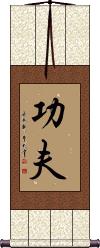
功夫 or Kung Fu is one of the most famous types of martial arts in the world - and not just because of Bruce Lee.
Some translate the meaning as “Accomplishment by Great Effort.” I think this is partially true, but directly translated, it literally means “Merit/Achievement/Accomplishment Man.” The word “fu” can sometimes mean “husband” or “porter,” but in this case, it can only mean “man.” However, few in China will think “man” when they hear the word “Gong Fu” spoken.
This term is also used for things other than martial arts. In fact, it's used to refer to a person with excellent skills in crafts that require a lot of effort to master, such as cooking, tea ceremonies, and calligraphy.
What a lot of people don't know is that the spelling of “Kung Fu” was actually taken from the old Wade Giles form of Romanization. Using this method, the sounds of the English “G” and “K” were both written as “K” and an apostrophe after the “K” told you it was supposed to sound like a “G.” Nobody in the west knew this rule, so most people pronounce it with a “K-sound.” And so, Gong Fu will always be Kung Fu for most westerners.
Also, just to educate you a little more, the “O” in “Gong” has a sound like the English word “oh.”
The popular Chinese dish “Kung Pao Chicken” suffers from the same problem. It should actually be “Gong Bao Chicken.”
Historical note: Many will claim that Kung Fu was invented by the monks of the Shaolin monastery. This fact is argued in both directions by scholars of Chinese history. Perhaps it is more accurate to say that the Shaolin Monks brought the original fame to Kung Fu many generations ago.
Japanese note: While most Japanese martial artists will recognize these characters, Katakana is more often used to approximate the pronunciation of "Kung Fu" with "カンフー." Some will argue as to whether this should be considered a Japanese word at all.
See Also: Bruce Lee
Shaolin
Little Forest
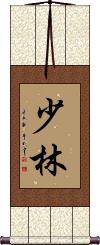
The 少林 or Shaolin monks of China have been practicing the art of Kung Fu for thousands of years. While there are many schools of Kung Fu in China, Shaolin are one of the more religiously devout and disciplined.
The title of Shaolin actually refers to a specific Buddhist monastery. It should be noted that the Shaolin were famous in China long before the Kung Fu TV show. Their fame in China is due to the monks' heroic and swift rescue of an emperor during the Tang Dynasty. Most Chinese people are not keenly aware of the Kung Fu TV show and have no idea who David Carradine is or anything about his character, Kwai Chang Caine.
Note: The literal meaning of 少林 is “little forest.”
The fame of the Shaolin has spread all over Asia, as even though this is a Chinese title, the same characters are used in Japanese with the same meaning.
Martial Arts / Wushu
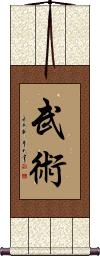
武術 is Wushu or Wu Shu, the very Chinese way to express “Martial Arts.”
Some even use this word to describe Kung Fu directly. But this is a label that fits all disciplines from Karate to Kung Fu to Taekwondo.
Note: This also means Martial Arts with the same appearance as old Korean Hanja characters and is pronounced “musul” or “musur” in Korean.
While this is best if your audience is Chinese or Korean, this also means “martial arts” in Japanese, where the popularity of this term is growing (romanized as Bujutsu or Bujitsu) in Japanese martial arts circles.
Inner Strength
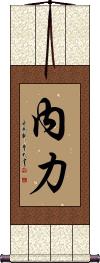
內力 is the shorter version of inner strength (can also be translated as “internal force”). The first character holds the meaning of “inner” or “internal.” The second character means “power,” “force,” or “strength.”
內力 is a Kung Fu way of talking about an inner power or strength from within. This is a way to express “inner chi.” This is something that you might hear in a real Chinese Kung Fu movie.
While understood in Chinese and Japanese, this can have a secondary meaning of “inner stress” in Japanese.
Shaolin Generational Poem
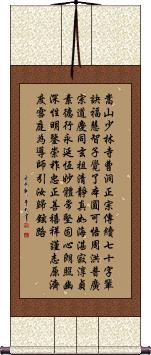
This is a poem, including a title, that celebrates the tactics and virtues of the Shaolin Kung Fu Monks for future generations.
Monkey Fist
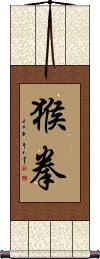
猴拳 literally means what you think, it's the “Monkey Fist” school of Kung Fu. A style that mimics the punches and movements of monkeys and apes.
Becoming popular during the Qing Dynasty, this style can trace its origins back to as early as the Song Dynasty. Some of the romance and popularity of this style comes from the novel “Journey to the West” which features the Monkey King and his fighting skills.
This novel and martial arts style has spawned a stream of Hong Kong movies featuring the Monkey King and other Kung Fu style variations such as “Drunken Monkey” and “Monkey Stealing Peaches” (a technique of disabling your opponent by grabbing and yanking on his testicles).
Note: This kind of makes sense in Korean Hanja and Japanese Kanji but probably unknown by all Koreans and Japanese except those who have an interest in this form of Kung Fu.
Neijing
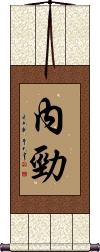
內勁 is Neijing or Nei Jing, the Kung Fu technique of using the conscious control of the practitioner's “qi” or “life energy” to gain advantages in combat.
The Five Animals
Dragon Snake Tiger Leopard Crane
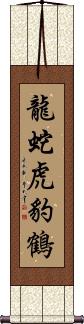
龍蛇虎豹鶴 is a list of the Chinese characters for the five animals of Shaolin Kung Fu in a comfortable order (meaning that they are in the proper order and will “feel right” to a Chinese person who views this arrangement).
Wu Xing Fist
Five Forms Fist of Kung Fu
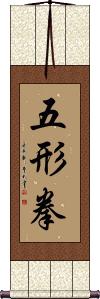
五形拳 is “Wu Xing Fist” or “Five Form Fist.”
The forms refer to Dragon, Snake, Tiger, Crane, and Leopard.
This term is used in Kung Fu, and is recognized by both Chinese and Japanese practitioners of martial arts.
Shaolin Chuan / Shao Lin Quan
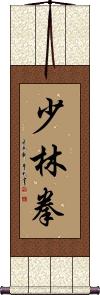
少林拳 is the title of the martial art (style of Kung Fu) that is taught to the monks and students in the Shaolin Buddhist Monastery.
The addition of Chuan or Quan, which means fist is what signifies that you are talking about this school or form of martial arts.
Wudang Fist
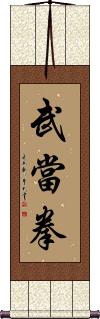
武當拳 means Wudang Quan or Wudang Fist.
Wudang (sometimes romanized as Wutang or Wu Tang) refers to a Mountain range in northwest Hubei. The Wudang martial arts style refers to a version of Shaolin Kung Fu.
Warrior Essence / Warrior Spirit / Martial
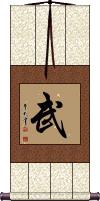
武 is the essence or spirit of a warrior. 武 is part of the word “wu shu” which is sometimes translated as “martial arts” or “kung fu.”
In more modern speech and another context, this can mean military, martial, warlike, fierce, and perhaps violent but usually as a prefix for a longer word or phrase.
Drunken Monkey
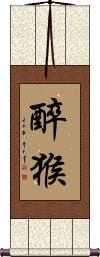
醉猴 is the short title for Drunken Monkey (often used as a title for a style of martial arts or kung fu which mimics the movements of a drunk monkey).
This martial arts style was inspired by the novel, “Journey to the West.”
See Also: Monkey Fist
Kajukenbo Slogan
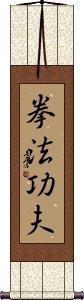
拳法功夫 is the Japanese slogan associated with Kajukenbo.
There is no way to write Kajukenbo in Japanese (as the “ka” for karate cannot be separated from the “kara” character it is supposed to represent - among a few other language issues). This slogan which reads, “fist law, kung fu” is often written on banners and patches for Kajukenbo clubs or dojos.
Monkey Fist
Saruken
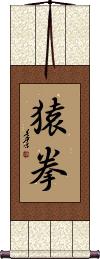
猿拳 is the Japanese martial arts title, “Monkey Fist,” referring to Monkey-Style Kung Fu.
猿拳 is very similar to a Chinese term that uses a different first character (the characters for ape and monkey were reversed when Japan borrowed Chinese characters, so this would be “Ape Fist” if a Chinese person read it).
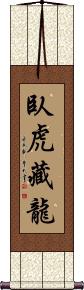
臥虎藏龍 is the movie title of the Kung Fu epic that was very popular in the west a few years back.
This is a re-ordering of an ancient Chinese proverb that refers to undiscovered talents.
The movie was one of the most popular Chinese foreign films to ever debut in the USA but received a lukewarm reception in China.
Note: This can be pronounced in Korean, but it's not a commonly used term.
Drunken Fist
(A legitimate style of Kung Fu)
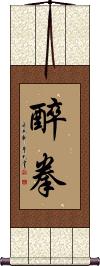
醉拳 is Drunken Fist, a traditional Chinese martial art/technique of Kung Fu.
It is a northern style of martial art that imitates a drunk person in its movements. Many staggering movements serve to deceive the opponent and keep them off-balance.
Some consider Drunken Fist to be among the more complex styles of martial arts due to the need for robust joints and fingers.
See Also: Drunken Monkey
Shaolin Temple
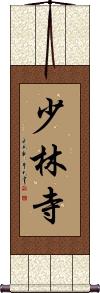
少林寺 is the full title of the Shaolin Temple.
This refers to the Buddhist monastery famous for its kung fu monks.
少林寺 is also known in Japanese, where they use the same characters but romanize them as Shourinji or Shōrinji.
Some believe this monastery and temple represent where Bodhidharma sat with his face to a wall for nine years, leading to his discovery of enlightenment and the establishment of Buddhism in China.
Jackie Chan
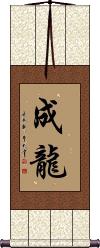
 成龍 is the Chinese and Japanese stage name of Jackie Chan, a Kung Fu film and Cantonese pop star icon.
His birth name was 陳港生 (romanized as Chan Kong-sang or Can Gong-sang in Cantonese, or Chén Gǎng-shēng in Mandarin.
Five Families / Tsoi Li Hoi Fut Hung
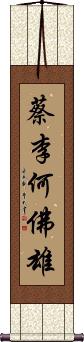
蔡李何佛雄 is the five families associated with San Soo Kung Fu.
The characters are always the same, but there are several ways these are romanized from Cantonese, Mandarin, and other dialects. Some common ones include Tsoi Li Hoi Fut Hung and Choi Li Ho Fut Hung.
If you are using a different romanization, that does not mean it's wrong. It might just be that your school is using a different dialect or romanization scheme.
Kenpo / Kempo / Quan Fa / Chuan Fa
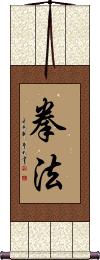
拳法 is a form of martial arts that can be translated in several ways.
Some will call it “fist principles,” “the way of the fist,” or even “law of the fist.” The first character literally means fist. The second can mean law, method, way, principle, or Buddhist teaching.
Kempo is really a potluck of martial arts. Often a combination of Chinese martial arts such as Shaolin Kung Fu with Japanese martial arts such as Karate, Jujutsu (Jujitsu), Aikido, and others. You may see the term “Kempo Karate,” which basically means Karate with other disciplines added. In this way, Kempo becomes an adjective rather than a title or school of martial arts.
These facts will long be argued by various masters and students of Kempo. Even the argument as to whether it should be spelled “kenpo” or “Kempo” ensues at dojos around the world (the correct Romaji should actually be “kenpou” if you precisely follow the rules).
The benefit of Kempo is that the techniques are easier to learn and master than pure Kung Fu (wu shu). Students are often taught basic Karate moves, kicks, and punches before augmenting the basic skills with complex Kung Fu techniques. This allows students of Kempo to achieve a level where they can defend themselves or fight in a relatively short amount of time (a few years rather than a decade or more).
Because the definition of this word is so fluid, I should make some notes here:
1. Purists in Okinawa will claim that “Okinawa Kenpo” or “Ryukyu Hon Kenpo” is the original and true version of this martial art from the old kingdom. It is actually little or no connection between Okinawa Kenpo and the way the word is used elsewhere.
2. In Chinese, where these characters are pronounced “quan fa” (sometimes Romanized as “chuan fa” because the Chinese-pinyin “q” actually sounds like an English “ch” sound), these characters do not hold the connotation of being a mixed martial art. It is simply defined as “the law of the fist.”
3. My Japanese dictionary oddly defines Kenpo as the “Chinese art of self-defense.” I personally don't feel this is the most common way that people perceive the word but just something you should know.
Strong bones come from hard knocks
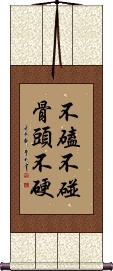
不磕不碰骨頭不硬 is a Chinese proverb that literally translates as: Without being knocked around a bit, [one's] bones won't become hard.
Figuratively, this means: One can't become strong without first being tempered by “hard knocks.”
While true for everyone, this sounds like the “Iron Body” form of Kung Fu, where practitioners' bodies are beaten (and often bone fractured) in order to become stronger.
For the rest of us, this is just about how we can be tempered and build character through the hardships in our lives.
This is not a common title for a wall scroll in China.
Black Belt
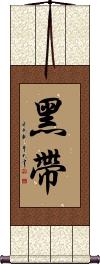
黑帶 is “black belt” in Chinese.
Many will argue whether rank systems that include a “black belt” are used in pure Chinese martial arts systems. The argument goes that it's more a Japanese idea merged into the western versions of Chinese martial arts. However, in Wushu (often referred to as Kung Fu), it's said that all students started with white belts. Over the years of training, the white belt would get dirty until finally appearing black with filth. Thus, more advanced students had darker belts.
If you want this title in Chinese, this would be the form.
 Often, the second character is written like the image to the right. If you like this version, click on this character instead of the button above.
Tang Soo Do / Tang Hand Way
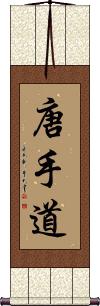
唐手道 is the alternate title for Karate-do.
This title uses a character, 唐, which represents the Tang Dynasty of China. Thus, this is often translated as the “Tang Hand Way” or incorrectly, “Tang Fist Way.”
I have also seen some call it “China Hand Way.”
Many in Korea refer to and romanize these characters as “Tang Soo Do” (당수도) where these characters refer to a kind of Korean style of Karate.
There is not a lot of information on this title but some believe that a simplified form of Kung Fu that started in China and ended up very popular in Japan used this title initially. It was later changed in Japan to a different Karate title which means “Empty Hand” (as in, without weapons).
Note: When used in Korean, this is pronounced 당수도. This title is often romanized as “Tang Soo Do,” “Tangsudo,” “Dang Su Do,” or “Dangsudo.” The last two romanizations on that list are the official Korean government romanization, though martial arts schools tend to use other non-standard versions.
Bravery / Courage
Courageous Energy
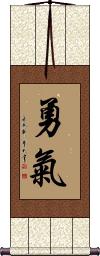
勇氣 is one of several ways to express bravery and courage in Chinese, Japanese, and Korean.
This version is the most spiritual. This is the essence of bravery from deep within your being. This is the mental state of being brave versus actual brave behavior. You'd more likely use this to say, “He is very courageous,” rather than “He fought courageously in the battle.”
The first character also means bravery or courage when it's seen alone. With the second character added, an element of energy or spirit is added. The second character is the same “chi” or “qi” energy that Kung Fu masters focus on when they strike. For this reason, you could say this means “spirit of courage” or “brave spirit.”
This is certainly a stronger word than just the first character alone.
Beyond bravery or courage, dictionaries also translate this word as valor/valour, nerve, audacity, daring, pluck, plucky, gallantry, guts, gutsy, and boldness.
This is also one of the 8 key concepts of tang soo do.
 While the version shown to the left is commonly used in Chinese and Korean Hanja (and ancient Japanese Kanji), please note that the second character is written with slightly fewer strokes in modern Japanese. If you want the modern Japanese version, please click on the character to the right. Both styles would be understood by native Chinese, Japanese, and many (but not all) Korean people. You should make your selection based on the intended audience for your calligraphy artwork. Or pick the single-character form of bravery/courage which is universal.
Shorinji Kempo / Kenpo
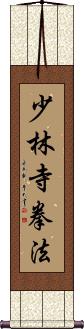
少林寺拳法 is a specific type of martial art in Japan that claims origins in the Kung Fu practiced in the original Shaolin Monastery of China.
The first three characters mean “Shaolin Monastery,” and you might notice the Japanese is pronounced in a very similar way. The reason is, many words were “borrowed” from the original Chinese when Japan did not have a written language and simply absorbed Chinese characters into their language around the 5th century. When a Japanese word did not exist, the Chinese pronunciation was often absorbed as well as the written form.
The last two characters mean “fist law” or “method of the fist.” It has long been argued as to whether the Japanese for these characters should be Romanized as “kempo” or “kenpo.” The official method should be “kenpou” but it's common to drop the “u” that comes after the “o.”
I imagine if you are looking for this title, you already know what it means, so the above is simply extra information that a student of Shorinji Kempo might want to know.
Sword
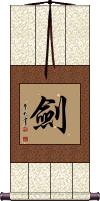
劍 is pronounced “jian” in Chinese. When you say it, imagine that you are making the sound of a sword as it clashes with a metal shield. This might get you closer to the correct pronunciation in Chinese.
I actually wonder if this word came from the metallic ringing sounds of a sword in battle - but such knowledge is lost in history.
The sword is a symbol of a warrior. The one thing that a soldier in ancient China lived and died by. A warrior with his skills and sword proves himself of great value. A warrior who losses his sword instantly becomes worthless.
劍 is an excellent scroll for someone in the military (especially officers of all services - as well as enlisted NCO Marines since they still carry swords even if mainly for ceremonial purposes). Or perhaps someone who practices variations of kung fu or tai chi that involve weapons.
Please note that while this character is understood with the sword meaning in Japanese, you might be looking for the word “katana” which also means sword in Japanese but means “knife” in Chinese.
There are other ways to write sword, and here are a few...


If you are particular about the version you receive, please let me know when you place your order (Note: Special styles are only available from one of our master calligraphers).
Life Energy / Spiritual Energy
Chi Energy: Essence of Life / Energy Flow
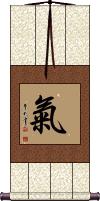
This 氣 energy flow is a fundamental concept of traditional Asian culture.
氣 is romanized as “Qi” or “Chi” in Chinese, “Gi” in Korean, and “Ki” in Japanese.
Chi is believed to be part of everything that exists, as in “life force” or “spiritual energy.” It is most often translated as “energy flow” or literally as “air” or “breath.” Some people will simply translate this as “spirit,” but you must consider the kind of spirit we're talking about. I think this is weighted more toward energy than spirit.
The character itself is a representation of steam (or breath) rising from rice. To clarify, the character for rice looks like this: 
Steam was apparently seen as visual evidence of the release of “life energy” when this concept was first developed. The Qi / Chi / Ki character is still used in compound words to mean steam or vapor.
The etymology of this character is a bit complicated. It's suggested that the first form of this character from bronze script (about 2500 years ago) looked like these samples: 

However, it was easy to confuse this with the character for the number three. So the rice radical was added by 221 B.C. (the exact time of this change is debated). This first version with the rice radical looks like this: 
The idea of Qi / Chi / Ki is really a philosophical concept. It's often used to refer to the “flow” of metaphysical energy that sustains living beings. Yet there is much debate that has continued for thousands of years as to whether Qi / Chi / Ki is pure energy or consists partially or fully of matter.
You can also see the character for Qi / Chi / Ki in common compound words such as Tai Chi / Tai Qi, Aikido, Reiki, and Qi Gong / Chi Kung.
In the modern Japanese Kanji, the rice radical has been changed into two strokes that form an X.
The original and traditional Chinese form is still understood in Japanese, but we can also offer that modern Kanji form in our custom calligraphy. If you want this Japanese Kanji, please click on the character to the right instead of the “Select and Customize” button above.
More language notes: This is pronounced like “chee” in Mandarin Chinese, and like “key” in Japanese.
This is also the same way to write this in Korean Hanja where it is Romanized as “gi” and pronounced like “gee” but with a real G-sound, not a J-sound.
Though Vietnamese no longer use Chinese characters in their daily language, this character is still widely known in Vietnam.
See Also: Energy | Life Force | Vitality | Life | Birth | Soul
Fatal error: Cannot redeclare foreignPrice() (previously declared in /home/gwest/web/chinesescrollpainting.com/public_html/includes/currencyconverter.php:22) in /home/gwest/web/orientaloutpost.com/public_html/includes/currencyconverter.php on line 22