Buy a Determination Chinese/Japanese Scroll
Buy custom artwork with Determination characters on a wall scroll or portrait here...
2. Dedication
3. Passionate Love / Ardent Love and Devotion
4. Desire
8. Diligence
9. Enthusiasm
13. Motivation
14. Romantic Passion
16. Enthusiasm / Passion for a Cause
17. Pleasure
Determination
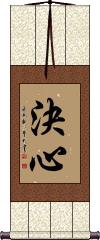
決心 is a Chinese, Japanese, and Korean word that holds the dictionary definition of determination but literally means determined heart.
The first character means to determine or determined.
The second character means heart, mind, or soul, so you can imagine that this form of determination partially means putting your heart into something. It can also be translated as resolve, resolution, or decision (as in a decision made and followed).
See Also: Devotion | Tenacious | Passion | Dedication | Will-Power
Dedication
Dedicated to One Thing
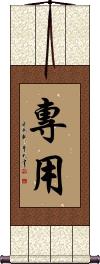
專用 is the dedication you might have to your job or a person.
Trivia: It is the same word used as an adjective in front of the word for “network” to say “dedicated network” in Chinese.
Please note: While this is a word in Korean, the meaning is private or “exclusive use.” So this is best if your audience is Chinese.
See Also: Devotion | Passion | Tenacious | Commitment
Dedication
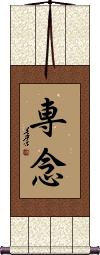
専念 is the Japanese word for dedication.
It means “give undivided attention” or “devote oneself to (something).”
Note: This can be pronounced in Korean, but it's not a commonly used term.
See Also: Devotion | Passion | Tenacious | Commitment
Passionate Love / Ardent Love and Devotion
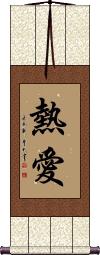
熱愛 means love passionately, ardent love, devotion, adoration.
The literal meaning is “hot love,” as the first character means heat, fervent, hot, and warm. Sometimes it can mean fever, restlessness, or zeal. The second character is, of course, love. If you adore and are devoted to someone with all your love, this is the title for you.
Desire
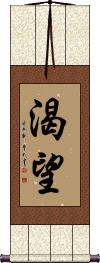
This Chinese word can mean desirous, wishful, or desire.
The first character means to thirst for [something] or to be thirsty. The second character means to hope for, to expect, to gaze (into the distance), or to look for something. The combined meaning of these two characters changes a bit, but I think it's nice to know the individual meanings to give you a better understanding of where a word comes from.
Korean definitions of this word include craving, longing, and thirst for knowledge.
Desire / Longing / Craving
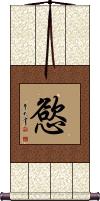
慾 means desire, longing, appetite, wish, covetousness, greed, passion, desire, avarice, and craving.
慾 is universal in Chinese, Japanese Kanji, and Korean Hanja.
The context in which this character is used determines whether the meaning is good or bad. As a single character on a wall scroll, you get to decide what the definition is to you (hopefully more toward desire than greed).
 Please note that Japanese use a simplified version of this character - it also happens to be the same simplification used in mainland China. Click on the character to the right if you want the Japanese/Simplified version of desire.
Desire / Craving
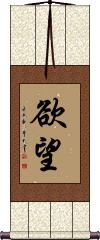
欲望 is a word that means strong desire, while some might translate it as “lust.”
The first character of this word means desire, longing, hunger, covetousness, greed, passion, desire, craving, or wish. The second character means to hope for, ambition, desire, aspire, expect, gaze (into the distance), or look for something.
Desire / Wish / Aspiration
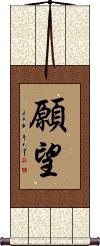
願望 means desire, wish, or aspiration in Chinese and Japanese.
Diligence
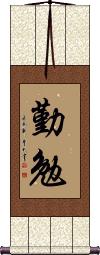
勤勉 can be translated as diligence, industrious, assiduity, assiduous, diligent, or sedulity.
Diligence is working hard and doing your absolute best. You take special care by doing things step by step. Diligence helps you to get things done with excellence and enthusiasm. Diligence leads to success.
See Also: Hard Work | Tenacity | Commitment | Passion for a Cause
Enthusiasm
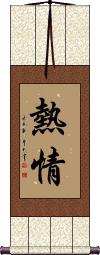
熱情 is a Chinese and Korean word for enthusiasm that can also be translated as passion (for a cause), ardency, ardor/ardour, enthusiasm, or zeal.
Enthusiasm is being warm, cheerful, happy, and full of spirit. It is doing something wholeheartedly and eagerly. When you are enthusiastic, you have a positive attitude.
In some contexts, this could mean being extremely fond of something or having a fondness for a cause or person.
This Chinese word can also be translated as "sincere and warm" or literally "warm sentiment / affection."
See Also: Motivation | Passion | Commitment | Tenacity
Evil Cause, Evil Result
Meaning: You reap what you sow
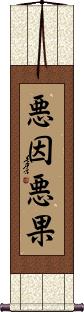
悪因悪果 is a Japanese proverb that means “Evil cause, evil effect” or “Bad causes bring bad results.”
The English equivalent is probably, “Sow evil and reap evil” or more commonly, “You reap what you sow.”
Note: 悪因悪果 is also considered to be a Buddhist phrase encompassing the idea of karmic retribution.
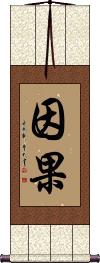
Karma - Cause and Effect
Lust / Desire / Passion
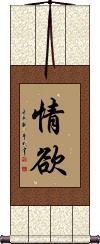
情欲 can be defined as lust, sexual desire, sensual desire, carnal desire, carnal passions, sexual desire, and passion.
The first character means feeling, emotions, passionate, sympathy, affection, love, compassion, tender feelings, and sometimes circumstances or facts.
The second character means desire, longing, appetite, wish, covetousness, greed, passion, desire, and craving.
This word is universal in Chinese, Japanese Kanji, and Korean Hanja.
Motivation
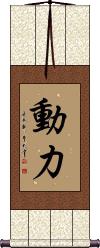
動力 can be used for motivation - it can also mean power/motion/propulsion/force. It can be anything internal or external that keeps you going.
動力 is the safest way to express motivation in Chinese. If your audience is Japanese, please see the other entry for motivation. 動力 is a word in Japanese and Korean, but it means “motive power” or “kinetic energy” (without the motivation meaning that you are probably looking for).
See Also: Enthusiasm | Passion
Motivation
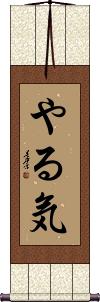
やる気 means motivation in Japanese.
It also can be translated as willingness (e.g., to do something), eagerness, inspiration, determination, totally willing, fully motivated, and high aspirations.
Note: Because this selection contains some special Japanese Hiragana characters, it should be written by a Japanese calligrapher.
See Also: Enthusiasm | Passion
Romantic Passion
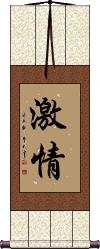
Beyond romantic passion, 激情 also means “strong emotion” or “fervor.”
The meaning in Japanese is a little more radical, as beyond "passion" it can be understood as "violent emotion" or "fury."
Passion for a Cause
Depending on the context, 熱情 can mean “cordial,” “enthusiastic,” “passionate,” or “passionately.”
This version is sometimes used in Japanese, but the character order is more common in Chinese and Korean Hanja. The meaning in Japanese for this Kanji order is ardor/ardour or zeal but rarely used in modern Japan. I suggest you choose a different version of “passion” if your audience is Japanese.
See Also: Persistence | Devotion | Tenacity | Commitment | Motivation
Enthusiasm / Passion for a Cause
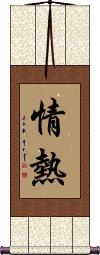
情熱 is the Japanese word that means enthusiasm or “passion for a cause.”
In some contexts, this could mean being extremely fond of something or having a fondness for a cause or person.
Can also be translated as passion, zeal, ardor/ardour, or fervor.
Note: This word (or character order) is not natural in Chinese. However, a typical Chinese person can guess this is a Japanese or Korean word and understand the intended meaning. This selection is best if your audience is Japanese or old-school Korean.
See Also: Persistence | Devotion | Tenacity | Commitment | Motivation
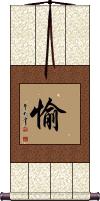
Pleasure
Fatal error: Cannot redeclare function foreignPrice() (previously declared in /home/gwest/web/chinesescrollpainting.com/public_html/includes/currencyconverter.php:22) in /home/gwest/web/orientaloutpost.com/public_html/includes/currencyconverter.php on line 22