Custom Faith / Devotion Chinese & Japanese Calligraphy Wall Scroll
We have many options to create artwork with Devotion characters on a wall scroll or portrait.
If you want to create a cool Devotion wall scroll, this is the place. Below you will find a few Asian symbols that express the idea of devotion.
1. Passionate Love / Ardent Love and Devotion
2. Devotion / Dedication / Attentive / Focused
3. Devotion / Diligence / Vigorous / Energetic
5. Devotion to your Profession / Career
6. Religious Devotion / Faith in God / Religious Faith
9. Sacrifice / Devotion / Dedication
12. Confidence / Faithful Heart
13. Dedication
14. Faith / Trusting in the Unseen
15. Faith is the bird that feels the light when the dawn is still dark
16. Faith Hope Love
17. Faith Love Peace
18. Faith
19. Good Intentions / Good Will / Good Faith
20. Faithful / Honorable / Trustworthy / Fidelity / Loyalty
21. Firm Belief / Strong Faith
23. Semper Fidelis / Always Faithful
25. Trust in God / Faith in God
26. Believe
28. Christian Friend
30. Determination
31. Dogen
32. Eishin-Ryu
33. Fidelity / Personal Integrity / Honor
36. Industrious / Hard Working
37. Honesty
39. Hope
40. John 3:16
41. Joshua 24:15
42. Karma
45. Loyalty
47. Namu Myoho Renge Kyo / Homage to Lotus Sutra
48. There is no god but Allah, and Muhammad is His Messenger
50. Enthusiasm / Passion for a Cause
51. Perseverance
52. Pure Heart
53. Pure Land / Jodo
54. Sangha
55. Self-Confidence
57. Spiritual Peace / Enlightened Peace
58. Daoism / Taoism
60. True Heart
61. Trust in God
62. Trust No One / Trust No Man
63. Trust in God / In God We Trust
Passionate Love / Ardent Love and Devotion
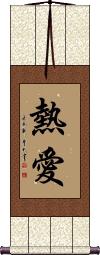
熱愛 means love passionately, ardent love, devotion, adoration.
The literal meaning is “hot love,” as the first character means heat, fervent, hot, and warm. Sometimes it can mean fever, restlessness, or zeal. The second character is, of course, love. If you adore and are devoted to someone with all your love, this is the title for you.
Devotion / Dedication / Attentive / Focused
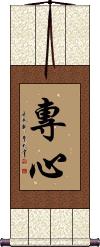
專心 makes a word that means “paying attention with your heart.”
It's often translated as “dedication,” as in “be absorbed in” or “concentrate one's efforts.” It's also used to mean “with the single mind,” “whole-heartedly,” “paying attention,” “undivided attention,” “concentration (-ed),” “engrossed,” “devotionally (listening/watching),” and/or “attentive.”
The first character means “for a particular person, occasion, or purpose,” “focused on one single thing,” “concentrated,” and sometimes, “special.”
The second character means “heart” or “mind” by itself.
My favorite translation, which comes from the Oxford Advanced Chinese/English Dictionary, is, “wholehearted devotion.”
If it seems like the meaning of this word is quite open, you are correct. The context in which the word is used matters a lot. It can mean different things depending on how you use it. This makes it kind of nice as you can decide what this means to you (within some limits). This is always positive in meaning, so even if a Chinese person reads it differently than you, it will still have a good meaning.
 In Japanese, they tend to use a variation of the second character which has one less stroke. If you want your calligraphy written this Japanese form, please click on the Kanji shown to the right instead of the button above. Note: Japanese and Chinese people will recognize either form.
See Also: Faith
Devotion / Diligence / Vigorous / Energetic
vīrya
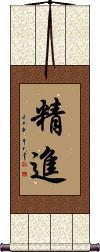
精進 is a wide-ranging word that is used in Chinese, Japanese, and Korean.
It can mean devotion, diligence, concentration, aggressive, enterprising, vigorous, energetic, purification, pushing, asceticism, assiduity, or virility. 精進 is deep, and these two characters can express ideas that take a full English phrase to describe, such as “concentration of mind,” “to forge ahead vigorously,” or “to dedicate oneself to progress.”
Used in the context of Buddhism, it means “making earnest efforts to cultivate virtue and get rid of evil” or “zeal in one's quest for enlightenment.”
Devotion / Enthusiasm
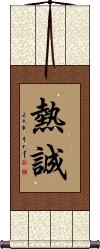
熱誠 is universal in Chinese, Japanese Kanji, and old Korean Hanja.
It can mean earnestness, enthusiasm, ardor, zeal, devotion, spirit, or fervor.
Devotion to your Profession / Career
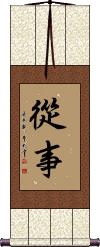
從事/従事 is often used to describe the devotion someone has to their profession - However, it can just mean career, depending on context.
We don't highly recommend this selection for a wall scroll.
In more simple terms, this word also means undertake / to deal with / to handle / to do. It does not have to refer to a career issue, as it could be used to encourage someone that is beginning their university studies etc.
This kind of makes sense in Japanese, however, there is a slight deviation in the way they write the first Kanji in Japanese.
 Please note that Japanese use an alternate version of the first character. Click on the character to the right if you want the Japanese version of this two-character Devotion-to-your-Profession calligraphy.
Religious Devotion / Faith in God / Religious Faith
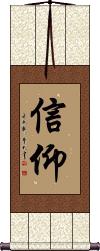
信仰 means firm belief, faith, persuasion, conviction, and sometimes religion or creed in Chinese, Japanese Kanji, and old Korean Hanja.
This clearly fits the religious connotation of the English word “devotion.”
This is often used to refer to a person of faith or a religious person.
This can be directly translated as “firm belief,” “creed,” “conviction,” or simply as “religious,” depending on context.
Some will also use this to mean “trust in God” in Japanese (though the term for God is not actually in this title).
It should be noted that this word is a little strange alone on a wall scroll.
While this can be pronounced in Japanese, it’s not a great selection for a wall scroll if your audience is Japanese.
See Also: Faith | Trust | Trust | Trust in God
Love and Devotion
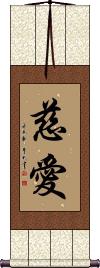
慈愛 refers to the kind of love and devotion you might have to your children or any loved one.
This especially applied to your children but could also be any member of your family - spouse, etc.
This can also be translated as affection, kindness, love, to love affectionately.
慈愛 is also used in a Buddhist context with the same meaning.
In Japanese, this can also be a female given name romanized as Yasue.
Loyalty / Devotion
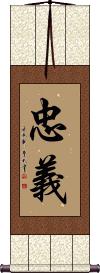
忠義 is another form of loyalty or devotion.
In Chinese, this is more specifically about being loyal and devoted to your friends.
In Japanese, this is more often used to mean loyalty to your country or nation.
Except for the slight difference noted above between Japanese and Chinese, this word is understood universally in Chinese, Japanese Kanji, and old Korean Hanja. It can also be used to describe devotion or fidelity.
It should be noted that this Kanji combination is being used less and less in modern Japan (this is a better choice if your audience is Chinese, though any Japanese person will clearly understand it).
Sacrifice / Devotion / Dedication
(complete bodily devotion)
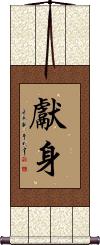
獻身 is used to describe being so devoted to something that you will make sacrifices for that goal/thing/person.
You can also translate this word as any of the following:
Sacrifice one's life for...
To dedicate oneself to...
Self-devotion
Dedication
Devote to...
Self-sacrifice
Giving your whole body to...
This can be a dedication to or for someone but is often used as a dedication or making sacrifices for your country, public service, or a cause. For instance, an Olympic athlete makes great sacrifices to train in his/her sport for their country and compatriots.

 While the form shown to the upper-left is considered an ancient Japanese version, in modern Japan, they use the simplified version of the first Kanji (shown to the right). Click on the Kanji at the right instead of the button above if you want this modern Japanese version.
If you are looking for a more religious meaning of devotion, see Faith.
See Also: Confidence | Dedication
Sincerity and Devotion
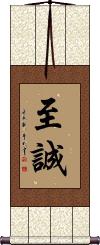
至誠 is the idea that you enter into something with the utmost sincerity and fidelity. Ideas such as devotion, honesty, and “one's true heart” are also contained in this word.
至誠 is a universal word as the Chinese, Japanese Kanji, and Korean Hanja are all identical.
Believe / Faith / Trust
śraddhā
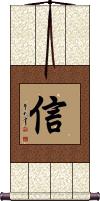
信 can mean to believe, truth, faith, fidelity, sincerity, trust, and confidence in Chinese, old Korean Hanja, and Japanese Kanji.
This single character is often part of other words with similar meanings.
It is one of the five basic tenets of Confucius.
In Chinese, it sometimes has the secondary meaning of a letter (as in the mail) depending on context but it will not be read that way when seen on a wall scroll.
In the Buddhist context, this is śraddhā (faith through hearing or being taught).
Confidence / Faithful Heart
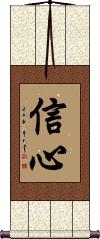
信心 is a Chinese, Japanese, and Korean word that means confidence, faith, or belief in somebody or something.
The first character means faith, and the second can mean heart or soul. Therefore, you could say this means “faithful heart” or “faithful soul.”
In Korean especially, this word has a religious connotation.
In the old Japanese Buddhist context, this was a word for citta-prasāda (clear or pure heart-mind).
In modern Japan (when read by non-Buddhists), this word is usually understood as “faith,” “belief,” or “devotion.”
See Also: Self-Confidence
Dedication
Dedicated to One Thing
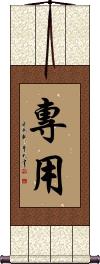
專用 is the dedication you might have to your job or a person.
Trivia: It is the same word used as an adjective in front of the word for “network” to say “dedicated network” in Chinese.
Please note: While this is a word in Korean, the meaning is private or “exclusive use.” So this is best if your audience is Chinese.
See Also: Passion | Tenacious | Commitment
Dedication
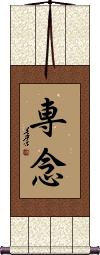
専念 is the Japanese word for dedication.
It means “give undivided attention” or “devote oneself to (something).”
Note: This can be pronounced in Korean, but it's not a commonly used term.
See Also: Passion | Tenacious | Commitment
Faith / Trusting in the Unseen
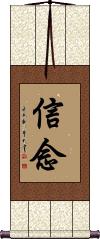
信念 expresses the idea of “having a belief” or “trusting in the unseen.”
信念 could also be translated as beliefs or convictions.
Note: Also considered to be one of the Seven Heavenly Virtues.
See Also: Dedication | Trust
Faith is the bird that feels the light when the dawn is still dark
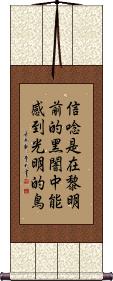
信唸是在黎明前的黑闇中能感到光明的鳥 is a philosophical poem/quote from Indian Poet and Philosopher, Rabindranath Tagore.
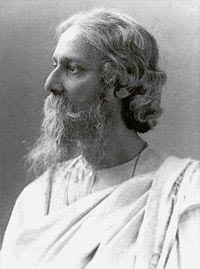
Rabindranath Tagore, 1915
This quote is not sourced, and therefore several variations exist in English. Some suggest the original was in the Bengali language.
This, of course, is the Chinese translation that has the meaning of, “Faith is the bird that feels the light and sings when the dawn is still dark.”
More about Rabindranath Tagore
Faith Hope Love
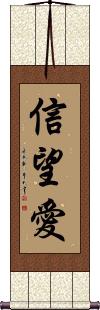
信望愛 is a Chinese list of words meaning faith, hope, and love.
This is not a typical phrase in Chinese but rather just random words strung together. There's no bad meaning, it's just not typical Chinese grammar.
Faith Hope Love
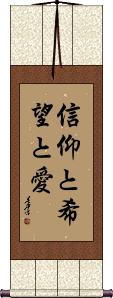
信仰と希望と愛 is a Japanese list of words (not really a phrase) meaning faith, hope, and love.
Some have associated this word list with Corinthians 13:13, though there are no specific religious connotations in this word list, and it's not directly from that Japanese Bible verse.
Note: Because this selection contains some special Japanese Hiragana characters, it should be written by a Japanese calligrapher.
Faith Love Peace
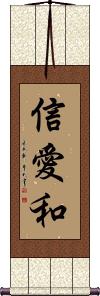
信愛和 is a word list that reads, “Faith Love Peace.”
This is not a natural phrase in Chinese or Japanese, as it lacks a subject, verb, or object. But if this is what you want, here it is.
Faith
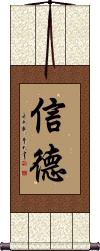
信德 is a term used often in Buddhism to express faith.
信德 is sometimes translated as the merit of the believing heart, faith of virtue, the power of faith, or virtuous faith.
In this context:
信 = Faith
德 = Virtue
Good Intentions / Good Will / Good Faith
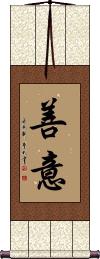
善意 is a word that means good intentions, goodwill, or to things done in good faith in Chinese, Japanese, and old Korean Hanja.
It's the reason you do good deeds or the desire you have inside yourself to do the right thing.
This can also be translated as benevolence, kindness, virtuous mind, positive mindset, or favorable sense.
善意 is also used in the legal context for things done in good faith (regardless of outcome).
In Japanese, this can be the personal name Yoshi or Yoshii.
Faithful / Honorable / Trustworthy / Fidelity / Loyalty
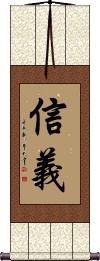
信義 is a word often used to describe a person with an honest and loyal reputation.
Simply put, this applies to somebody you can trust (with your life).
In Chinese, this is often defined as good faith, honor, trust, and justice.
In Korean, this word means fidelity, truthfulness, or faithfulness.
In Japanese: faith, fidelity, and loyalty. It's also a Japanese male given name when pronounced “Nobuyoshi.”
Firm Belief / Strong Faith
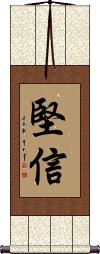
堅信 means to believe firmly, with firm faith, or without any doubt.
Japanese Christians sometimes use this term to mean the rite of confirmation.
This can also be the Japanese given name Kenshin.
Love Faith Strength
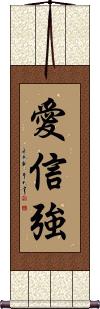
愛信強 is the shortest way to write the word list, “love faith strength.”
The first character is love, the second is faith or believe, and the third means strong or strength.
It should be noted that word lists like this are not as natural sounding in Chinese as word lists can be in English. it’s more common to have a full phrase (with subject, verb, and object) or single words on calligraphy wall scrolls in Asia.
Love Faith Strength
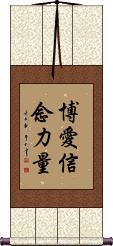
博愛信念力量 is the verbose way to write the word list, “love faith strength.”
It should be noted that word lists like this are not as natural sounding in Chinese as word lists can be in English. it’s more common to have a full phrase (with subject, verb, and object) or single words on calligraphy wall scrolls in Asia.
Semper Fidelis / Always Faithful
U.S. Marines Slogan
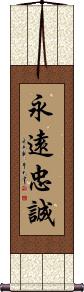
永遠忠誠 is the clearest and most natural way to translate “Semper Fidelis” or “Always Faithful” into Mandarin Chinese. 永遠忠誠 is meant explicitly for U.S. Marines who often use the shortened term “Semper Fi.”
The first two characters are a word that always means, forever, and/or eternally.
The last two characters are a word that means fidelity, loyal, and/or devotion.
I spent 10 years in the Marines, so it was a no-brainer to add this to our calligraphy database.
Trust / To Have Faith
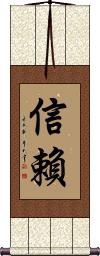
信賴 can also be translated as confidence, reliance, or dependence; thus, it can also mean “to rely on” or “to depend on.”
Trust is having faith in someone or something. It is a positive attitude about life. You are confident that the right thing will happen without trying to control or make it happen. Even when difficult things happen, trust helps us to find the gift or lesson in it.
 There is a slight deviation in the Japanese Kanji form of the second character. If you want the modern Japanese version, please click on the special Kanji shown to the right instead of the button above. Note that the traditional Chinese form is still readable and understood by Japanese people.
See Also: Confidence | Truth | Honor
Trust in God / Faith in God
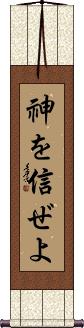
神を信ぜよ is a way to express “Trust in God” in Japanese.
The first character is “God.”
The second character is a particle that links the ideas here.
The last three characters are a word that means “to believe,” “to believe in,” “to place trust in,” “to confide in,” and “to have faith in.”
Basically, this is the Japanese phrase for “Have faith in God,” “Belief in God,” or “Trust in God.”
Note: Because this selection contains some special Japanese Hiragana characters, it should be written by a Japanese calligrapher.
Believe
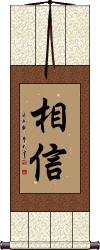
相信 is the Chinese way to say believe.
This specifically means to be convinced that something is true or to accept something as true or real.
This can also be translated as “convinced of,” “have trust in,” or “have faith in.”
Believe in Yourself
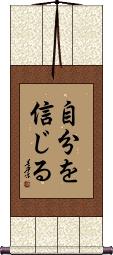
自分を信じる means “believe in yourself,” “have faith in yourself,” or “believe in myself” (can be myself or yourself depending on if you're saying it to yourself or someone else).
Note: Because this selection contains some special Japanese Hiragana characters, it should be written by a Japanese calligrapher.
Christian Friend
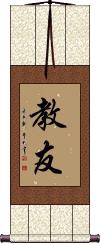
Depending on the context, 教友 can mean Christian or “friend of the same religion.”
While technically, it could be any religion, this is used mainly within the Christian faith. You can also translate this as “Christian friend” and, in some cases, “Church member.”
Christianity / Christian
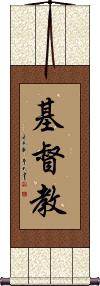
基督教 is the Chinese, Japanese and Korean word for “Christianity.”
Just as in English, this word is often used to mean “Protestant” but includes Catholics in the true definition.
It is the word used to refer to the whole “Christian religion” or “Christian Faith,” and therefore, it can be translated as “Christianity.” However, used as an adjective in regard to a person, it would translate as “Christian.” But more like saying, “His religion is Christianity,” rather than a noun form.
If you break it apart, the characters mean Base/Foundation Leading/Supervising Religion/Teaching. It makes more sense in Japanese, Chinese, and Korean. The first two characters together are translated as “Christ.” So you can also say this means “Christ's Religion” or “Christ's Teachings” when directly translated, or in reverse, “The Religion of Christ” or “The Teaching of Christ.”
Notes: The last character has a slight difference in one stroke - however, in calligraphic form, this will not be apparent. This entry can easily be read by any Korean person who knows Hanja characters (Chinese characters used in Korean).
See Also: Jesus Christ | God of Abraham
Determination
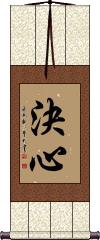
決心 is a Chinese, Japanese, and Korean word that holds the dictionary definition of determination but literally means determined heart.
The first character means to determine or determined.
The second character means heart, mind, or soul, so you can imagine that this form of determination partially means putting your heart into something. It can also be translated as resolve, resolution, or decision (as in a decision made and followed).
See Also: Tenacious | Passion | Dedication | Will-Power
Dogen
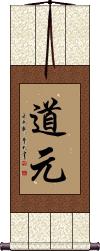
Usually, when people are looking for 道元 or “Dogen,” they are referring to the Japanese Zen monk by this name.
He lived from 1200-1253. This Dogen name or title literally means “The Way Origin” or “Beginning of the Path.” It is understood to mean “beginning of right doctrine or faith” in the context of his name and work to establish the Sōtō school of Zen in Japan.
To accomplish that task, this humble monk traveled from Japan and across China to find the more original or pure forms of Buddhism.
Eishin-Ryu
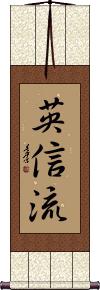
英信流 is the Japanese martial arts term, Eishin-ryu.
This can also be pronounced Hidenobu-ryu. The direct meaning is something like, hero faith school (or school of heroic faith).
Fidelity / Personal Integrity / Honor
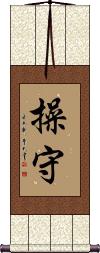
操守 is the Chinese and Japanese Kanji for personal integrity, constancy, fidelity, and honor/honour.
The original meaning of the first character is chastity, fidelity, honor, and/or faith.
The second character means to defend, guard, keep watch, and be observant.
So, this is about being observant of and guarding your integrity and honor.
Fragrant / Good Smell
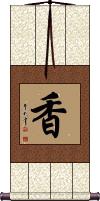
香 is the Chinese, Japanese Kanji, and old Korean Hanja that means: fragrant; sweet smelling; aromatic; savory; appetizing; perfume; incense; aroma; fragrance; scent; good smell.
Fragrance or incense is known to be one of the Buddha's messengers to stimulate faith and devotion.
Galatians 5:22-23

Here is Galatians 5:22 and a bit of 23 in Chinese.
The text with punctuation:
圣灵所结的果子,就是仁爱,喜乐,和平,忍耐,恩慈,良善,信实,温柔,节制。
Hand-painted calligraphy does not retain punctuation.
This translation is from the Chinese Union Bible.
You may know it from the KJV as:
5:22 But the fruit of the Spirit is love, joy, peace, longsuffering, gentleness, goodness, faith,
5:23 Meekness, temperance...
Industrious / Hard Working
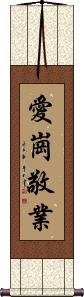
愛崗敬業 is used to refer to someone who puts forth maximum effort and achieves much.
We might call this kind of person a “go-getter” in English.
See Also: Dedication | Tenacious
Honesty
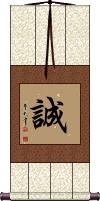
誠 means truth, faith, fidelity, sincerity, trust, and/or confidence.
As a single-character wall scroll, this suggests that you believe “honesty is the best policy,” as your personal philosophy.
This is also a virtue of the Samurai Warrior
See our page with just Code of the Samurai / Bushido here
Honesty / Fidelity
信 is another character that expresses the idea of honesty.
It can also mean truth, faith, belief in, fidelity, sincerity, trust, and/or confidence.
Some have included this in the list for the Bushido, although “makoto” is probably more common/popular.
Note: In some contexts, this character can mean a letter (mail), news, or envoy. However, alone, it will generally be read with the honesty-meaning.
See our page with just Code of the Samurai / Bushido here
See Also: Loyalty Trustworthiness Trustworthy
Hope
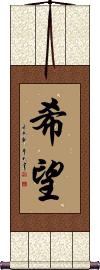
John 3:16

神愛世人甚至將他的獨生子賜給他們叫一切信他的不至滅亡反得永生 is the full translation of John 3:16 into Chinese.
This is from the Chinese Union Bible which comes from a revised version of the King James. This Chinese Bible was originally translated and printed in 1919 (several revisions since then).
Because of the origin being the KJV, I'll say that in English, this would be, “For God so loved the world, that he gave his only begotten Son, that whosoever believeth in him should not perish but have everlasting life.”
As with any translation, there are interesting cultural and linguistic issues. For instance, the word used for “world” in Chinese can also mean “common people.” So you could say that it means “For God so loved the common people...”
This does not take away from the text, as it will be understood with the same meaning and connotation.
There is no direct Greek-to-Chinese translation in print (that I know of), so this is the best available. Of course, you can ask any Greek person of faith, and they will claim that a bit is lost from the original Greek of the New Testament to any of the English versions of the Bible in print.
Joshua 24:15
This House Serves the LORD
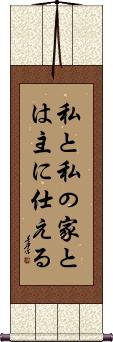
私と私の家とは、主に仕える is the last bit of Joshua 24:15 in Japanese.
Joshua 24:15 (KJV) ...as for me and my house, we will serve the LORD.
Joshua 24:15 (NIV) ...as for me and my household, we will serve the LORD.
This came from the Shinkaiyaku Japanese Bible. This is the most commonly-used Bible translation in Japan for both Protestants and Catholic Japanese folks.
I think it is a bit like having a secret code on your wall that quietly expresses to whom you are faithful.
This will be a nice gift for a friend or a wonderful expression of faith for your own home.
Note: Because this selection contains some special Japanese Hiragana characters, it should be written by a Japanese calligrapher.
Karma (of your past lives)
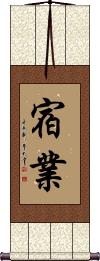
宿業 is the Buddhist concept of Past Karma. Simply put, it's the sum of all the good and bad from all previous lives (perhaps earlier in your current life). This term is not commonly used outside of the Buddhist faith (you'll have a tough time finding a non-Buddhist Asian person that knows this word).
Other ways to translate this are “The karma of previous existence,” “The karma remaining from prior existences,” or simply “Former karma.”
See Also: Buddhism
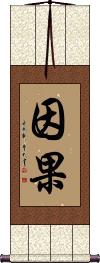
Karma - Cause and Effect
Love and Affection
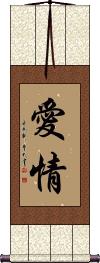
愛情 is a universal word in Japanese, Korean, and Chinese which means love and affection.
Some may translate this as “love between a man and a woman.”
Depending on the context, it can mean utter devotion or favorite.
Loyalty
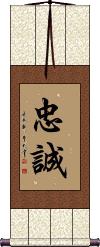
忠誠 is the written form of loyalty that is universal in Chinese, Japanese Kanji, and old Korean Hanja.
Loyalty is staying true to someone. It is standing up for something you believe in without wavering. It is being faithful to your family, country, school, friends, or ideals when the going gets tough and when things are good. With loyalty, you build relationships that last forever.
Notes:
1. There is also a Japanese version that is part of the Bushido Code which may be more desirable depending on whether your intended audience is Japanese or Chinese.
2. This version of loyalty is sometimes translated as devotion, sincerity, fidelity, or allegiance.
Namo Shakyamuni Buddha
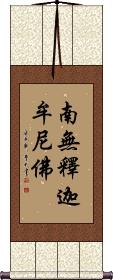
南無釋迦牟尼佛 is a Buddhist chant or prayer of respect to the Shakyamuni Buddha.
Some will translate this as the Buddhist vow.
The first two characters, 南無, are sometimes translated as “amen”; others will translate it as “belief in” or “homage to.”
To expand on this, 南無 can also mean “taking of refuge in” while representing devotion or conviction. 南無 as with most religious concepts or words, different people or denominations will have varying definitions.
Namu Myoho Renge Kyo / Homage to Lotus Sutra
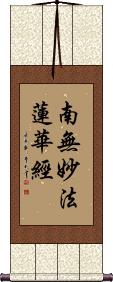
南無妙法蓮華經 is sometimes translated as the “Devotion to the Law of the Lotus Flower Scripture.”
This is a meditation chant and homage to the Lotus Sutra, used by Nichiren Buddhists in Japan.
This is also a chant used in China by certain sects of Buddhism that celebrate the deity Guanyin.
Also romanized as “Nam Myōhō Renge Kyō” or without accents as “Nam Myoho Renge Kyo.”


Original
Traditional
Version
The last character was originally written as seen on the left. Sometimes, you will see it written in the Japanese variant form as shown on the right. If you want this Japanese variant, click on the "Modern Japanese Variant" text instead of the button up by the main title of this entry.
There is no god but Allah, and Muhammad is His Messenger
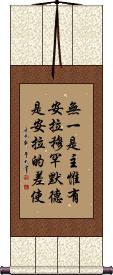
無一是主惟有安拉穆罕默德是安拉的差使 is one of the key creeds of Islam.
While perhaps more often seen in Arabic as
there are many native Chinese Muslims (especially the Hui ethnicity) that do not speak Arabic.
Instead, they use this Chinese phrase to express this idea or statement of faith.
Passion for a Cause
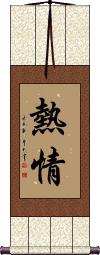
Depending on the context, 熱情 can mean “cordial,” “enthusiastic,” “passionate,” or “passionately.”
This version is sometimes used in Japanese, but the character order is more common in Chinese and Korean Hanja. The meaning in Japanese for this Kanji order is ardor/ardour or zeal but rarely used in modern Japan. I suggest you choose a different version of “passion” if your audience is Japanese.
See Also: Persistence | Tenacity | Commitment | Motivation
Enthusiasm / Passion for a Cause
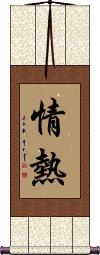
情熱 is the Japanese word that means enthusiasm or “passion for a cause.”
In some contexts, this could mean being extremely fond of something or having a fondness for a cause or person.
Can also be translated as passion, zeal, ardor/ardour, or fervor.
Note: This word (or character order) is not natural in Chinese. However, a typical Chinese person can guess this is a Japanese or Korean word and understand the intended meaning. This selection is best if your audience is Japanese or old-school Korean.
See Also: Persistence | Tenacity | Commitment | Motivation
Perseverance
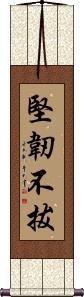
堅韌不拔 is about perseverance, being steadfast and persistent.
堅韌不拔 is a great phrase for you if you commit to your goals and overcome obstacles, no matter how long it takes.
The translation of this proverb literally means “something so persistent or steadfast, that it is not uprootable, movable, or surpassable.”
Other translations include being firm and indomitable or tenacious and unyielding.
See Also: Tenacious | Persistence | Indomitable
Pure Heart
Pure and Innocent
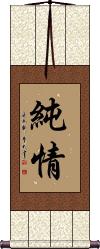
純情 means “Pure Heart” in Chinese, Japanese Kanji, and old Korean Hanja.
It's used to reflect the ideas of being “pure and innocent.”
Depending on the context in which this title is used, it can relay “self-sacrificing devotion” or, in some cases, “naïveté.”
This would be in the same way we might refer to a young girl giving her lunch money to a beggar on the street. She has a pure and precious heart but perhaps is also a bit naive.
Pure Land / Jodo
Also a sect of Buddhism
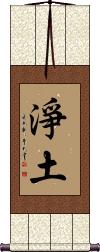
淨土 literally means “pure land” or “clean earth.”
淨土 is also the abbreviated title of a Buddhist sect that involves faith in the rebirth of Buddha Amitabha (Amitābha) in the Western Heaven. Sometimes this sect is translated as “Paradise of the West.” Other titles of this school of Buddhism include Amidism or Elysium.
See Also: Nirvana | Shin Buddhism
Sangha
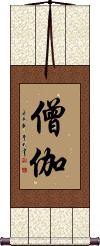
In Buddhism, 僧伽 refers to a community of monks and/or nuns (one of the “Three Jewels”). In general terms, it can simply mean “all followers of the Buddha.”
Notes: Though there are not vast numbers of Chinese Hindus, in the Hindu faith, this term means “community together.”
The original Sanskrit word is also Romanized as samgha.
The first character means “monk.” The second character means Buddha or Shakyamuni.
僧伽 is a transliteration of the original Sanskrit, but it uses two very profound Chinese characters related to Buddhism.
Some may pronounce this as “seng qie” or “seng jia” in Mandarin (two possible pronunciations for the second character). Note that “qie” sounds like “chee-ah” using typical English pronunciation. Chinese Romanization is not actually designed to match English sounds.

 Note that when writing this as Kanji, Japanese will tend to write the first character in the form shown to the right. If you select our Japanese master calligrapher, please expect this special Kanji form. However, it should also be noted that this is not a common term in Japanese (except by certain sects of Buddhism or perhaps devout Buddhists in Japan).
Self-Confidence
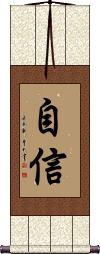
自信 is created by simply putting the character for “faith/believe/confidence” with the character for “oneself” in front of it.
The literal translation holds the same meaning in English, Chinese, and Japanese.
It's like a self-affirmation to say, “you can do it.”
Some may also use this to mean self-esteem or a sense of self-worth. 自信 is also how to say “believe in oneself.”
See Also: Confidence
Seven Heavenly Virtues
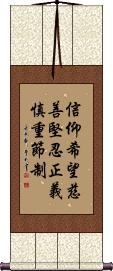
信仰希望慈善堅忍正義慎重節制 is a list in Chinese and Japanese Kanji of an interpretation of the Seven Heavenly Virtues.
1. Faith is belief in God, and the right virtues.
2. Hope is taking a positive future view that good will prevail.
3. Charity is a concern for, and active helping of, others.
4. Fortitude is never giving up.
5. Justice is being fair and equitable with others.
6. Prudence is care of and moderation with money.
7. Temperance is moderation of needed things and abstinence from things that are not needed.
The full list is here. 信仰希望慈善堅忍正義慎重節制 is a word list, not a common phrase. While all Chinese and Japanese people will recognize the words in the list, they may not understand what the list is about (unless they are familiar with the Seven Heavenly Virtues).
don’t get this as a tattoo or anything like that without first consulting a native translator in the target language. These are fine for a wall scroll but a long discussion is needed before you commit to this for a lifetime inking commitment.
Spiritual Peace / Enlightened Peace
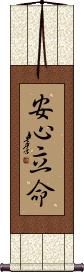
These Japanese Kanji, 安心立命, can be translated as “religious enlightenment” or “spiritual peace gained through faith.”
Other dictionaries define as “spiritual peace and enlightenment” or “keeping an unperturbed mind through faith.”
My Buddhist dictionary defines it as “spiritual peace and realization of enlightenment.”
In the Zen school, this is about settling one's body and life; attaining complete peace, and establishing one's course of life in accord with the ultimate reality.
Daoism / Taoism
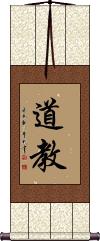
道教 is the title often used in both Chinese and Japanese to describe the beliefs or religion of Taoism / Daoism.
The first character is simply “dao” and the second character can be translated as “teachings,” “faith” or “doctrine.”
Tenacious / Tenacity
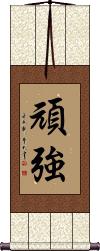
頑強 means “Tenacious,” “Hard to Defeat,” or “Dogged.”
Alone, the first character means mischievous, obstinate, or stubborn. But it loses some of the mischievous meaning when the second character is added.
The second character means strength, force, power, or better.
See Also: Determination | Dedication | Never Give Up
True Heart
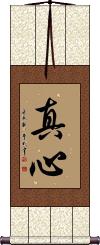
While 真心 literally reads as “true heart” or “genuine heart,” the understood meaning is sincerity, devotion, sincere, or heartfelt. Some will extend the meaning to be like “true love.” It's the idea of doing something or treating someone with genuine feelings.
真心 is valid and has the same meaning in both Chinese characters and Japanese Kanji.
Note: While not too common, this can be the female given name “Mami” in Japanese.
Trust in God
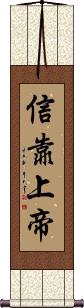
信靠上帝 means “Trust in God,” “Faith in God,” “Rely upon God” and/or “Believe in God.”
Trust No One / Trust No Man
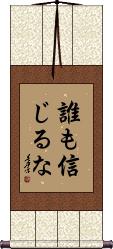
誰も信じるな is as close as you can get to the phrase “trust no man” in Japanese, though no gender is specified.
The first two characters mean everyone or anyone but change to “no one” with the addition of a negative verb.
The third through fifth characters express the idea of believing in, placing trust in, confiding in, or having faith in.
The last character makes the sentence negative (without the last character, this would mean “trust everyone,” with that last character, it's “trust no one”).
Note: Because this selection contains some special Japanese Hiragana characters, it should be written by a Japanese calligrapher.
Trust in God / In God We Trust
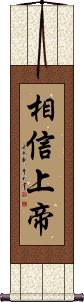
相信上帝 means exactly what the title suggests. The first two characters mean “trust” or “believe,” and the second two mean “God” (as in the God of Abraham and the God of Zion).
Thisis also how the American phrase “In God We Trust” as seen on U.S. Currency would be translated into Chinese. It would also be correct to say that this means “Believe in God,” though, in this arrangement/context, one would be more likely to interpret it as “trust.”
Trust in God / Belief in God
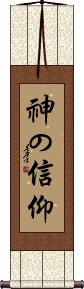
神の信仰 is the simplest way to express “Trust in God” in Japanese.
The first character means God, deity, divinity, or spirit (in this case, it will be read as God).
The second character is a particle that links the ideas.
The last two characters mean faith, belief, or creed in a religious context.
Xin Xin Ming / Shinjinmei
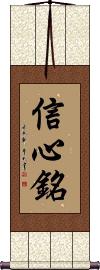
This is the title of a Buddhist poem known as Xin Xin Ming, Xinxinming, or Hsin Hsin Ming in Chinese and Shinjinmei in Japanese.
This title is typically translated as “Faith in Mind.”
The poem itself is quite long and steeped with meaning.
Download this document for more info: http://www.ln.edu.hk/econ/staff/Xin Xin Ming.doc
Fatal error: Cannot redeclare foreignPrice() (previously declared in /home/gwest/web/chinesescrollpainting.com/public_html/includes/currencyconverter.php:22) in /home/gwest/web/orientaloutpost.com/public_html/includes/currencyconverter.php on line 22