Many custom options...


And formats...



Aikido in Chinese / Japanese...
Buy an Aikido calligraphy wall scroll here!
Personalize your custom “Aikido” project by clicking the button next to your favorite “Aikido” title below...
Aikido
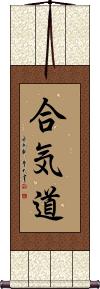
合気道 is the modern Japanese way to write Aikido.
Aikido is often referred to as the defensive martial art.
While Aikido was born in Japan, it has become a somewhat famous form of defensive tactics taught to soldiers and Marines, as well as some law enforcement officers in the West.
Looking at the characters, the first means “union” or “harmony.”
The second character means “universal energy” or “spirit.”
The third means “way” or “method.”
Please note that while the original 合氣道 characters can be pronounced in Chinese, this word is not well-known in China and is not considered part of the Chinese lexicon.
Note: It is somewhat accepted that this is the origin of Hapkido in Korea. And other than a modern simplification to the middle Kanji of this 3-Kanji word, it is written the same in Korean Hanja.
See Also: Martial Arts | Hapkido
Heart of Aikido
Aikido no Kokoro
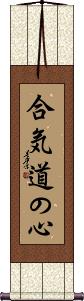
合気道の心 is often translated as “The Spirit of Aikido,” but it is more directly translated as “Heart of Aikido.”
Shotokan Aikido
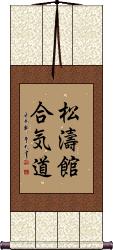
松涛館合気道 is the title for Shotokan Aikido in Japanese.
Note: Chinese and Korean pronunciations of these characters are included above, however, this title would only be understood in Chinese or Korean by someone who practices or is familiar with Shotokan Aikido. Please consider this title to be “Japanese only.”
See Also: Martial Arts | Hapkido
Aikido Yoshinkan
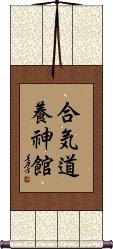
合気道養神館 is the title Aikidō Yōshinkan in Japanese Kanji.
Kodokan Aikido
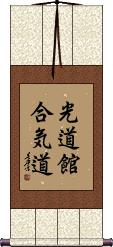
光道館合気道 / 光道館合氣道 is Kodokan Aikido.
Be sure this is the right Kodokan for your school, as there are two different titles that romanize as Kodokan in Japanese.
Wado-Kai Aikido
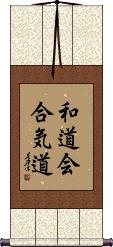
Chushin Aikido Dojo

中心合気道道場 is the name Chushin Aikido Dojo in Japanese Kanji.
The Japanese romanization, Chushin, can also be 忠心 (Loyal-Heart) or 中真 (True Center), so let me know if you need 忠心合気道道場 or 中真合気道道場 instead of 中信合気道道場.
Hapkido
Korean Martial Art of re-directing force
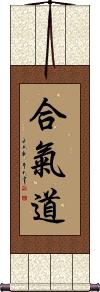
Hapkido or 合氣道 is a mostly-defensive martial art in Korea.
Hapkido has some connection to the Aikido of Japan. They are written with the same characters in both languages. However, it should be noted that the Korean Hanja characters shown here are the traditional Chinese form - but in modern Japan, the middle character was slightly simplified.
Note: You can consider this to be the older Japanese written form of Aikido. Titles on older books and signs about Aikido use this form.
The connection between Japanese Aikido and Korean Hapkido is muddled in history. The issue is probably due to the difficult relationship between the two countries around WWII. Many Koreans became virtual slaves to the Japanese during that period. After WWII, many things in Korea were disassociated from having any Japanese origin. The relationship has greatly mellowed out now.
Looking at the characters, the first means “union” or “harmony.”
The second character means “universal energy” or “spirit.”
The third means “way” or “method.”
One way to translate this into English is the “Harmonizing Energy Method.” This makes sense, as Hapkido has more to do with redirecting energy than fighting strength against strength.
More Hapkido info
More notes:
1. Sometimes Hapkido is Romanized as “hap ki do,” “hapki-do” “hab gi do” or “hapgido.”
2. Korean Hanja characters are actually Chinese characters that usually hold the same meaning in both languages. There was a time when these characters were the standard and only written form of Korean. The development of modern Korean Hangul characters is a somewhat recent event in the greater scope of history. There was a time when Chinese characters were the written form of many languages in places known in modern times as North Korea, South Korea, Japan, Vietnam, Singapore, Hong Kong, Taiwan, Mainland China, and a significant portion of Malaysia. Even today, more people in the world can read Chinese characters than English.
3. While these Korean Hanja characters can be pronounced in Chinese, this word is not well-known in China and is not considered part of the Chinese lexicon.
Aikikai
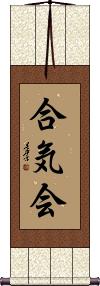
合気会 or “Aikikai” is the original school of Aikido.
Several organizations use this title. The first was established in Japan in 1940 (The Aikikai Foundation or 財団法人合気会).
The only difference between this title and Aikido is the last character, “kai” which means club, group, fraternity, organization, or assembly.
Note: 合気会 may be romanized with a dash like this: Aiki-Kai.
Okami Hapkido
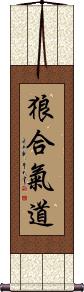
Aiki Budo
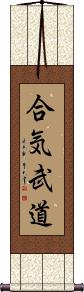
合気武道 is the title Aiki-Budo or “Aiki Martial Arts” in Japanese Kanji.
合 means “union” or “harmony.”
気/氣 means “universal energy” or “spirit.”
武 means “martial” or “military.”
道 means “way” or “method.”
合気武道 is the modern Japanese way to write this. You may also see 合氣武道, where the second character is written in the older traditional (pre-1945) form. If you want this written 合氣武道, just include a note or email with your order.
合氣武道 are all Chinese characters as well, so I included the Chinese pronunciation above. However, while it can be understood in Chinese, this is not a common term in that language and is not used in any Chinese martial arts. Also, 気 is only used in Japan - Chinese will understand 気 to be the Japanese form of 氣.
See Also: Martial Arts | Hapkido
Fatal error: Cannot redeclare foreignPrice() (previously declared in /home/gwest/web/chinesescrollpainting.com/public_html/includes/currencyconverter.php:22) in /home/gwest/web/orientaloutpost.com/public_html/includes/currencyconverter.php on line 22