Many custom options...


And formats...



Animals in Chinese / Japanese...
Buy an Animals calligraphy wall scroll here!
Personalize your custom “Animals” project by clicking the button next to your favorite “Animals” title below...
See also: Chinese Zodiac / Animal Years
1. Animals
3. Kirin / Giraffe / Mythical Creature
4. Fox
5. Lioness
6. Giraffe
7. Bear
8. Every Creature Has A Domain
9. Wolf
10. Animal Kingdom
Animals
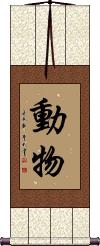
動物 is the way to write “animals” in Chinese characters, Japanese Kanji, and old Korean Hanja.
The first character means “moving,” and the second means “things.”
So animals are “moving things” in these Asian languages.
The Five Animals
Dragon Snake Tiger Leopard Crane
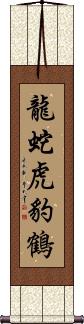
龍蛇虎豹鶴 is a list of the Chinese characters for the five animals of Shaolin Kung Fu in a comfortable order (meaning that they are in the proper order and will “feel right” to a Chinese person who views this arrangement).
Kirin / Giraffe / Mythical Creature
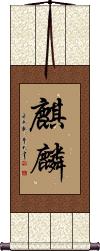
麒麟 is the title of a mythical beast of Asia.
The animal is thought to be related to the giraffe, and in some ways, it is a giraffe. However, it is often depicted with the horns of a dragon or deer and sometimes with the body like a horse, but many variations exist.
In Japanese, it is pronounced “Kirin” as in “Kirin Ichiban” beer.

Notes:
1. This is sometimes spelled as “kylin.”
2. In Japanese, this is the only Kanji word for giraffe. Therefore in Japan, this word needs context to know whether you are talking about the mythical creature or the long-necked giraffe of Africa.
3. Apparently, this was the first word used for regular giraffes in China (some were brought from Africa to China during the Ming Dynasty - probably around the year 1400). Though the mythical creature may have existed before, the name “qilin” was given to the “new giraffe.” This is because, more than 600 years ago, giraffes somewhat matched the mythical creature's description when Chinese people saw them for the first time. Later, to avoid such an ambiguous title, a three-character word was devised to mean a “giraffe of Africa.” The characters for “qilin” shown here are only for the mythological version in modern Chinese.
4. More information about the qilin / kirin from Wikipedia.
5. This creature is sometimes translated as the “Chinese Unicorn,” although it is generally portrayed with two horns. I think this is done more for the fantasy aspect of the unicorn and because most westerners don't know what a qilin or kirin is (this avoids a long explanation by the translator).
6. In Korean, this can mean kirin or simply giraffe (usually, the mythological creature is what they would think of when seeing these characters alone on a wall scroll).
Fox
The Sly Animal
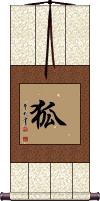
This is Chinese, Japanese Kanji, and old Korean Hanja title for the sly animal known as a fox.
Lioness
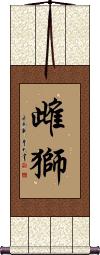
雌獅 is how to write “lioness” in Chinese.
Note: 雌獅 is not a very common title for a wall scroll in China. Perhaps because lions are not indigenous to China. Though oddly enough, the rarity of lions made them very prized - and lion dances are a popular festival attraction.
If you see the name of this animal species written on a wall scroll, it's more likely to be the masculine form of “lion.”
Giraffe
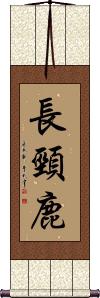
長頸鹿 is the Chinese word for Giraffe (the animal).
Not to be confused with the mythical “kirin” or “qilin” beast.
Bear
Animal
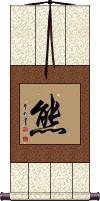
熊 is the way to write “bear” (as in the animal) in Chinese, Japanese Kanji, and old Korean Hanja.
If you are a bear fanatic, this is the wall scroll for you.
熊 is not specific to species, such as panda bears, polar bears, brown bears, etc.
If you need a more specific title, just post a contact me.
See Also: Panda
Every Creature Has A Domain
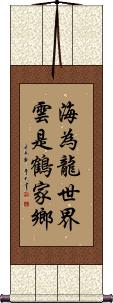
海為龍世界雲是鶴家鄉 is a somewhat poetic way to say that everyone and everything has its place in the world.
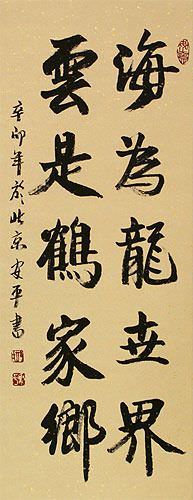 The first line (which is the column on the right) says, “The Ocean is the World of the Dragon.” The next column says, “The Clouds are the Domain of the Cranes.”
The image to the right is what this calligraphy can look like in xing-kaishu style by a Master Calligrapher.
Wolf
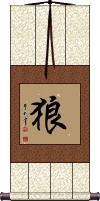
狼 is the character used to represent the elusive animal known as the wolf in both Chinese and Japanese.
If you are a fan of the wolf or the wolf means something special to you, this could make a great addition to your wall.
Do keep in mind, that much like our perception of wolves in the history of western culture, eastern cultures do not have a very positive view of wolves (save the scientific community and animal lovers). The wolf is clearly an animal that is misunderstood or feared the world over.
狼 is seldom used alone in Korean Hanja but is used in a compound word that means utter failure (as in a wolf getting into your chicken pen - or an otherwise ferocious failure). Not a good choice if your audience is Korean.
Animal Kingdom
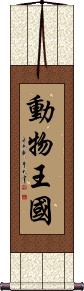
動物王國 is literally what it says.
There is even a TV show in China that is similar to Wild Kingdom or what you would currently see on the Discovery Channel that has this same title.
For your information: In the Chinese way of thinking, the Tiger is the king of the animal kingdom (lions are not native to China, so the tiger took the role that we have given to the lion in our western way of thinking).
The modern Japanese version has a slight variation on the last character (国 instead of 國). Let me know if you want the modern Japanese version (國 would be considered the old or traditional version).
Fatal error: Cannot redeclare foreignPrice() (previously declared in /home/gwest/web/chinesescrollpainting.com/public_html/includes/currencyconverter.php:22) in /home/gwest/web/orientaloutpost.com/public_html/includes/currencyconverter.php on line 22