Many custom options...


And formats...



Art of Healing in Chinese / Japanese...
Buy an Art of Healing calligraphy wall scroll here!
Personalize your custom “Art of Healing” project by clicking the button next to your favorite “Art of Healing” title below...
Art of Healing
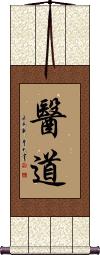
醫道 means the art of healing or medical skill.
This can also refer to a Korean TV show, Hur Jun about an ancient doctor. The Chinese-subtitled version of the show is also quite popular in China.
While this is a common title in Chinese and Korean, it's not used as often in Japanese where someone might read it as “medical course” or “the way of medicine.”
Healing Hands
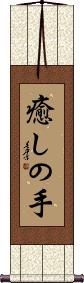
癒しの手 can be translated as “healing hands” in Japanese.
The first two characters mean healing, to heal, to cure, soothing, therapy, comfort, and solace.
The third character is a possessive particle that connects the ideas.
The last Kanji means hand or hands.
Note: Because this selection contains some special Japanese Hiragana characters, it should be written by a Japanese calligrapher.
Reiki
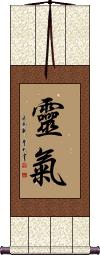
靈氣 is the title of a healing practice now found globally but with origins in Japan.
Special note: Outside of the context of the healing practice of Reiki, this means “aura” or “spiritual essence that surrounds all living things.” A Japanese person unfamiliar with the practice will take the “aura” meaning.
Reiki is a technique for stress reduction and relaxation that also heals. It can be compared to massage but is based on the idea that an unseen “life force energy” flows through us and is what causes us to be alive. If your life force energy is low, you'll be more likely to get sick or feel stressed. If your life force energy is abundant and flowing well, you become more capable of being happy and healthy.
There is a lot of information available if you want to Google this term - my job is to offer the calligraphy while you can decide if it is right for you.


Note: We are showing the ancient (traditional) form of the Reiki Kanji. I have seen Reiki written with the slightly simplified version and this more classic form. If you want the form of Reiki with the two strokes in the shape of an X on the second character and the modern first character, simply click on the Kanji characters to the right.
Note: 靈氣 is also a Chinese word, but in Chinese, these characters create a word that refers to a smart person or someone with high aspirations. It is not read as a healing method in Chinese.
In Korean Hanja, this can be read as a “mysterious atmosphere” by a Korean who is not familiar with the practice of Reiki (still has a cool meaning in Korean).
Heal / Healing
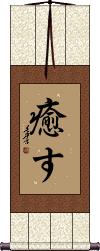
癒す is the common word for heal or healing in Japanese.
This word can also mean to cure.
Healing Hands
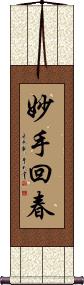
妙手回春 can be translated as “healing hands.”
The first two characters are used to describe a doctor or medical professional who has admirable skills in curing disease. Literally: Wonderful or skilled hands.
The last two characters mean “Springing back to life.”
Altogether, it suggests that these skilled hands can cure whatever ails you and bring you back to life. 妙手回春 is a great honor to bestow on your doctor or other healthcare professionals that have helped you.
Cure
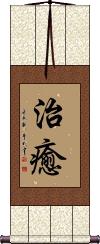
治癒 is the Chinese, Japanese Kanji, and old Korean Hanja for cure, healing, and/or recovery.
Doctor
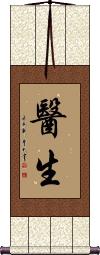
醫生 is the title used to refer to medical doctors or physicians in China.
Note: Sometimes, this same term is used in Korean, but not common.
The meaning is close to “healer [of] life” as the first character, 醫, can mean medicine, the healing art, healing, curing, medical, to cure, or to treat. The second character, 生, means birth or life.

 In Japan, they use a simplified version of the first character (医生 is also used as the Simplified Chinese version of Doctor). If you want this version, please click the characters to the right instead of the button above.
Johrei / Jyorei
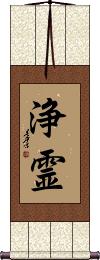
Jyorei or Johrei is a healing art that uses divine light to dissolve the spiritual impurities that are the source of all physical, emotional, and personal problems.
浄霊/浄靈 is a Japanese title that can refer to the purification of the spirit described above, but this is also the word for exorcism in Japanese.
Romanization variations include Jyorei, Johrei, Jourei and Jore. Regardless of romanization, the actual pronunciation is like "Joe Ray."
Reiki - Master Symbol
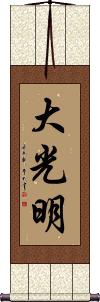
大光明 is the master symbol “Daikomyo” or “Dai Ko Myo,” which is usually associated with the healing practice of Reiki.
This title can be translated as “Great Bright Light.” This symbol, as used in Reiki, alludes to “Enlightened Nature” or the radiance of a purified soul or deity.
Pronunciations in Chinese and Korean are included above but this title has no meaning except when used by a Reiki practitioner. In fact, this title is not that well known by those outside the Reiki community in Japan.
In Chinese, this would be interpreted as “Great Bright Future” (the second two characters alone create a word that means “bright future” in Chinese).
To Heal
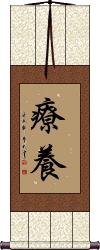
療養 is “to heal” in Chinese, Japanese Kanji, and old Korean Hanja.
This can also be translated as to get well, to recuperate, to convalesce, convalescence, recuperation, and in certain contexts, medical treatment or to nurse.
Fatal error: Cannot redeclare foreignPrice() (previously declared in /home/gwest/web/chinesescrollpainting.com/public_html/includes/currencyconverter.php:22) in /home/gwest/web/orientaloutpost.com/public_html/includes/currencyconverter.php on line 22