Many custom options...


And formats...



Beautiful in Chinese / Japanese...
Buy a Beautiful calligraphy wall scroll here!
Personalize your custom “Beautiful” project by clicking the button next to your favorite “Beautiful” title below...
1. Beautiful
2. Beautiful Heart / Beautiful Spirit
3. Beauty / Beautiful / Handsome
6. Beautiful Life / Life in Perfect Harmony
7. Beautiful Heart / Beautiful Mind
10. Beautiful Sight
14. Beautiful Soul
15. Beautiful Spirit
16. Beautiful Mind
18. Beauty / Beautiful Princess
20. Goddess of Beauty / Beautiful Spirit
22. Life is Good / Life is Beautiful
23. The Good Life / Beautiful Life
Beautiful
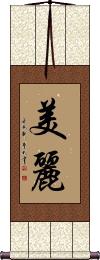
美麗 is a two-character word used often in Chinese, old Korean, and ancient Japanese to express beauty.
I've had a few requests for a “two-character beautiful,” and this is by far the best word. This is not a common word for an Asian person to want on a wall scroll. However, you will see it commonly used as an adjective in phrases, stories, and titles throughout magazines and signage in China.
美麗 can also be translated as gorgeous or lovely.
Note: 美麗 is not commonly used in modern Japan.
Beautiful Heart / Beautiful Spirit
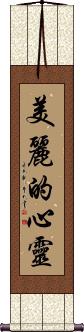
美麗的心靈 means a beautiful heart, a beautiful mind, or a beautiful spirit in Chinese.
Beauty / Beautiful / Handsome
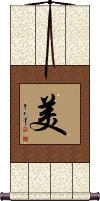
美 is often used to describe the beauty of a woman.
However, when applied to a man, it can mean handsome. It's also the first character in the word for “beauty salon” which you will see all over China and Japan.
This can be used as the given name for a girl (spell it or say it as “Mei” or “May”).
For a bit of trivia: The title for the “USA” in Chinese is “Mei Guo” which literally means “Beautiful Country.” This name was bestowed at a time before Chairman Mao came to power and decided that China didn't like the USA anymore (even though we fought together against the Japanese in WWII). But these days, Chinese people love Americans (but have a distaste for American politics and policy). But I digress...
美 is also how “Beautiful” is written in Japanese Kanji and Korean Hanja. 美 can also mean: very satisfactory; good; to be pleased with oneself; abbreviation for the USA; fine; handsome; admirable; madhura; sweet; and/or pleasant.
See Also: Beautiful Woman | Beautiful Girl
Beautiful Soul
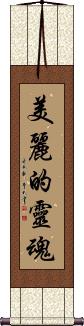
美麗的靈魂 means “Beautiful Soul” in Chinese.
The first two characters mean beautiful, beauty, or gorgeous.
The middle character connects the ideas (a possessive article).
The last two characters mean soul or spirit.
Beautiful Soul
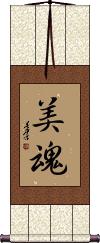
美魂 is a very short or abbreviated way to say “Beautiful Soul” in Japanese.
There is a more extended version that might be a little more natural and also closer to the intended meaning. This short title is often translated awkwardly as “Beauty Soul” in Japanese.
Beautiful Virtue
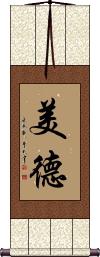
美德 written in Chinese or Korean Hanja can also mean “grace of character” or “noble virtue.”
 There is a slight variation in the modern Japanese Kanji form of the second character. If you want the modern Japanese version, please click on the special Kanji shown to the right instead of the button above. Note that the traditional Chinese form is still readable and understood by Japanese people (
it’s
the ancient Japanese form anyway).
There is a slight variation in the modern Japanese Kanji form of the second character. If you want the modern Japanese version, please click on the special Kanji shown to the right instead of the button above. Note that the traditional Chinese form is still readable and understood by Japanese people (
it’s
the ancient Japanese form anyway).
Beautiful Life / Life in Perfect Harmony
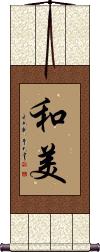
和美 is a word that means “harmonious” or, “in perfect harmony.”
The deeper meaning or more natural translation would be something like, “beautiful life.”
The first character means peace and harmony.
The second character means beautiful. But in this case, when combined with the first character, beautiful refers to being satisfied with what you have in your life. This can be having good relations, good feelings, comfort, and having enough (with no feeling of wanting).
Note: In Japanese, this is often used as the name "Wami." This title is probably more appropriate if your audience is Chinese.
Beautiful Heart / Beautiful Mind
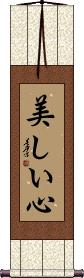
美しい心 means “beautiful heart” or “beautiful mind,” in Japanese.
The word for “heart” also means “mind” and sometimes “soul” in ancient Asia.
Note: Because this selection contains some special Japanese Hiragana characters, it should be written by a Japanese calligrapher.
Beautiful Girl
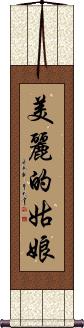
美麗的姑娘 is the best way to express “beautiful girl” in Chinese.
See Also: Beautiful Woman | Beauty
Beautiful Woman
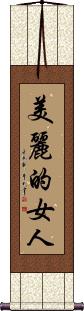
美麗的女人 is the best and most polite way to express “beautiful woman” in Chinese.
Note: Some people may like the simple 2-character 美女 way to express this, but there are some bad connotations with that, so better to stay with this longer and more respectful title.
See Also: Beautiful Girl | Beauty
Beautiful Sight
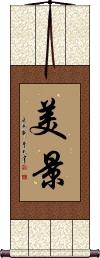
美景 can be translated as a beautiful view, beautiful scenery, or a beautiful sight.
Note: Not a commonly used word in modern Japanese.
Beautiful Dreamer
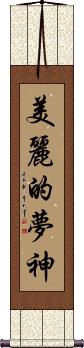
美麗的夢神 is the Chinese title for the song Beautiful Dreamer.
It translates as Beautiful Dream Saint.
Beautiful Princess
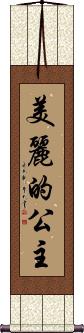
美麗的公主 is how to write beautiful princess in Chinese.
The first two characters mean feminine beauty or rather a way to say beautiful that only applies to women. The middle character is just a connecting character. The last two characters mean princess.
See Also: Queen
Strong and Beautiful
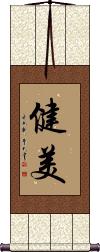
We don't really have a word like 健美 in English, but these two characters create a word that means “strong and beautiful.” It could also be translated as “healthy and beautiful.”
Note: 健美 is a word in Chinese and Korean, but it's also the family name Takemi in Japanese. The characters hold the same meaning in Japanese; however, it's like having the English name Stillwell when few people would perceive the meanings of still and well.
Beautiful Soul
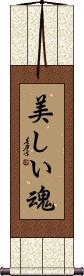
美しい魂 is a common way to write “Beautiful Soul” in Japanese.
Note: Because this selection contains some special Japanese Hiragana characters, it should be written by a Japanese calligrapher.
Beautiful Spirit
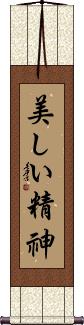
美しい精神 is a common way to write “Beautiful Spirit” in Japanese.
Note: Because this selection contains some special Japanese Hiragana characters, it should be written by a Japanese calligrapher.
Beautiful Mind
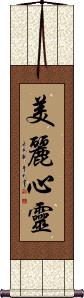
美麗心靈 means “Beautiful Mind” in Chinese.
美麗心靈 is also the Chinese title of the 2001 movie of the same name.
Beautiful Woman Proverb
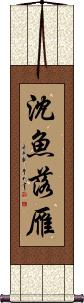
沈魚落雁 is an old proverb that literally means “fish sink, goose alights.”
...But this takes some explaining. This is a proverb from Zhuangzi (莊子), who lived in the late 4th century BC.
This figuratively refers to female beauty that is so captivating that even the birds and beasts take notice.
Perhaps a better and more accurate way to describe this is to say that it speaks of the charms of a uniquely beautiful woman who is so beautiful that fish stay on the bottom of the water and flying wild geese fall from the sky in shame.
This proverb is so famous that it is also known and used in Japan (same characters, different pronunciation).
Note: This can also be written 沉魚落雁 instead of 沈魚落雁 (just the first character varies slightly).
Beauty / Beautiful Princess
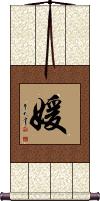
媛 means, a beauty; beautiful (woman); princess; a young lady of noble birth; girl; small & lovely.
媛 is used a bit more commonly in Chinese than in Japanese.
Note: This can be the female given name "Hime" in Japanese.
Mirror: Beautiful Clarity
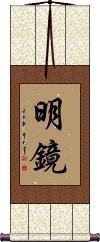
While 明鏡 means mirror in Chinese, Japanese Kanji, and old Korean Hanja, it's commonly used as a metaphor for something beautiful and bright or something that provides clarity and insight.
Goddess of Beauty / Beautiful Spirit
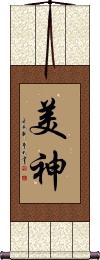
In Chinese, 美神 means Goddess of Beauty.
The first character means beauty or beautiful.
The second character means spirit (can also mean god, goddess, or soul).
Some will use this as a short way to say, “Beautiful Spirit.”
This has a similar meaning in Japanese but is used more often as a female given name in Japan. As a Japanese given name, it can be pronounced Mikami, Mikan, or Binasu.
Beautiful Clear Sky
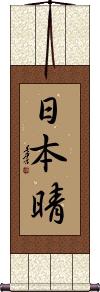
日本晴 is a Japanese Kanji title that means beautiful weather, clear and cloudless sky, or clear weather.
It's a little odd, but if you literally translated this phrase, it says, “Japanese weather,” as if that was an indication of perfect weather (maybe a little arrogant on behalf of Japan - I've experienced a monsoon there, which was unpleasant).
Life is Good / Life is Beautiful
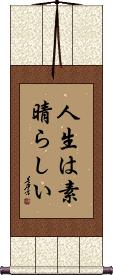
人生は素晴らしい means “life is good,” “life is great,” or “life is beautiful” in Japanese.
The first two characters mean “life” (as in your or a human lifespan).
The third character kind of means “is.”
The last five characters are a long adjective that means wonderful, splendid, and/or magnificent. In the context of life, it reads more like good or beautiful.
Note: Because this selection contains some special Japanese Hiragana characters, it should be written by a Japanese calligrapher.
The Good Life / Beautiful Life
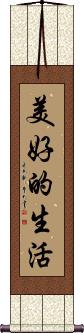
In Chinese, 美好的生活 means “Beautiful Life,” or “The Good Life.”
Life is Good / Life is Beautiful
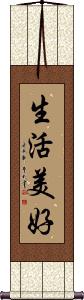
生活美好 means “life is good” in Chinese.
The first two characters mean “life” or “living.”
The last two characters mean “good” or “beautiful.”
Beauty: The art of makeup / cosmetics
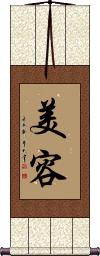
In Chinese, 美容 is the title for the art of beauty, as applying makeup or cosmetics to enhance beauty.
Note: In Japanese and Korean, this takes the meaning of beautiful face or beauty of figure or form. Be sure you know who your audience is and have matched the desired meaning.
Fatal error: Cannot redeclare function foreignPrice() (previously declared in /home/gwest/web/chinesescrollpainting.com/public_html/includes/currencyconverter.php:22) in /home/gwest/web/orientaloutpost.com/public_html/includes/currencyconverter.php on line 22