Many custom options...


And formats...



Belief Trust in Chinese / Japanese...
Buy a Belief Trust calligraphy wall scroll here!
Personalize your custom “Belief Trust” project by clicking the button next to your favorite “Belief Trust” title below...
1. Trust in God / Belief in God
5. Faith / Trusting in the Unseen
6. Trust in God / Faith in God
7. Faith is the bird that feels the light when the dawn is still dark
Trust in God / Belief in God
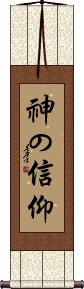
神の信仰 is the simplest way to express “Trust in God” in Japanese.
The first character means God, deity, divinity, or spirit (in this case, it will be read as God).
The second character is a particle that links the ideas.
The last two characters mean faith, belief, or creed in a religious context.
Belief / Trust
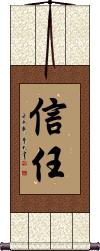
信任 means belief or trust in Chinese characters, old Korean Hanja, and Japanese Kanji.
It can also mean having confidence in or credence.
Believe / Faith / Trust
śraddhā
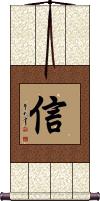
信 can mean to believe, truth, faith, fidelity, sincerity, trust, and confidence in Chinese, old Korean Hanja, and Japanese Kanji.
This single character is often part of other words with similar meanings.
It is one of the five basic tenets of Confucius.
In Chinese, it sometimes has the secondary meaning of a letter (as in the mail) depending on context but it will not be read that way when seen on a wall scroll.
In the Buddhist context, this is śraddhā (faith through hearing or being taught).
Trust / To Have Faith
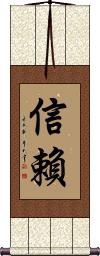
信賴 can also be translated as confidence, reliance, or dependence; thus, it can also mean “to rely on” or “to depend on.”
Trust is having faith in someone or something. It is a positive attitude about life. You are confident that the right thing will happen without trying to control or make it happen. Even when difficult things happen, trust helps us to find the gift or lesson in it.
 There is a slight deviation in the Japanese Kanji form of the second character. If you want the modern Japanese version, please click on the special Kanji shown to the right instead of the button above. Note that the traditional Chinese form is still readable and understood by Japanese people.
See Also: Confidence | Truth | Honor
Faith / Trusting in the Unseen
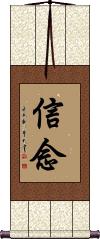
信念 expresses the idea of “having a belief” or “trusting in the unseen.”
信念 could also be translated as beliefs or convictions.
Note: Also considered to be one of the Seven Heavenly Virtues.
See Also: Devotion | Dedication | Trust
Trust in God / Faith in God
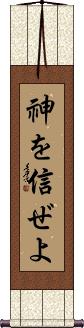
神を信ぜよ is a way to express “Trust in God” in Japanese.
The first character is “God.”
The second character is a particle that links the ideas here.
The last three characters are a word that means “to believe,” “to believe in,” “to place trust in,” “to confide in,” and “to have faith in.”
Basically, this is the Japanese phrase for “Have faith in God,” “Belief in God,” or “Trust in God.”
Note: Because this selection contains some special Japanese Hiragana characters, it should be written by a Japanese calligrapher.
Faith is the bird that feels the light when the dawn is still dark
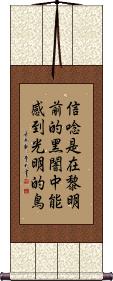
信唸是在黎明前的黑闇中能感到光明的鳥 is a philosophical poem/quote from Indian Poet and Philosopher, Rabindranath Tagore.
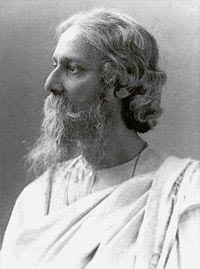
Rabindranath Tagore, 1915
This quote is not sourced, and therefore several variations exist in English. Some suggest the original was in the Bengali language.
This, of course, is the Chinese translation that has the meaning of, “Faith is the bird that feels the light and sings when the dawn is still dark.”
More about Rabindranath Tagore
Religious Devotion / Faith in God / Religious Faith
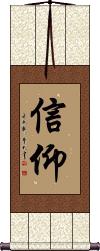
信仰 means firm belief, faith, persuasion, conviction, and sometimes religion or creed in Chinese, Japanese Kanji, and old Korean Hanja.
This clearly fits the religious connotation of the English word “devotion.”
This is often used to refer to a person of faith or a religious person.
This can be directly translated as “firm belief,” “creed,” “conviction,” or simply as “religious,” depending on context.
Some will also use this to mean “trust in God” in Japanese (though the term for God is not actually in this title).
It should be noted that this word is a little strange alone on a wall scroll.
While this can be pronounced in Japanese, it’s not a great selection for a wall scroll if your audience is Japanese.
See Also: Faith | Trust | Devotion | Trust | Trust in God
Honesty / Fidelity
信 is another character that expresses the idea of honesty.
It can also mean truth, faith, belief in, fidelity, sincerity, trust, and/or confidence.
Some have included this in the list for the Bushido, although “makoto” is probably more common/popular.
Note: In some contexts, this character can mean a letter (mail), news, or envoy. However, alone, it will generally be read with the honesty-meaning.
See our page with just Code of the Samurai / Bushido here
See Also: Loyalty Trustworthiness Trustworthy
Fatal error: Cannot redeclare foreignPrice() (previously declared in /home/gwest/web/chinesescrollpainting.com/public_html/includes/currencyconverter.php:22) in /home/gwest/web/orientaloutpost.com/public_html/includes/currencyconverter.php on line 22