Many custom options...


And formats...



Benevolence in Chinese / Japanese...
Buy a Benevolence calligraphy wall scroll here!
Personalize your custom “Benevolence” project by clicking the button next to your favorite “Benevolence” title below...
1. Benevolence
2. Kindheartedness / Benevolence / Humanity
4. Learning leads to Knowledge, Study leads to Benevolence, Shame leads to Courage
5. Mercy / Compassion / Buddhist Loving Kindness
6. Kindness and Forgiving Nature
7. Confucius: Golden Rule / Ethic of Reciprocity
8. Generosity
10. Benevolent Love
11. Benevolent and Skilled Doctor
12. Compassionate Heart / Benevolent Heart
13. Benevolent and Skilled Doctor
14. Loving-Kindness Conquers All
15. Dana: Almsgiving and Generosity
16. Kindness
17. Love and Respect / Kindness and Respect
18. Benevolent Heart
Benevolence
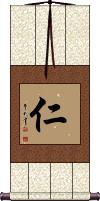
Beyond benevolence, 仁 can also be defined as “charity” or “mercy” depending on context.
The deeper meaning suggests that one should pay alms to the poor, care for those in trouble, and take care of his fellow man (or woman).
仁 is one of the five tenets of Confucius. In fact, it is a subject that Confucius spent a great deal of time explaining to his disciples.
I have also seen this benevolent-related word translated as perfect virtue, selflessness, love for humanity, humaneness, goodness, goodwill, or simply “love” in the non-romantic form.
This is also a virtue of the Samurai Warrior
See our page with just Code of the Samurai / Bushido here
Kindheartedness / Benevolence / Humanity
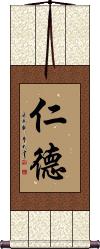
仁德 is a word that can be translated as love, kindheartedness, benevolence, and humanity.
The first character means benevolence by itself.
The second character means virtue or morality.
Japanese note: The second Kanji of this word has been slightly simplified (one tiny horizontal stroke removed). It is still readable for Japanese but if you select our Japanese calligrapher, expect that stroke to be missing on your wall scroll.
Kindness / Benevolence
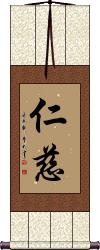
仁慈 word is used in Chinese, Korean, Japanese, and Asian Buddhism to relay the important idea of loving kindness.
仁慈 can also be defined as: benevolent; charitable; kind; merciful; kind-hearted; benevolence; kindness; humanity; mercy.
In Japanese, this can also be the given name Hitoji. This would also be a good Mandarin Chinese given name romanized as Jentzu (in Taiwan) or Renci (which sounds like ren-tsuh).
Learning leads to Knowledge, Study leads to Benevolence, Shame leads to Courage
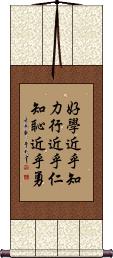
好學近乎知力行近乎仁知恥近乎勇 is a Saying from Confucius which relates certain actions to virtues.
A more verbose translation:
To love learning is akin to knowledge,
to study diligently is akin to benevolence,
to know shame is akin to courage.
Mercy / Compassion / Buddhist Loving Kindness
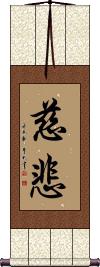
Besides the title above, 慈悲 can also be defined as clemency or lenience and sometimes the act of giving charity.
In the Buddhist context, it can be defined as “benevolence,” “loving-kindness and compassion,” or “mercy and compassion.”
This Buddhist virtue is perhaps the most important to employ in your life. All sentient beings that you encounter should be given your loving kindness. And trust me, however much you can give, it comes back. Make your life and the world a better place!
This Chinese/Japanese Buddhist term is the equivalent of Metta Karuna from Pali or Maitri Karuna from Sanskrit.
慈 can mean loving-kindness by itself.
悲 adds a component of sorrow, empathy, compassion, and sympathy for others.
See Also: Benevolence
Kindness and Forgiving Nature
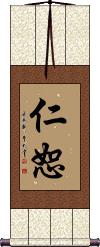
仁恕 is a word in Chinese and Japanese that means something like benevolence with magnanimity or kindness with a forgiving nature.
If this describes you, then you are the type of person that I would like to call my friend.
This may not be the most common word in daily use, but it's old enough that it transcended cultures from China to Japan in the 5th century when Japan lacked a written language and absorbed Chinese characters and words into their language.
Note: 仁恕 is not commonly used in Korean.
Confucius: Golden Rule / Ethic of Reciprocity
Do not do to others what you do not want done to yourself
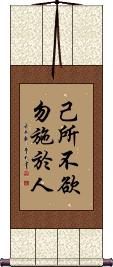
Some may think of this as a “Christian trait,” but actually, it transcends many religions.
This Chinese teaching dates back to about 2,500 years ago in China. Confucius had always taught the belief in being benevolent (ren), but this idea was hard to grasp for some of his students, as benevolence could be kind-heartedness or an essence of humanity itself.
When answering Zhong Gong's question as to what "ren" actually meant, Confucius said:
己所不欲勿施于人 or "When you go out, you should behave as if you were in the presence of a distinguished guest; when people do favors for you, act as if a great sacrifice was made for you. Whatever you wouldn't like done to you, do not do that thing to others. Don't complain at work or home.”
Hearing this, Zhong Gong said humbly, “Although I am not clever, I will do what you say.”
From this encounter, the Chinese version of the “Golden Rule” or “Ethic of Reciprocity” came to be.
The characters you see above express, “Do not do to others whatever you do not want to be done to yourself.”
See Also: Confucius Teachings | Benevolence
Generosity
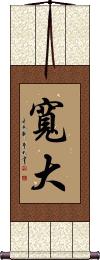
寬大 is a Chinese, Japanese, and Korean word that means Generosity.
Generosity is giving and sharing. You share freely, not with the idea of receiving something in return. You find ways to give others happiness and give just for the joy of giving. Generosity is one of the best ways to show love and friendship.
寬大 can also be translated as charitable, magnanimity, liberality, or in some contexts, broad-mindedness.
Note: There is a tiny deviation in the first character when written in Japanese. If you choose our Japanese master calligrapher, the little dot on the lower right of the first character will be omitted. With or without the dot, this can be read in Chinese, Japanese Kanji, and old Korean Hanja.
See Also: Benevolence | Altruism | Charity
Kindness / Caring
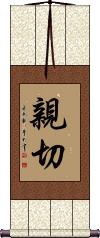
親切 is a Chinese/Japanese/Korean word that can also mean affectionate, cordial, warm, or close (emotionally).
Kindness shows you care and are doing some good to make life better for others. Be thoughtful about people's needs. Show love and compassion to someone who is sad or needs your help. When you are tempted to be cruel, to criticize or tease, decide to be kind instead.
See Also: Love | Caring | Benevolence
Benevolent Love
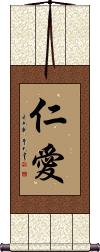
仁愛 is a word that means benevolence, charity, compassion, and/or love.
This can also be a Japanese female name that romanizes as Megumi.
Benevolent and Skilled Doctor
Short version
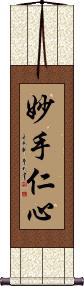
妙手仁心 is a phrase that celebrates the benevolence, skill, and service to his/her patients.
Here's a breakdown of the characters:
妙手 miào shǒu is an admirable skill in curing disease (when referring to doctors).
仁心 rén xīn kindheartedness, charity, benevolent heart.
Compassionate Heart / Benevolent Heart
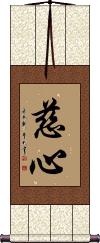
慈心 means “Compassionate Heart” or “Benevolent Heart.”
It's used in day-to-day speech to refer to someone who has the traits of benevolence, mercy, and compassion for their fellow humans.
This title is also used in Buddhism with the same profound meaning.
Benevolent and Skilled Doctor
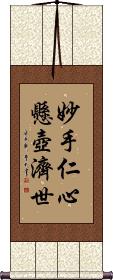
妙手仁心悬壶济世 is a phrase that celebrates the benevolence, skill, and service to his/her patients.
Here's a breakdown of the characters:
妙手 miào shǒu admirable skill in curing disease (when used in reference to doctors).
仁心 rén xīn kindheartedness, charity, benevolent heart.
悬壶济世 xuán hú jì shì practice medicine or pharmacy to help the people or the public.
Loving-Kindness Conquers All
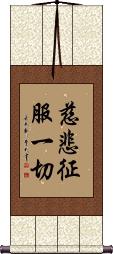
慈悲征服一切 is a way to express the idea that mercy, compassion, and loving-kindness can overcome all things.
This phrase is composed of 3 Chinese words:
慈悲 = loving-kindness; mercy; compassion; benevolence. It's used in Buddhism a lot to express the idea of how one should treat everyone else and all living beings.
征服 = to conquer; to subdue; to vanquish; to overcome.
一切 = all; everything; the whole; lock, stock, and barrel; without exception.
Dana: Almsgiving and Generosity
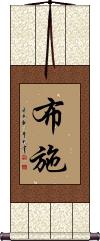
布施 is the Buddhist practice of giving known as Dāna or दान from Pali and Sanskrit.
Depending on the context, this can be alms-giving, acts of charity, or offerings (usually money) to a priest for reading sutras or teachings.
Some will put Dāna in these two categories:
1. The pure or unsullied charity, which looks for no reward here but only in the hereafter.
2. The sullied almsgiving whose object is personal benefit.
The first kind is, of course, the kind that a liberated or enlightened person will pursue.
Others will put Dāna in these categories:
1. Worldly or material gifts.
2. Unworldly or spiritual gifts.
You can also separate Dāna into these three kinds:
1. 財布施 Goods such as money, food, or material items.
2. 法布施 Dharma, as an act to teach or bestow the Buddhist doctrine onto others.
3. 無畏布施 Courage, as an act of facing fear to save someone or when standing up for someone or standing up for righteousness.
The philosophies and categorization of Dāna will vary among various monks, temples, and sects of Buddhism.
Breaking down the characters separately:
布 (sometimes written 佈) means to spread out or announce, but also means cloth. In ancient times, cloth or robs were given to the Buddhist monks annually as a gift of alms - I need to do more research, but I believe there is a relationship here.
施 means to grant, to give, to bestow, to act, to carry out, and by itself can mean Dāna as a single character.
Dāna can also be expressed as 檀那 (pronounced “tán nà” in Mandarin and dan-na or だんな in Japanese). 檀那 is a transliteration of Dāna. However, it has colloquially come to mean some unsavory or unrelated things in Japanese. So, I think 布施 is better for calligraphy on your wall to remind you to practice Dāna daily (or whenever possible).
Kindness
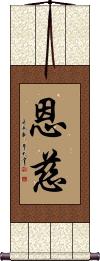
恩慈 means to bestow kindness or favor upon someone. This can also be a Japanese surname that romanizes as Onji.
Love and Respect / Kindness and Respect
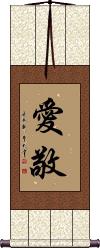
愛敬 is a Chinese, Japanese Kanji, and old Korean Hanja title that can mean “love and respect,” “kindness and respect,” “to love with reverence,” “charm,” “amiability,” “winsomeness,” “courtesy,” or “ingratiating behavior.”
Note: The wide-ranging definitions show that this word is a bit ambiguous without the context of being used in a sentence.
Benevolent Heart
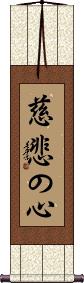
慈悲の心 means benevolent heart, compassionate heart, or merciful heart in Japanese.
This is a Japanese-only phrase and should be ordered from our Japanese master calligrapher. This is because the third character is unique Hiragana.
Chances are you are into Inuyasha and are seeking the title of chapter 471 which is often translated as “Merciful Heart.”
Compassion / Kindness

思いやり is compassion, kindness, or sympathy in Japanese.
The first part of this word suggests feelings, emotion, sentiment, love, affection, wish, and hope are connected with this idea of compassion and sympathy.
Note: Because this selection contains some special Japanese Hiragana characters, it should be written by a Japanese calligrapher.
Fatal error: Cannot redeclare foreignPrice() (previously declared in /home/gwest/web/chinesescrollpainting.com/public_html/includes/currencyconverter.php:22) in /home/gwest/web/orientaloutpost.com/public_html/includes/currencyconverter.php on line 22