Many custom options...


And formats...



Benevolent Love in Chinese / Japanese...
Buy a Benevolent Love calligraphy wall scroll here!
Personalize your custom “Benevolent Love” project by clicking the button next to your favorite “Benevolent Love” title below...
Benevolent Love
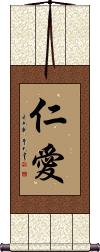
仁愛 is a word that means benevolence, charity, compassion, and/or love.
This can also be a Japanese female name that romanizes as Megumi.
Love Between Child and Parents
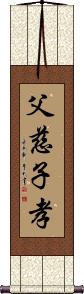
父慈子孝 is a Chinese proverb that means “benevolent father, filial son.”
Figuratively, this is the natural love between parents and children.
Benevolent Heart
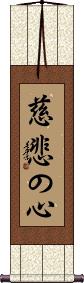
慈悲の心 means benevolent heart, compassionate heart, or merciful heart in Japanese.
This is a Japanese-only phrase and should be ordered from our Japanese master calligrapher. This is because the third character is unique Hiragana.
Chances are you are into Inuyasha and are seeking the title of chapter 471 which is often translated as “Merciful Heart.”
Kindness / Benevolence
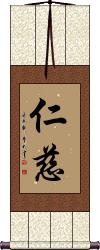
仁慈 word is used in Chinese, Korean, Japanese, and Asian Buddhism to relay the important idea of loving kindness.
仁慈 can also be defined as: benevolent; charitable; kind; merciful; kind-hearted; benevolence; kindness; humanity; mercy.
In Japanese, this can also be the given name Hitoji. This would also be a good Mandarin Chinese given name romanized as Jentzu (in Taiwan) or Renci (which sounds like ren-tsuh).
Benevolence
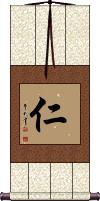
Beyond benevolence, 仁 can also be defined as “charity” or “mercy” depending on context.
The deeper meaning suggests that one should pay alms to the poor, care for those in trouble, and take care of his fellow man (or woman).
仁 is one of the five tenets of Confucius. In fact, it is a subject that Confucius spent a great deal of time explaining to his disciples.
I have also seen this benevolent-related word translated as perfect virtue, selflessness, love for humanity, humaneness, goodness, goodwill, or simply “love” in the non-romantic form.
This is also a virtue of the Samurai Warrior
See our page with just Code of the Samurai / Bushido here
Art of War: 5 Points of Analysis
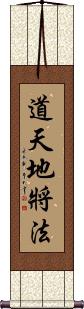
道天地將法 is a list of five key points to analyzing your situation from the first chapter of Sun Tzu's Art of War.
This reads like a 5-part military proverb. Sun Tzu says that to sharpen your skills, you must plan. To plan well, you must know your situation. Therefore, you must consider and discuss the following:
1. Philosophy and Politics: Make sure your way or your policy is agreeable among all of your troops (and the citizens of your kingdom as well). For when your soldiers believe in you and your way, they will follow you to their deaths without hesitation and will not question your orders.
2. Heaven/Sky: Consider climate / weather. This can also mean considering whether God is smiling upon you. In the modern military, this could be waiting for clear skies so that you can have air support for an amphibious landing.
3. Ground/Earth: Consider the terrain in which the battle will take place. This includes analyzing defensible positions, and exit routes, while using varying elevations to your advantage. When you plan an ambush, you must know your terrain and the best location from which to stage that ambush. This knowledge will also help you avoid being ambushed, as you will know where the likely places in which to expect an ambush from your enemy.
4. Leadership: This applies to you as the general and your lieutenants. A leader should be smart and be able to develop good strategies. Leaders should keep their word, and if they break a promise, they should punish themselves as harshly as they would punish subordinates. Leaders should be benevolent to their troops, with almost a fatherly love for them. Leaders must have the ability to make brave and fast decisions. Leaders must have steadfast principles.
5. [Military] Methods: This can also mean laws, rules, principles, models, or systems. You must have an efficient organization in place to manage both your troops and supplies. In the modern military, this would be a combination of how your unit is organized and your SOP (Standard Operating Procedure).
Notes: This is a simplistic translation and explanation. Much more is suggested in the actual text of the Art of War (Bing Fa). It would take a lot of study to master all of these aspects. In fact, these five characters can be compared to the modern military acronyms such as BAMCIS or SMEAC.
CJK notes: I have included the Japanese and Korean pronunciations but in Chinese, Korean and Japanese, this does not make a typical phrase (with subject, verb, and object) it is a list that only someone familiar with Sun Tzu’s writings would understand.
Fatal error: Cannot redeclare foreignPrice() (previously declared in /home/gwest/web/chinesescrollpainting.com/public_html/includes/currencyconverter.php:22) in /home/gwest/web/orientaloutpost.com/public_html/includes/currencyconverter.php on line 22