Many custom options...

Tan Paper and Copper Silk Love Wall Scroll
Red Paper and Ivory Silk Love Wall Scroll
Orange Paper Love Scroll
Crazy Blue and Gold Silk Love Scroll


And formats...

Love Vertical Portrait
Love Horizontal Wall Scroll
Love Vertical Portrait

Better Late Than Never in Chinese / Japanese...

Buy a Better Late Than Never calligraphy wall scroll here!

Personalize your custom “Better Late Than Never” project by clicking the button next to your favorite “Better Late Than Never” title below...


  1. Better Late Than Never

  2. Marco Polo

  3. Do not shed a tear until you see the coffin

  4. Asayama Ichiden-Ryu

  5. Tranquil Night

  6. Tranquil Midnight

  7. Do not take action until the time is right

  8. Heike Star / Betelgeuse

  9. Tenshin Buko-Ryu Heiho

10. Hua Tuo

11. Beautiful Woman Proverb

12. Tea Fate


Better Late Than Never

It's Never Too Late Too Mend
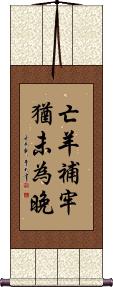
 wáng yáng bǔ láo yóu wèi wéi wǎn
Better Late Than Never Scroll

Long ago in what is now China, there were many kingdoms throughout the land. This time period is known as “The Warring States Period” by historians because these kingdoms often did not get along with each other.

Sometime around 279 B.C. the Kingdom of Chu was a large but not particularly powerful kingdom. Part of the reason it lacked power was the fact that the King was surrounded by “yes men” who told him only what he wanted to hear. Many of the King's court officials were corrupt and incompetent which did not help the situation.

The King was not blameless himself, as he started spending much of his time being entertained by his many concubines.

One of the King's ministers, Zhuang Xin, saw problems on the horizon for the Kingdom, and warned the King, “Your Majesty, you are surrounded by people who tell you what you want to hear. They tell you things to make you happy and cause you to ignore important state affairs. If this is allowed to continue, the Kingdom of Chu will surely perish, and fall into ruins.”

This enraged the King who scolded Zhuang Xin for insulting the country and accused him of trying to create resentment among the people. Zhuang Xin explained, “I dare not curse the Kingdom of Chu but I feel that we face great danger in the future because of the current situation.” The King was simply not impressed with Zhuang Xin's words.
Seeing the King's displeasure with him and the King's fondness for his court of corrupt officials, Zhuang Xin asked permission from the King that he may take leave of the Kingdom of Chu, and travel to the State of Zhao to live. The King agreed, and Zhuang Xin left the Kingdom of Chu, perhaps forever.

Five months later, troops from the neighboring Kingdom of Qin invaded Chu, taking a huge tract of land. The King of Chu went into exile, and it appeared that soon, the Kingdom of Chu would no longer exist.

The King of Chu remembered the words of Zhuang Xin and sent some of his men to find him. Immediately, Zhuang Xin returned to meet the King. The first question asked by the King was “What can I do now?”

Zhuang Xin told the King this story:

A shepherd woke one morning to find a sheep missing. Looking at the pen saw a hole in the fence where a wolf had come through to steal one of his sheep. His friends told him that he had best fix the hole at once. But the Shepherd thought since the sheep is already gone, there is no use fixing the hole.
The next morning, another sheep was missing. And the Shepherd realized that he must mend the fence at once. Zhuang Xin then went on to make suggestions about what could be done to reclaim the land lost to the Kingdom of Qin, and reclaim the former glory and integrity of the Kingdom of Chu.

The Chinese idiom shown above came from this reply from Zhuang Xin to the King of Chu almost 2,300 years ago.
It translates roughly into English as...
“Even if you have lost some sheep, it's never too late to mend the fence.”

This proverb, 亡羊补牢犹未为晚, is often used in modern China when suggesting in a hopeful way that someone change their ways, or fix something in their life. It might be used to suggest fixing a marriage, quitting smoking, or getting back on track after taking an unfortunate path in life among other things one might fix in their life.

I suppose in the same way that we might say, “Today is the first day of the rest of your life” in our western cultures to suggest that you can always start anew.

Note: This does have Korean pronunciation but is not a well-known proverb in Korean (only Koreans familiar with ancient Chinese history would know it). Best if your audience is Chinese.

 mǎ kě bō luó
Marco Polo Scroll

馬可波羅 is the Chinese title for Marco Polo, the Venetian explorer who traveled the Silk Road to China in the late 1200s AD.

Do not shed a tear until you see the coffin

 bú jiàn guān cái bú luò lèi
Do not shed a tear until you see the coffin Scroll

不見棺材不落淚 is a cautionary tale that suggests you are unknowingly (though it should be obvious)on a bad course.

It further suggests that you will not realize your folly until the worst has happened.

This can also be a warning of inaction until it's too late to take action. Again, not realizing your error until it's too late.

In an alternate interpretation, some will suggest this means doing something bad and not looking back - Then the worst happens.

It should be noted that this is one of the oddest selections for a wall scroll in our whole Asian calligraphy database. All of our translators are convinced that no Chinese person would ever hang this on their wall.

Asayama Ichiden-Ryu

 asa yama ichi den ryuu
Asayama Ichiden-Ryu Scroll

浅山一伝流 or Asayama Ichiden-ryū is a Japanese koryū martial art founded in the late Muromachi period by Asayama Ichidensai Shigetatsu.

Tranquil Night

 seiya
Tranquil Night Scroll

静夜 is a Japanese word meaning “quiet night” or “tranquil night.” It implies late night, such as midnight.

静夜 is also a female given name in Japanese, Seiya.

Tranquil Midnight

 yè shēn rén jìng
Tranquil Midnight Scroll

夜深人靜 literally means “Night Deep/Dark People Quiet/Tranquil.”

In more natural English, some translate this as “late night, all is quiet,” “tranquil midnight,” or “in the dead of night” (implying the dead quiet of midnight).

Do not take action until the time is right

 bù dào huǒ hou bù jiē guō
Do not take action until the time is right Scroll

不到火候不揭锅 translates as: Don't take the lid off the pot until the food is done.

Figuratively, this means: Don't take action until the time is right.

You can take this as a call to be patient or pick just the right time to do something (not too early, not too late).

Heike Star / Betelgeuse

 hei ke boshi
Heike Star / Betelgeuse Scroll

平家星 is the old Japanese title for the Betelgeuse star in the constellation Orion.

While also known as Alpha Orionis or Betelgeuse in the West, this was the “Heike star” in Japan.

The powerful Taira clan, known colloquially as the 平家 (Heike clan), adopted this star's red color as its symbol sometime in the late 800s AD. They called the star 平家星 (Heike-boshi).

Tenshin Buko-Ryu Heiho

 tiān zhēn wǔ jiǎ liú bīng fǎ
 ten shin bu kou ryu hei ho
Tenshin Buko-Ryu Heiho Scroll

天真武甲流兵法 is the Kanji title that romanizes as Tenshin Bukō-Ryū Heihō or Tenshin Buko-Ryu Heiho.

天真武甲流兵法 is a Japanese koryū martial art that has its roots in the Toda-ryū, founded in the late Muromachi period around the year 1560 by Toda Seigen.

This title can be pronounced in Chinese with a similar meaning, however, it should be considered a Japanese title.

 huá tuó
Hua Tuo Scroll

華佗 or Hua Tuo was a Chinese physician who lived during the late Eastern Han dynasty.

The historical texts Records of the Three Kingdoms and Book of the Later Han record Hua Tuo as the first person in China to use anesthesia during surgery.

Hua Tuo used a general anesthetic combining wine with a herbal concoction called 麻沸散, literally, “cannabis boil powder.” This was in the second century AD, almost 1700 years before western medicine had any form of anesthesia (1846).

Beautiful Woman Proverb

 chén yú luò yàn
 chin gyo raku gan
Beautiful Woman Proverb Scroll

沈魚落雁 is an old proverb that literally means “fish sink, goose alights.”

...But this takes some explaining. This is a proverb from Zhuangzi (莊子), who lived in the late 4th century BC.

This figuratively refers to female beauty that is so captivating that even the birds and beasts take notice.

Perhaps a better and more accurate way to describe this is to say that it speaks of the charms of a uniquely beautiful woman who is so beautiful that fish stay on the bottom of the water and flying wild geese fall from the sky in shame.

This proverb is so famous that it is also known and used in Japan (same characters, different pronunciation).


Note: This can also be written 沉魚落雁 instead of 沈魚落雁 (just the first character varies slightly).

 chá yuán
Tea Fate Scroll

茶緣 is a special title for the tea lover. This kind of means “tea fate,” but it's more spiritual and hard to define. Perhaps the tea brought you in to drink it. Perhaps the tea will bring you and another tea-lover together. Perhaps you were already there, and the tea came to you. Perhaps it's the ah-ha moment you will have when drinking the tea.

I've been told not to explain this further, as it will either dilute or confuse the purposefully-ambiguous idea embedded in this enigma.

I happen to be the owner of a piece of calligraphy written by either the son or nephew of the last emperor of China, which is the title he wrote. It was given to me at a Beijing tea house in 2001. 茶緣 is where I learned to love tea after literally spending weeks tasting and studying everything I could about Chinese tea. I did not understand the significance of the authorship or the meaning of the title at all. Some 10 years later, I realized the gift was so profound and had such providence. Only now do I realize the value of a gift that it is too late to give proper thanks for. It was also years later that I ended up in this business and could have the artwork properly mounted as a wall scroll. It has been borrowed for many exhibitions and shows and always amazes native Chinese and Taiwanese who read the signature. This piece of calligraphy I once thought was just a bit of ink on a thin and wrinkled piece of paper, is now one of my most valued possessions. And fate has taught me to be more thankful for seemingly simple gifts.


Fatal error: Cannot redeclare foreignPrice() (previously declared in /home/gwest/web/chinesescrollpainting.com/public_html/includes/currencyconverter.php:22) in /home/gwest/web/orientaloutpost.com/public_html/includes/currencyconverter.php on line 22
