Many custom options...


And formats...



Blue Sky in Chinese / Japanese...
Buy a Blue Sky calligraphy wall scroll here!
Personalize your custom “Blue Sky” project by clicking the button next to your favorite “Blue Sky” title below...
1. Blue Sky
4. Blue Lotus
5. Blue Dragon
8. Cyan
9. Violet Color
11. Sapphire
13. Sapphire
14. Shichi-Kyu
15. Chung Do Kwan
16. Green
17. Shen Long
Blue Sky
The Blue Dome of Heaven
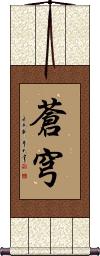
蒼穹 is a poetic way to express “sky” in Chinese and Japanese Kanji.
It's like saying, “The blue dome of heaven,” or a way to say “blue sky” within a poem.
Clear Blue Sky
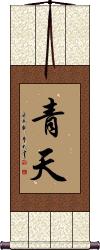
青天 means clear sky and/or blue sky in Chinese and Japanese Kanji.
Sometimes this term is used in Chinese to refer to an upright and honorable official or politician (a very rare thing).
In Japanese, this can also be the name Harutaka.
Blue / Indigo
Color
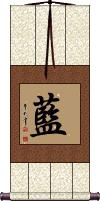
藍 is the single character for the color blue in Chinese.
It can also mean indigo in Japanese Kanji and old Korean Hanja.
Blue Lotus
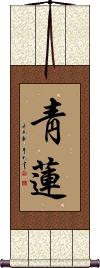
靑蓮 is a common title for Blue Lotus.
靑蓮 is often used in a Buddhist context for blue lotus from the Sanskrit “utpala.” This often refers to the clarity and purity of the lotus blue eyes possessed by a Living Buddha. It can also represent the purity of mind (without desire, suffering, fear, etc.).
Blue Dragon
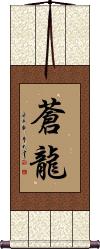
蒼龍 is one of a couple of possible titles for “blue dragon” (occasionally also translated as “green dragon”).
The first character means “deep blue” or “azure.”
The last character is dragon.
Green Dragon / Blue Dragon
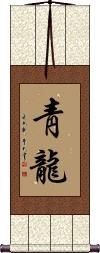
靑龍 is a title that can mean blue or green dragon.
The first character can mean blue, green, azure, or celadon.
The second character means dragon.
This is mostly a Chinese title (especially in Buddhism). It will be understood but less commonly used in Japanese and Korean.
Blue Dragon / Azure Dragon
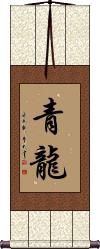
青龍 is a scholarly title for “Blue Dragon” or “Azure Dragon.”
You'll find this title used in ancient Chinese literature and astronomy. This dragon has dominion over the eastern sky or eastern heavens. The Azure Dragon is also noted for representing the spring season. Also seen as an auspicious omen.
Emperor Huizong of the Song Dynasty canonized the five colored dragons as “kings.” The Azure Dragon represents the most compassionate of kings.
In Japanese, this title is known with the same meaning but can also be a given name, Seiryuu or Seiryu.
Note, the first character can be written as  OR
OR  . Same character, just two ways to write it.
Cyan
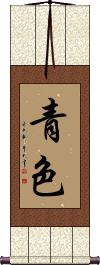
青色 is a Chinese word that is used for the color cyan.
This can also refer to a blue-green color.
In Japanese, this is an alternate way to refer to a blue color.
Violet Color
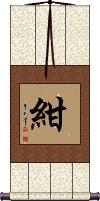
紺 is a slightly-rare Chinese and old Korean title for the color violet or purple.
In Japanese, this refers to a very deep blue color.
Ironman Triathlon Event
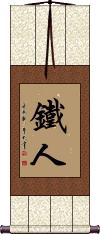
鐵人 is the Chinese name for the Ironman Triathlon Event.
The literal meaning of these characters is “iron person.”
This can also refer to a Japanese toy, Tetsujin (a big blue tin man).
Sapphire
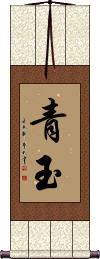
青玉 is a Japanese word that means sapphire or jacinth.
青玉 literally means blue/green jade.
Note: This also makes sense in Chinese, but will be read as "blue jade", rather than being understood to be sapphire (藍寶石 is sapphire in Chinese).
Ch'ang Hon Taekwondo
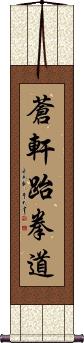
蒼軒跆拳道 is the title “Chang Hon Taekwon-Do” written in old Korean Hanja.
This literally means “Pale Blue Kick Fist/Punch Way.”
The rather awkward official romanization is “cang heon tae gweon do.”
Occasionally, you will see the first Hanja character written as 苍 instead of 蒼. it’s just a different way to write the same character. If you want 苍 instead of 蒼, just let me know.
Sapphire
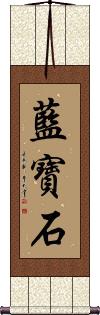
藍寶石 means sapphire in Chinese.
Literally, 藍寶石 means blue gemstone.
Shichi-Kyu

七級 or Shichi-Kyu/Shichikyu is the 7th Kyu or 7th Rank before black belt in many Japanese martial arts ranking schemes.
In some cases this is a yellow belt with two stripes, other schools designate this with a blue belt.
In Chinese, this can mean seven floors - like a seven-floor pagoda.
Chung Do Kwan
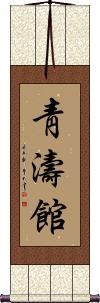
靑濤館 is the Korean martial arts style, Chung Do Kwan, meaning “Blue Wave School.”
If you want this in modern Korean Hangul characters, click on the Hangul next to the Korean flag above instead of the button above.
Also Romanized as “Cheong Do Gwan” or “Ch'ŏng Do Kwan.”
Green
The fresh green of nature
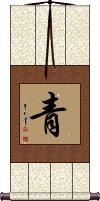
青 is nature's color and can refer to forest green, greenish-blue, or the darkest of greens.
青 and color represent nature, youth, and young people.
In the same way, we refer to green bananas and the rookie being green, the same is true in Chinese and Japanese, where, in a certain context, this can mean immature, unripe, or young.
In Japan, this can also be a female given name “Haru.” It can also be used as a given name (for either sex) in China.
Shen Long
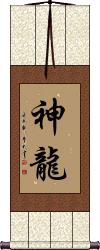
神龍 or Shen Long literally means “god dragon” or “divine dragon.”
神龍 is a spiritual dragon from Chinese mythology that controls wind, storms, clouds, and rain. Historically, farmers in China avoid offending this dragon, as it could result in a drought or flooding of their fields.
Shen Long has blue/azure scales and appears on the beautiful robes of some Chinese emperors.
Sometimes romanized as Shen Lung and sometimes written as 神竜 in Japan with the pronunciation of Shinryū or Shenron. It can also be a given name in Japan.
Fatal error: Cannot redeclare foreignPrice() (previously declared in /home/gwest/web/chinesescrollpainting.com/public_html/includes/currencyconverter.php:22) in /home/gwest/web/orientaloutpost.com/public_html/includes/currencyconverter.php on line 22