Many custom options...


And formats...



Body Karada in Chinese / Japanese...
Buy a Body Karada calligraphy wall scroll here!
Personalize your custom “Body Karada” project by clicking the button next to your favorite “Body Karada” title below...
Body / Karada
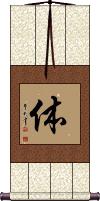
体 is used in Japanese to mean “body.”
体 can also refer to the form, style, corporeal existence, appearance, identity, or state of something or someone. 體 is also used in Buddhism in regard to the corporeal existence of someone (their earthy vessel). It's kind of a broad term that can be used in a lot of different ways.
As a single character, it's usually pronounced “karada” but it can also be pronounced “tai” or “te” (Japanese pronunciation borrowed from the original Chinese).
體 is not a common Kanji to use for a wall scroll. Only select this if you have a personal and meaningful reason to do so. Also, consider this version to be “Japanese only” - see below...
 In Chinese and old Korean Hanja, this character is written in the traditional form shown to the right. If you want this version, click on the character to the right instead of the button above.
Body
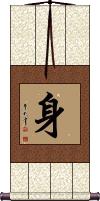
身 is how to write “body” as in your human body, in Chinese, Japanese Kanji, and Korean Hanja.
Depending on the context and certain language issues, this character can also mean: main part, hull, oneself, somebody, person, I, me, sword, lifetime, one's station in life, etc.
While this written word is universal in three languages, it still makes a rather odd selection for a wall scroll. Also, they tend to use 体 (karada) in Japanese for the body (depending on context).
See Also: Karada
Strong Body, Strong Mind
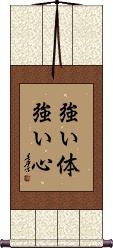
強い体強い心 is a way to write “strong mind, strong body” in Japanese.
Each of the two lines starts with 強い (tsuyoi) which means: strong; powerful; mighty; potent; resistant; resilient; durable; tough; stiff; hard; inflexible.
The body is represented with 体 (the ancient version is 體, romanized as karada), which means: body; build; physique; posture; torso; trunk; health.
Mind is represented with 心 (kokoro), which can mean heart, mind, or soul, depending on context.
強い體強い心 is not a common phrase in Japanese, so it's not the most natural title for calligraphy. In English, you might want to write it, “strong mind, strong body” but, “strong mind, strong body,” is more natural in Japanese.
Note: Because this selection contains some special Japanese Hiragana characters, it should be written by a Japanese calligrapher.
Fatal error: Cannot redeclare function foreignPrice() (previously declared in /home/gwest/web/chinesescrollpainting.com/public_html/includes/currencyconverter.php:22) in /home/gwest/web/orientaloutpost.com/public_html/includes/currencyconverter.php on line 22