Many custom options...


And formats...



Body Mind Spirit in Chinese / Japanese...
Buy a Body Mind Spirit calligraphy wall scroll here!
Personalize your custom “Body Mind Spirit” project by clicking the button next to your favorite “Body Mind Spirit” title below...
Body Mind Spirit
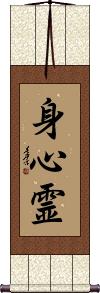
身心霊 means “body mind spirit” in Japanese.
This refers to your physical, mental, and spiritual presence.
This can also be translated as “body heart spirit” as 心 can mean mind or heart.
Note that this is a "word list" and not a proper phrase (with a subject, verb, and object) nor a typical title in Japanese. So it's not too commonly seen in Japan. However, the term 身心霊整合性医療 that refers to holistic medicine is gaining popularity.
Mind Body Spirit
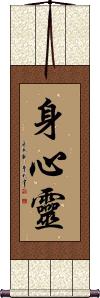
身心靈 is probably the best way to express the idea of “Body, Mind, and Spirit” in Chinese and old Korean Hanja. We are actually using the word “heart” here because, for thousands of years, the heart was thought to be the place where your thoughts, feelings, and emotions came from. We do something similar in the west when we say “warm-hearted” or “I love you with all of my heart.” In this context, heart = mind in Asian language and culture.
The very literal translation of these three characters is “body, heart & spirit,” which could also be interpreted as “body, mind & soul.”
We have arranged these characters in this order because it simply “feels” like the proper order in the Chinese language. Word lists like this are not so common for calligraphy artwork, so we must be careful to put them in the most natural order. It should be noted that this is not a common title in Asia, nor is it considered an actual phrase (as it lacks a clear subject, verb, and object).
 In Japanese Kanji, they use an alternate form of the character for soul or spirit. If you want this using the Japanese alternate, please click on the Kanji shown to the right instead of the button above.
Japanese disclaimer: This is not a natural phrase/list in Japanese. While not totally-natural in Chinese, this word list is best if your audience is Chinese.
Energy Sword Body in Concert
Spirit, Sword & Body as One
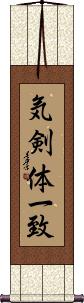
气剑体一致 often gets translated as “Mind Sword Body,” or “Spirit, Sword, and Body as One.” But I think these translations don't tell you enough about what this is really saying.
In this context, 気, which is the modern Japanese version of 氣, means spiritual and unseen energy or “life energy.” In some cases, 気 can be translated as spirit, feeling, or nature. If defined as the mind, it's more about the invisible or intangible parts of one's mind (or soul).
剣 is the Japanese version of 劍 meaning sword.
体 is the modern Japanese version of 體 meaning body.
The Kanji 一 means one, and in this case, suggests “all in one.”
The Kanji 到 means to send, deliver, or convey. But together, 一到 suggests all these things in agreement, union cooperation, or in concert.
Note: Arguments exist as to whether this should be romanized as Kikentaiitchi, Kikentaiicchi, or kikentaiichi. Technically, if you drop the last character, you get 気剣体一 and kikentaiichi (ki ken tai ichi), which is also a valid phrase.
Ghost / Soul / Spirit
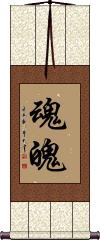
魂魄 is a Chinese, Japanese Kanji, and old Korean Hanja term for ghost, soul, or spirit.
It's used in the context of Buddhism as:
Animus and anima; the spiritual nature or mind, and the animal soul; the two are defined as mind and body or mental and physical, the invisible soul inhabiting the visible body, the former being celestial, the latter terrestrial.
Soul / Spirit
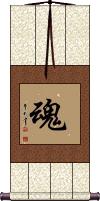
魂 means soul or spirit as in the immortal soul that can be detached from the body.
This can also refer to one's Yang energy or spirit.
In the Buddhist context, this can be the soul, conscious mind, or vijñāna.
Ken Zen Ichi Nyo
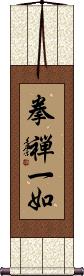
拳禪一如 is a Japanese phrase that is often translated as “train both body and spirit.”
Here's the breakdown of the words in this phrase:
拳 means fist.
禅 is zen, which means meditation.
一如 is a word that means “to be just like,” “oneness,” “true nature,” or “true character.”
So to get to the translation of “train both body and spirit,” you must understand that “fist” is representing “body” and the idea of meditation is representing “mind.”
I have to say, this is not how I would translate this. To me, it's really about training with your mind and remembering that meditation is a huge part of training, not just your fist. As the Shaolin Buddhist monks show us, meditation is just as important as physical training in martial arts.
Spiritual Soul Mates
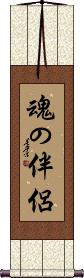
魂の伴侶 is a Japanese-only title for soulmates.
魂 means soul, spirit, immortal soul (the part of you that lives beyond your physical body), or the conscious mind. In the Buddhist context, this is vijñāna or viññāṇa (consciousness, life force, or mind).
の is a possessive article that connects everything here.
伴侶 means mates, companions, partners, and spouses.
Jin Shin Jyutsu
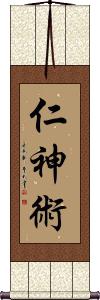
仁神術 is Jin Shin Jyutsu or Jin Shin Jutsu.
This is a practice of calming the mind and clearing the flow of Qi energy in the body. Jin Shin Jyutsu has some commonality with the practice of Reiki.
A good translation of 仁神術 would be “Benevolent Spirit Method.”
We can break that down into all of the possible meanings:
仁 = benevolence (esp. as a virtue of Confucianism), consideration, compassion, humanity, charity, kindness, or virtue.
神 = deity, soul, spirit, mysterious, psyche, god, divinity, spiritual powers, deva, divine, spiritual, or supernatural.
術 = way, method, means, art, trick, or plan. The correct romaji for this 術 Kanji should be “jutsu.” However, in martial arts, this is often written “jitsu” but in this case, “jyutsu” became common.
Shingitai / Shin Gi Tai
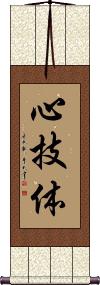
心技体 is the Japanese title “shin gi tai” or “shingitai.”
This can refer to the three elements of Sumo wrestlers or martial artists, “heart-technique-physique.”
Here is what each character represents:
心 (shin) mind, heart, and spirit.
技 (gi) skill, knowledge, and experience.
体 (tai) body and physical effort.
心技体 have the same meanings in Chinese, though this title is used much more often in Japanese.
Sanchin
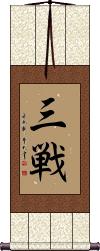
三戦 is a title that literally means “three battles/conflicts/wars.”
三戦 is often figuratively used to relay the idea of a battle to unify the mind, body, and spirit.
Original usage likely comes from Fujian province in Southern China (just across from Taiwan).
This title is used in various schools such as Okinawan Karate, Uechi-Ryū, Gōjū-Ryū, Fujian White Crane, and Five Ancestors among others.
Fatal error: Cannot redeclare foreignPrice() (previously declared in /home/gwest/web/chinesescrollpainting.com/public_html/includes/currencyconverter.php:22) in /home/gwest/web/orientaloutpost.com/public_html/includes/currencyconverter.php on line 22