Many custom options...


And formats...



Bruce Lee in Chinese / Japanese...
Buy a Bruce Lee calligraphy wall scroll here!
Personalize your custom “Bruce Lee” project by clicking the button next to your favorite “Bruce Lee” title below...
1. Bruce Lee
2. Bruce
4. Jeet Kune Do
6. The key to immortality is first living a life worth remembering
7. Ip Man
8. Unbreakable / Indestructible
10. Lee / Plum
Bruce Lee
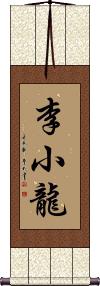
李小龍 is the real full name of Bruce Lee.
 Many people have no idea that Bruce Lee had a “real” Chinese name. In Mandarin and Cantonese, he is known as “Lǐ XiǎoLóng” and “Léi SíuLùng” respectively.
He kept his family name pronunciation (Li = Lee). 李 is a common family name that also means “plum.”
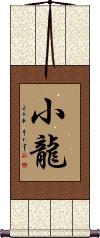
His given name 小龍 (Xiao-Long), literally means “little dragon.” 李小龍 is why you often see the character for dragon associated with Bruce Lee on various posters etc.
For a pronunciation lesson, the “X” in Romanized Mandarin is pronounced like a “sh” sound but with your tongue at the bottom of your mouth. The vowel sound in “Long” is like the English “oh,” not like the “ah” sound in the English word “long.”
If you are a big Bruce Lee fan, you should know this information, and you should have this wall scroll hanging in your room or martial arts studio.
Note: Japanese use these same Chinese characters / Kanji to write Bruce Lee's real name (with different pronunciation - which is a bit like how the name “Bruce Lee” sounds in English).
See Also: Kung Fu | Martial Arts
Bruce
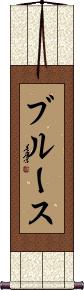
ブルース is the name Bruce in Japanese.
Note: Because this title is entirely Japanese Katakana, it should be written by a Japanese calligrapher.
Bruce
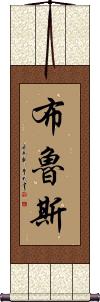
布魯斯 is the name Bruce in Chinese (Mandarin).
Little Dragon
Jeet Kune Do
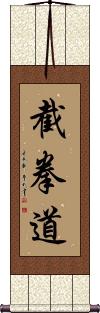
In Cantonese, 截拳道 is Jeet Kune Do. Often it is explained as the “Way of the Intercepting Fist.”
截拳道 is a martial art style founded by Bruce Lee.
The first character means to cut off or sever.
The second character is a fist.
The last character means way or method.
See Also: Bruce Lee
Kung Fu / Gong Fu
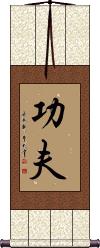
功夫 or Kung Fu is one of the most famous types of martial arts in the world - and not just because of Bruce Lee.
Some translate the meaning as “Accomplishment by Great Effort.” I think this is partially true, but directly translated, it literally means “Merit/Achievement/Accomplishment Man.” The word “fu” can sometimes mean “husband” or “porter,” but in this case, it can only mean “man.” However, few in China will think “man” when they hear the word “Gong Fu” spoken.
This term is also used for things other than martial arts. In fact, it's used to refer to a person with excellent skills in crafts that require a lot of effort to master, such as cooking, tea ceremonies, and calligraphy.
What a lot of people don't know is that the spelling of “Kung Fu” was actually taken from the old Wade Giles form of Romanization. Using this method, the sounds of the English “G” and “K” were both written as “K” and an apostrophe after the “K” told you it was supposed to sound like a “G.” Nobody in the west knew this rule, so most people pronounce it with a “K-sound.” And so, Gong Fu will always be Kung Fu for most westerners.
Also, just to educate you a little more, the “O” in “Gong” has a sound like the English word “oh.”
The popular Chinese dish “Kung Pao Chicken” suffers from the same problem. It should actually be “Gong Bao Chicken.”
Historical note: Many will claim that Kung Fu was invented by the monks of the Shaolin monastery. This fact is argued in both directions by scholars of Chinese history. Perhaps it is more accurate to say that the Shaolin Monks brought the original fame to Kung Fu many generations ago.
Japanese note: While most Japanese martial artists will recognize these characters, Katakana is more often used to approximate the pronunciation of "Kung Fu" with "カンフー." Some will argue as to whether this should be considered a Japanese word at all.
See Also: Bruce Lee
The key to immortality is first living a life worth remembering
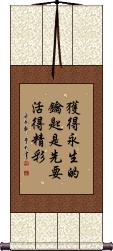
獲得永生的鑰匙是先要活得精彩 is a famous quote from Bruce Lee.
However, when quoted, he was speaking in English. So this is a translation of his English quote into Chinese. Since Bruce spoke both Chinese and English, his quotes sometimes go both ways.
Ip Man
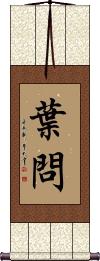
葉問 is the name of “Ip Man” or “Yip Man” (1893-1972).
He was a martial arts practitioner and master. He is perhaps most famous for being the master of Bruce Lee.
Unbreakable / Indestructible
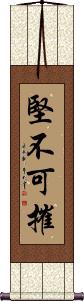
堅不可摧 means “unbreakable” in Chinese.
It can also mean invulnerable, indestructible, or impregnable.
You may be searching for this because you like the 2000 film, Unbreakable, starring Bruce Willis. This is the title of that film in Chinese.
Be Like Water
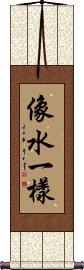
像水一樣 is a short quote from a much longer statement by Bruce Lee.
He summarized how people should be flexible to all circumstances, attacks, or situations. In the end, he exclaims, “Be like water, my friend.” 像水一樣 is the “Be like water” part alone since that seems to be what most people want.
Lee / Plum
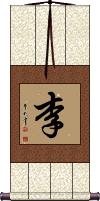
This is the most common Chinese character which sounds like “Lee” or “Li” and is used as a surname / family name in China.
李 actually means “Plum.” So it's really Mr. Plum and Mrs. Plum if you translated the name instead of romanizing.
This is not the only character in Chinese that can be romanized as “Lee” or “Li.” If your family name is “Lee” or “Li” please be sure this is the correct character before you order this scroll (look at your grandparents' Chinese passports or other documents if you are an ABC and are trying to create a heritage wall scroll).
Famous people with this surname include Bruce Lee (Li Xiao-Long), Minister Li Peng, and famous Tang Dynasty poet Li Bai.
In Korea, this is the original character for a surname that romanizes as “Yi.”
Note: This also one version of Lee that is a common Korean surname. However, it’s often romanized as "Yi" and sometimes as "Ri" or "Rhee."
Fatal error: Cannot redeclare foreignPrice() (previously declared in /home/gwest/web/chinesescrollpainting.com/public_html/includes/currencyconverter.php:22) in /home/gwest/web/orientaloutpost.com/public_html/includes/currencyconverter.php on line 22