Many custom options...


And formats...



Buddhism Buddha in Chinese / Japanese...
Buy a Buddhism Buddha calligraphy wall scroll here!
Personalize your custom “Buddhism Buddha” project by clicking the button next to your favorite “Buddhism Buddha” title below...
3. Buddhism
5. Pure Land Buddhism / Jodo Buddhism
8. Zen Buddhism
9. Three Treasures of Buddhism
10. Kensho Jobutsu - Enlightenment - Path to Buddha
11. Triple Truth of Japanese Buddhism
12. Ten perfect Mahayana rules
15. Appreciation of Truth by Meditation
16. Bodhi - Awakening Enlightenment
17. Pure Land / Jodo
18. Namu Amida Butsu
19. Bodhisattva
20. Kensho - Initial Enlightenment
21. Goddess of Mercy and Compassion
22. Walk in the Way
23. Siddhartha
26. Sangha
27. Avatar
28. Open Mind
29. Dharma / Buddhist Doctrine
30. The World
31. Thirst for Truth
32. Karma Connection
34. Nichiren
36. Light / Bright and Promising Future
37. The Middle Way
39. Nirvana
Buddhism / Buddha
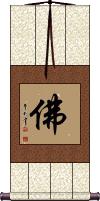
佛 is the essence of the Buddha or Buddhism.
Depending on the context, this word and character can be used to refer to the religion and lifestyle of Buddhism, or in some cases, the Buddha himself.
It is interesting to note that this word is separate from all others in the Chinese language. The sound of “fo” has only this meaning. 佛 is in contrast to many sounds in the Chinese language, which can have one of four tones, and more than 20 possible characters and meanings. This language anomaly shows how significantly Buddhism has affected China since ancient times.
More about Buddhism
佛 is also used with the same meaning in Korean Hanja.
It's used in the very religious context of Buddhism in Japan. It should be noted that there are two forms of this Kanji in use in Japan - this is the more formal/ancient version, but it's rarely seen outside of religious artwork and may not be recognized by all Japanese people.
It also acts as a suffix or first syllable for many Buddhist-related words in Chinese, Japanese, and Korean.
See our Buddhism & Zen page
See Also: Bodhisattva | Enlightenment
Buddha / Buddhism
Hotoke
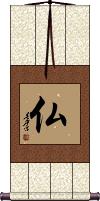
仏 is the single Japanese Kanji that can mean Buddha or Buddhism.
This Kanji was a shorthand way to write 佛 (Buddha) in Chinese (popular around the 13th century). Somehow, this became the version of this Chinese character that was absorbed into Japanese and thus became part of standard Kanji. Centuries later, this character is not recognized in China (except for those from China with a background in Chinese literature or language).
仏 is also a rare or derivative Korean Hanja form - but I doubt you will find any Korean that knows that.
Buddhism
(2 Kanji)
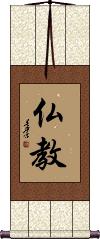
仏教 can mean Buddha or Buddhism in Japanese.
Depending on the context, this word can be used to refer to the religion and lifestyle of Buddhism or in some cases, the Buddha himself.
Note: Until the 5th century, Japan did not have a written language. At that time, Japan absorbed Chinese characters to form their written language (these characters are known as “Kanji” in Japanese). The first character of this Buddhism title was a shorthand way to write 佛 (Buddha) in Chinese (popular around the 13th century). Somehow, this became the version of this character that was absorbed into Japanese and thus became part of standard Kanji. Centuries later, this character is not recognized in China at all.
仏 is also a rare form of Buddha Korean Hanja - though seldom used even when the Korean Hanja writing system was more common 100 years ago.
Buddhism
(2 characters)
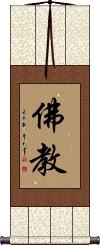
佛教 is the more exact way to express the religion or lifestyle of Buddhism.
It can also be read as “Buddha's Teachings.” 佛教 is Chinese only, as a different character is more commonly used in Japanese to express Buddhism. The same first character is used in Korea, but a slight variation exists in the second character in Korean Hanja. However, it would be fully recognized by any Korean person who can read Hanja.
Dharma / Damo / Daruma
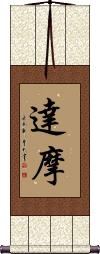
達摩 is the Chinese and Japanese title for Dharma (a short name for Bodhidharma).
He's known in Chinese as Damo and in Japanese as Daruma.
Note: In Japanese, they tend to write the last character as  versus
  . If you choose the Japanese master calligrapher, expect it to be written in the Japanese version.
Pure Land Buddhism / Jodo Buddhism
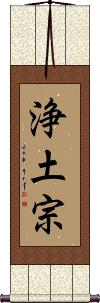
浄土宗 is the title of Japanese “Pure Land Buddhism.” This form is also romanized/known as “Jodo Shu” (jōdo shū).
Also known as Amidism for the fact that this is a branch of Mahayana (Mahāyāna) Buddhism which focuses on Amitabha (Amitābha) Buddha. This form of Buddhism, along with Chinese characters, came to Japan via China in the 5th century, according to most historians.
Notes:
Pure Land Buddhism is also known as 


 (jōdo bukkyō).
Some will just express it with just (Pure Land).
See Also: Shin Buddhism
The Principles of Buddhism
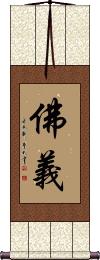
In short, 佛義 is the Principles of Buddhism, but there is more (especially for the second character):
佛 is the character for the Buddha and Buddhism.
義 has deeper meanings including justice, righteousness, morality, honour/honor, teachings, doctrine, right, proper, righteous, loyalty, purpose, or meaning. So the single word “principles” is often used to encompass all these ideas.
Namo Amitabha Buddha
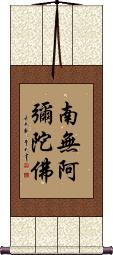
南無阿彌陀佛 is how to express “The Compassionate Amitabha Buddha” (especially for the Pure Land Buddhist Sect).
Some will translate as “Homage to Amitâbha Buddha” or “I seek refuge in the Amitâbha Buddha.”
This is valid in Chinese characters, Japanese Kanji, and old Korean Hanja.
Sometimes modern Japanese use a different version of the 4th and last Kanji, but the version shown here is the most universal.
This is used to pay homage to Amitabha Buddha.
See Also: Bodhisattva | Buddhism | Nirvana
Zen Buddhism
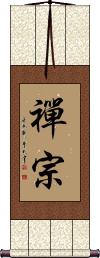
禪宗 is one way to title “Zen Buddhism.” Because the original pronunciation of Zen in Chinese is Chan, you'll also see this expressed as Chan Buddhism.
From the Buddhist Dictionary:
The Chan, meditative or intuitional, sect is usually said to have been established in China by Bodhidharma, the twenty-eighth patriarch, who brought the tradition of the Buddha-mind from India. This sect, believing in direct enlightenment, disregarded ritual and sūtras and depended upon the inner light and personal influence for the propagation of its tenets, founding itself on the esoteric tradition supposed to have been imparted to Kāśyapa by the Buddha, who indicated his meaning by plucking a flower without further explanation. Kāśyapa smiled in apprehension and is supposed to have passed on this mystic method to the patriarchs. The successor of Bodhidharma was 慧可 Huike, and he was succeeded by 僧璨 Sengcan, 道信 Daoxin, 弘忍 Hongren, 慧能 Huineng, and 神秀 Shenxiu, the sect dividing under the two latter into the southern and northern schools: the southern school became prominent, producing 南嶽 Nanyue and 靑原 Qingyuan, the former succeeded by 馬祖 Mazu, the latter by 石頭 Shitou. From Mazu's school arose the five later schools.
Three Treasures of Buddhism
The Triple Gem
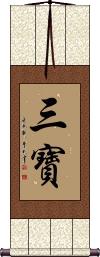
三寶 is the title for “Three Precious Treasures of Buddhism” or “The Triple Gem.”
These three treasures are the Buddha 佛, the Dharma 法 (teachings or the law of the Buddha), and the Sangha 僧 (the community of monks or followers).
This term is used by most (perhaps not all) Buddhists in China, Japan, and South Korea (written the same in the original form but pronounced differently in each language). Non-Buddhists may just read this as “Three Treasures” without the religious context. For instance, there is also a “Three Treasures of Chinese Medicine” that is sometimes titled the same way.
In modern Japanese and Simplified Chinese, this is written 三宝 instead of 三寶.
Kensho Jobutsu - Enlightenment - Path to Buddha
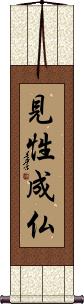
見性成仏 or Kenshō Jōbutsu is the initial enlightenment that leads to self-awareness, becoming Buddha, and the path to enter Nirvana.
Kenshō Jōbutsu is a complex concept in Japanese Buddhism. 見性成仏 is probably better translated as “Seeing one’s nature and becoming a Buddha.”
See Also: Buddhism | Enlightenment | Initial Enlightenment
Triple Truth of Japanese Buddhism

人間性を再生するのは寛容な心親切な言葉奉仕と思いやりの精神 is known as the Triple Truth of Buddhism in Japanese.
The Buddha ordered that all should know this triple truth...
A generous heart, kind speech, and a life of service and compassion are the things that renew humanity.
That is the English translation most commonly used for this Japanese Buddhist phrase. You might have seen this on a coffee cup or tee shirt.
Note: Because this selection contains some special Japanese Hiragana characters, it should be written by a Japanese calligrapher.
Ten perfect Mahayana rules
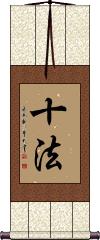
十法 is the title of the ten perfect or perfecting Mahāyāna rules.
The order of rules is as follows:
1. right belief.
2. right conduct.
3. right spirit.
4. the joy of the bodhi mind.
5. joy in the dharma.
6. joy in meditation.
7. pursuing the correct dharma.
8. obedience to, or accordance with dharma.
9. departing from pride, desire, etc.
10. comprehending the inner teaching of Buddha and taking no pleasure in attaining such knowledge or noting the ignorance of others.
This title is only used in the context of Buddhism. Japanese and Chinese people who are not familiar with Buddhism will not recognize this title.
Buddha Dharma Sangha
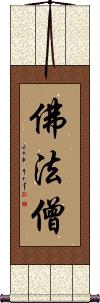
佛法僧 is the Buddha, Dharma, and Saṅgha.
These three characters are the “Triple Gem” of Buddhism or the Buddhist Trinity.
Shakyamuni / The Buddha
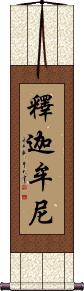
釋迦牟尼 is a transliteration of “Shakyamuni” or “Sakyamuni” in Chinese, Japanese, and old Korean.
The perceived meaning of the name is roughly translated as “Sage of the Sakyas.”
This same Buddha is also known as “Siddhartha Gautama,” “Gotama Buddha,” “Tathagata,” or simply, “The Supreme Buddha.”
Shakyamuni is the legendary man and prince who eventually established the Buddhist religion.
Note: Occasionally Romanized as “Siddhattha Gotama.”
This combination of characters is sometimes seen and used in South Korea and Japan as well (with the same meaning).
Note: 釋迦牟尼 came from the Sanskrit शाक्यमुनि and can also be romanized with diuretics as Śākyamuni.
Shakyamuni / The Buddha
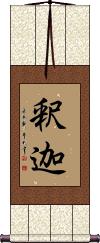
釈迦 is the way to write Shakyamuni in Japanese.
It's just two Kanji, the first is a simplified version of the one used in Chinese for Shakyamuni, and the second one is identical to the Chinese.
This refers to the Buddha (Siddhartha Gautama, 563 BCE-483 BCE) also known as Sakyamuni and Gautama Buddha.
This has a very good meaning in Japanese but is an odd selection for a wall scroll. It appears here more for reference.
Appreciation of Truth by Meditation
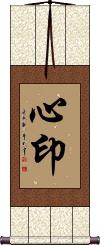
心印 is a Buddhist concept that simply stated is “appreciation of truth by meditation.”
It's a deep subject, but my understanding is that you can find truth through meditation, and once you've found the truth, you can learn to appreciate it more through further meditation. This title is not commonly used outside of the Buddhist community (your Asian friends may or may not understand it). The literal translation would be something like “the mind seal,” I've seen this term translated this way from Japanese Buddhist poetry. But apparently, the seal that is stamped deep in your mind is the truth. You just have to meditate to find it.
Soothill defines it this way: Mental impression, intuitive certainty; the mind is the Buddha-mind in all, which can seal or assure the truth; the term indicates the intuitive method of the Chan (Zen) school, which was independent of the spoken or written word.
Reference: Soothill-Hodous Dictionary of Chinese Buddhism
See Also: Zen
Bodhi - Awakening Enlightenment
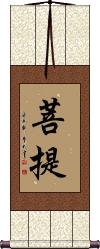
The Bodhi or 菩提 is the moment of completion in Buddhism.
It is when all things become known and you have completed your journey to enlightenment.
The reference is to the Bodhi tree where Siddhartha Gautama (the legendary man who established the Buddhist religion) achieved enlightenment. Sometimes this is referred to as “the tree of enlightenment,” but if you want the full version with the character for a tree at the end, please see the Bodhi Tree entry.
See Also: Buddhism | Buddha | Nirvana | Enlightenment
Pure Land / Jodo
Also a sect of Buddhism
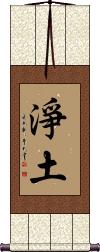
淨土 literally means “pure land” or “clean earth.”
淨土 is also the abbreviated title of a Buddhist sect that involves faith in the rebirth of Buddha Amitabha (Amitābha) in the Western Heaven. Sometimes this sect is translated as “Paradise of the West.” Other titles of this school of Buddhism include Amidism or Elysium.
See Also: Nirvana | Shin Buddhism
Namu Amida Butsu
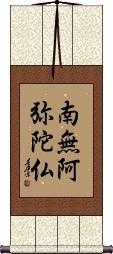
南無阿弥陀仏 is the modern Japanese version of “Namu Amida Butsu” or “The Compassionate Amitabha Buddha.”
Some will translate this as “I sincerely believe in Amitabha; Lord have mercy on me.”
This phrase especially applies to Japanese Pure Land Buddhists.
There is a universal version using ancient characters (with more strokes) for the 4th and last characters. That version is also used in Chinese, Korean, and occasionally Vietnamese.
This is used to pay homage to Amitabha Buddha.
See Also: Bodhisattva | Buddhism | Nirvana
Bodhisattva
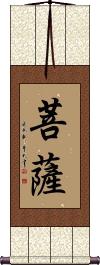
菩薩 is the title of a Buddhist deity that exists to help you reach enlightenment.
In Buddhist beliefs, a bodhisattva (bodhisatta) is dedicated to helping us achieve enlightenment. Bodhisattva means enlightenment truth which is bodhi sattva in Sanskrit.
This term is sometimes used to refer to a kindhearted person, one who will sacrifice himself/herself for others and lacks ego or desire but is instead devoted to the good and well-being of others.
See Also: Buddha | Namo Amitabha
Kensho - Initial Enlightenment
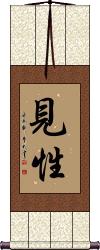
見性 has the same meaning as Satori but refers to the initial state or initial experience of enlightenment.
This can also mean “self-discovery,” “self-awareness,” or “consciousness of one's character.”
In a very religious context, this means to behold the Buddha nature within oneself.
This term is exclusively used by devout Buddhists. It is not a common term, and is remains an unknown concept to most Japanese and Chinese people. Some Japanese people will dispute whether this title is valid in the Japanese language. Only order this if you are sure this title is right for you.
See Also: Buddhism | Enlightenment
Goddess of Mercy and Compassion
This is the long or more formal version of this title
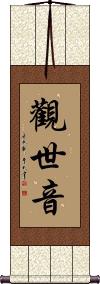
觀世音 is the longer and perhaps more formal title for the Buddhist deity known as the Goddess of Mercy or Bodhisattva of Compassion.
The longer title of this bodhisattva is Romanized in the following ways:
Mandarin Chinese: Guanshi Yin, Kuan-shih Yin.
Japanese: Kanzeon.
Sanskrit: Bodhisattva Avalokitesvara.
Korean: Gwan-se-eum.
Vietnamese: Quan Thế Âm.
Thai: Prah Mae Kuan Eim.
English: Bodhisattva of Mercy and Salvation, Goddess of Compassion, Buddha of Mercy, et al.
Please view our more common and shorter version, “Guan Yin” before you make a decision. Also, note that the first character has a slight variation in Japanese. If your audience is specifically Japanese, you may want to select that version.
Goddess of Mercy and Compassion
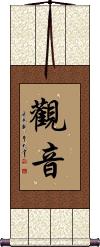
觀音/観音 is the Buddhist deity known as the Goddess of Mercy or Bodhisattva of Compassion.
In Chinese, the proper name of this being is Guan Yin. There is some debate as to whether Guan Yin is female. The argument comes from some scripture that suggests Buddhist deities take on the male form. Others say that Guan Yin has no sex. And still, others are okay with the female representation of Guan Yin.
This bodhisattva is also known or Romanized in the following ways:
Mandarin Chinese: Guan Yin, Kuan Yin, Kwan Yin.
Japanese: Kannon, Kwannon.
Sanskrit: Bodhisattva Avalokitesvara.
Korean: Gwan-eum.
Vietnamese: Quan Âm.
Thai: Kuan Eim.
English: Bodhisattva of Mercy and Salvation, Goddess of Compassion, Buddha of Mercy, et al.
Note: The first character has a slight variation in Japanese. If your audience is specifically Japanese, you may want to select that version.
See Also: Buddhism | Goddess | Namo Amitabha | Bodhisattva
Walk in the Way
The Way of Buddha Truth
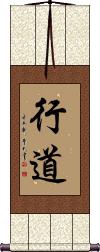
In Taoist and Buddhist contexts, 行道 means to “Walk in the Way.” In Buddhism, that further means to follow the Buddha truth. In some Buddhist sects, this can mean making a procession around a statue of the Buddha (always with the right shoulder towards the Buddha).
Outside of that context, this can mean route (when going somewhere), the way to get somewhere, etc.
In Japanese, this can be the surname or given name Yukimichi.
Siddhartha
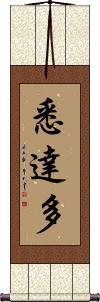
悉達多 is the name Siddhartha (as in Siddhartha Gautama), the personal name for Śākyamuni.
This same Buddha is also known as “Shakyamuni Gautama,” “Gotama Buddha,” or “Tathagata.”
Siddhartha Gautama was a spiritual teacher in the northern region of the Indian subcontinent who founded Buddhism. He is generally seen by Buddhists as the Supreme Buddha (Sammāsambuddha) of known human history.
The actual meaning of this name in Chinese is the realization of all aims, or simply being prosperous.
This name is sometimes romanized from the original Sanskrit or Pali as Siddhattha (from Siddhattha Gotama), Siddharth, Siddhārtha, or Sarvāthasiddha.
Siddhārtha or Sarvāthasiddha can also be written as 悉達, 悉多, 悉多頞他, or 悉陀.
Eternal Wheel of Life
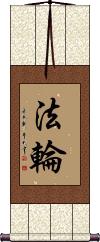
法輪 is the Chinese, Japanese Kanji, and old Korean Hanja title, “The Eternal Wheel of Life,” in Buddhism.
Also known as the wheel of the law, or Buddha-truth, which can crush all evil and all opposition. It is likened to Indra's wheel, which rolls on from man-to-man, place-to-place, age-to-age.
Colloquially used in some sects to mean preaching or spreading Buddha-truth.
Fudo Myo-o / Wisdom King
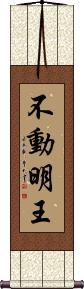
不動明王 is the fierce form of the Buddha Vairocana, and the most important of the Myō-ō or Ming Wang class of deities.
Romanized as Fudō Myō-ō, in Japanese Buddhism or Bùdòng Míngwáng / Pu-Tung Ming-Wang in Chinese Buddhism,
Originally Acala/Achala (अचल “The Immovable”), Acalanātha (अचलनाथ “Immovable Lord”) or Āryācalanātha (आर्याचलनाथ, “Noble Immovable Lord”).
In English, this deity is sometimes called “Wisdom King.”
Sangha
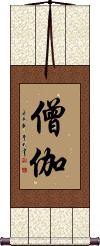
In Buddhism, 僧伽 refers to a community of monks and/or nuns (one of the “Three Jewels”). In general terms, it can simply mean “all followers of the Buddha.”
Notes: Though there are not vast numbers of Chinese Hindus, in the Hindu faith, this term means “community together.”
The original Sanskrit word is also Romanized as samgha.
The first character means “monk.” The second character means Buddha or Shakyamuni.
僧伽 is a transliteration of the original Sanskrit, but it uses two very profound Chinese characters related to Buddhism.
Some may pronounce this as “seng qie” or “seng jia” in Mandarin (two possible pronunciations for the second character). Note that “qie” sounds like “chee-ah” using typical English pronunciation. Chinese Romanization is not actually designed to match English sounds.

 Note that when writing this as Kanji, Japanese will tend to write the first character in the form shown to the right. If you select our Japanese master calligrapher, please expect this special Kanji form. However, it should also be noted that this is not a common term in Japanese (except by certain sects of Buddhism or perhaps devout Buddhists in Japan).
Avatar
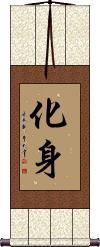
化身 is a way to say avatar in Chinese characters, Korean Hanja, and Japanese Kanji.
This is the original Buddhist idea of an avatar (not the movie). This can also mean: incarnation; reincarnation; embodiment; personification; impersonation.
化身 is the Chinese word used for the original Sanskrit, nirmāṇakāya. Alternates for nirmāṇakāya include 應身, 應化身, or 變化身. In the context of Buddhism, this is a Buddha's metamorphosic body, which has the power to assume any shape to propagate the Truth. This title, 化身, is used for the appearance of a Buddha's many forms.
Open Mind
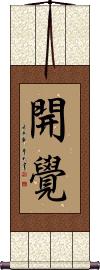
開覺 is a Buddhist term meaning “open mind.”
The more full definition as used in Buddhism is, “To arouse, awaken; to allow the original Buddha-nature to open and enlighten the mind.”
Dharma / Buddhist Doctrine
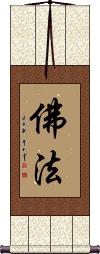
The World
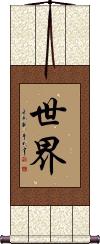
世界 is the Chinese, Japanese Kanji, and old Korean Hanja for the world.
Beyond the world, this can refer to society, the universe, space, a sphere, or a circle.
In Buddhism, this would mean the realm governed by one Buddha.
Thirst for Truth
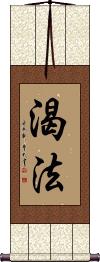
渴法 means to thirst for the truth or the Buddha-way.
渴法 is the internal need to seek the way of the truth in Buddhism.
Karma Connection
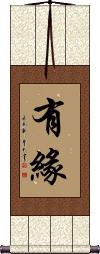
有緣 means: related; brought together by fate; same karma; those who have the cause, link, or connection.
有緣 is a common word in Chinese but usually only used in the context of Buddhism in Japanese.
Buddhists will say this refers to those that are influenced by and responsive to the Buddha.
The Original Mind
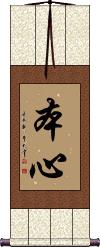
In Zen Buddhism, 本心 means “original mind” or “original heart,” which refers to one's Buddha-nature present from birth.
This can also be translated as true feelings, real intention, one's own heart, one's right mind, one's senses, one's conscience, or fundamental mind.
Note: 心 can mean heart or mind - thought in ancient Asia to be the same organ.
Nichiren
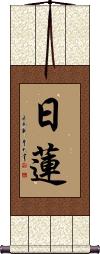
日蓮 is the title Nichiren.
This title refers to a Buddhist priest who lived from 1222 to 1282. He is the founder of the Nichiren sect of Buddhism.
According to historical documents, the Nichiren sect was established in 1252. Adding the character 宗 for sect, this would be 日蓮宗 (Nichiren sect), which is also known as the 法華宗 or Lotus sect.
According to Soothill-Hodous...
Nichiren's chief tenets are the three great mysteries 三大祕法, representing the trikāya:
1. 本尊 or chief object of worship, being the great maṇḍala of the worlds of the ten directions, or universe, i.e., the body or nirmāṇakāya of Buddha.
2. 題目 the title of the Lotus Sutra 妙法蓮華經 Myo-ho-ren-ge-kyo, preceded by Namo, or “Adoration to the scripture of the lotus of the wonderful law,” for it is Buddha's spiritual body.
3. 戒壇 the altar of the law, which is also the title of the Lotus as above; the believer, wherever he is, dwells in the Pure-land of calm light 寂光淨土, the saṃbhogakāya.
Five Ancestors Fist
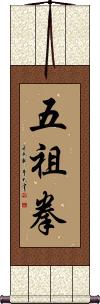
五祖拳 is a martial arts concept (or school) known as Five Ancestors' Fist.
The first character means five.
The second means ancestor, forefather, or grandparents.
The third means fist.
The ancestors referred to by this title and whose attributes contribute to this style are as follows:
1. Grace of the White Crane.
2. Agility of the Monkey.
3. Precision and skill of Emperor Taizu (great mythical ancestor).
4. Power of Luohan (Buddhist arhat).
5. Breath of Damo (founder of Buddhism, or the first Buddha).
Light / Bright and Promising Future
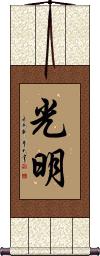
光明 is a nice way to say “light” in Chinese and old Korean Hanja.
This is because the word also suggests a bright future or refers to someone who is very promising (great future potential).
The first character means light or bright.
The second character means bright and clear (in this context).
This word appears in most Japanese dictionaries, but it is not the most common Japanese Kanji word for light (more commonly used for the name Mitsuharu).
In old Korean Hanja, this can also mean brightness or brilliance.
In the context of Buddhism, this means “Light emanating from a Buddha or Bodhisattva, symbolizing their wisdom and compassion.”
The Middle Way
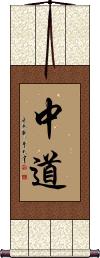
In the most basic translation, 中道 means road through the middle or middle road.
The expanded meaning can be moderation or the golden mean.
But if you are looking for this title, you are probably seeking the Buddhist definition, which is more complex.
中道 is the middle way or middle path of Buddhism. This has various interpretations. In general, it denotes the mean between two extremes and has special reference to the mean between realism and nihilism, or eternal substantial existence and annihilation.
The Buddha teaches that one should not take things to extremes. Don't be extremely evil and engage in debauchery and murder. But do not spend every waking out trying to be a perfect saint. Instead, take the middle path, try to help others, show loving kindness wherever you can, and try not to do harm. If you inadvertently harm another being, make amends if you can, and move on. Realize you are not perfect, but in time, a path of moderation lead toward proper living and enlightenment.
Sangha / Order of Monks
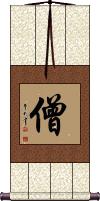
僧 is the single-character or short form of Sangha, the Buddhist idea of community or order (of monks, nuns, or followers of the Buddha).
Alone, this character can simply mean “monk” (Just means monk in Japanese).
Note that when writing this as Kanji, Japanese will tend to write this in the form shown to the right. If you select our Japanese master calligrapher, please expect this special Kanji form.
Nirvana
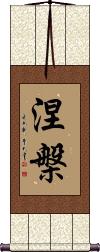
涅槃/涅盤 are the Chinese characters that mean Nirvāṇa. I will let you decide what Nirvana means to you.
This can also be translated as “Buddha's death and salvation” or “death of a Buddhist monk,” depending on the context. However, this is not seen with any bad meaning. You could replace “death” with “moving on,” as that is how it's seen in a Buddhist context.
More info from our dictionary: Nirvana
Fatal error: Cannot redeclare function foreignPrice() (previously declared in /home/gwest/web/chinesescrollpainting.com/public_html/includes/currencyconverter.php:22) in /home/gwest/web/orientaloutpost.com/public_html/includes/currencyconverter.php on line 22