Many custom options...


And formats...



Buddhist Monk in Chinese / Japanese...
Buy a Buddhist Monk calligraphy wall scroll here!
Personalize your custom “Buddhist Monk” project by clicking the button next to your favorite “Buddhist Monk” title below...
3. To Know Hardship, One Must Experience It
4. Nirvana
6. Meet the Buddha, Kill the Buddha
7. Ikkyu
8. Grand Master / Great Teacher
10. Paramartha
Buddhist Monk
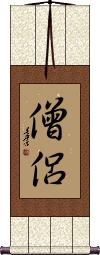
僧侶/僧侶 is a Japanese title for a Buddhist monk.
The first Kanji means Buddhist priest or monk by itself.
The second Kanji means follower or companion.
 Note, if you order this from the Japanese master calligrapher, the first character will look a bit more like the Kanji shown to the right than the Kanji shown above. Let us know if you have a preference, as both versions are technically-correct in both Chinese and Japanese.
Sangha / Order of Monks
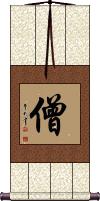
僧 is the single-character or short form of Sangha, the Buddhist idea of community or order (of monks, nuns, or followers of the Buddha).
Alone, this character can simply mean “monk” (Just means monk in Japanese).
 Note that when writing this as Kanji, Japanese will tend to write this in the form shown to the right. If you select our Japanese master calligrapher, please expect this special Kanji form.
To Know Hardship, One Must Experience It
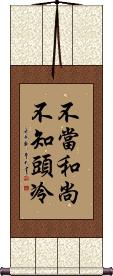
不當和尚不知頭冷 is a Chinese proverb that literally translates as: [One who has] not been a monk [does] not know [the feeling of a] cold head.
I need to explain that a Chinese Buddhist monk always has a shaved head, and thus a cold head in winter.
Figuratively, this means: One cannot know the true meaning of hardship until one has experienced it oneself.
This is an idiom in Chinese, so the figurative meaning is what people perceive when they hear or read this phrase. Just as in English, when someone says, "The grass is always greener," one will think about the idea of jealousy, rather than the quality of one’s lawn.
Nirvana
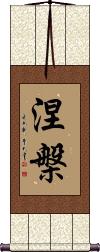
涅槃/涅盤 are the Chinese characters that mean Nirvāṇa. I will let you decide what Nirvana means to you.
This can also be translated as “Buddha's death and salvation” or “death of a Buddhist monk,” depending on the context. However, this is not seen with any bad meaning. You could replace “death” with “moving on,” as that is how it's seen in a Buddhist context.
More info from our dictionary: Nirvana
Ten Commandments
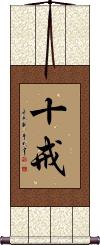
十戒 means Ten Commandments or Ten Precepts.
In the Buddhist context, these are prohibitions consisting of five commandments for the layman:
1. Not to destroy life 不殺生 Pāṇātipātāveramaṇi.
2. Not to steal 不倫盜 Adinnādānāver.
3. Not to commit adultery 不婬慾 Abrahmacaryaver.
4. Not to lie 不妄語 Musāvādāver.
5. Not to take intoxicating liquor 不飮酒 Suramereyya-Majjapamādaṭṭhānāver.
The ten commandments for the monk are the preceding five plus:
6. Not to eat food outside of regulated hours 不非時食 Vikāla-Bhojanāver.
7. Not to use garlands or perfumes 不著華鬘好香塗身 Mālā- Gandha-Vilepana-Dhāraṇa-Maṇḍana-Vibhūṣanaṭṭhānā.
8. Not to sleep on high or broad beds (chastity) 不坐高廣大牀 Uccāsayanā-Mahāsayanā.
9. Not to take part in singing, dancing, musical or theatrical performances 不歌舞倡伎不往觀聽 Nacca-Gīta-Vādita-Visūkadassanāver.
10. To refrain from acquiring uncoined or coined gold, or silver, or jewels 不得捉錢金銀寶物 Jātarūpa-Rajata-Paṭīggahaṇāver.
These original Buddhist commandments date back to about 2500 years ago. The English definitions above are followed by Chinese characters and original Pali pronunciation.
Under the Māhayāna Buddhism, these ten commands for the monk were changed, to accord with the new environment of the monk, to the following: not to kill, not to steal, to avoid all unchastity, not to lie, not to slander, not to insult, not to chatter, not to covet, not to give way to anger, to harbor no skepticism.
Meet the Buddha, Kill the Buddha
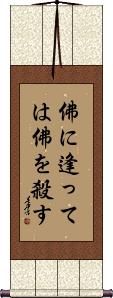
This controversial Buddhist koan means “On encountering Buddha, you should kill him.”
This is the short concise Japanese version of an original statement by ninth-century Chinese Buddhist monk Linji Yixuan, “If You Meet The Buddha On The Road, Kill Him.”
This takes some explaining... The concept here is that if you think you have seen, experienced, or achieved true enlightenment, the chances that you really have are so slim that you should kill or dismiss that idea.
Another suggestion is that one's path to becoming a Buddha is one's own, and one should not get caught up in religious fervor, and avoid “showing off” that they are a Buddhist.
Helpful references for this concept:
Lion's Roar addresses "If You Meet The Buddha On The Road, Kill Him"
Kill the Buddha
Note: Because this selection contains some special Japanese Hiragana characters, it should be written by a Japanese calligrapher.
Ikkyu
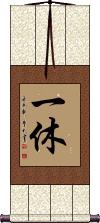
一休 is the Japanese name Ikkyuu, Ikkyū, or Ikyu.
This can sort of mean “instant” or “a rest.”
Chinese people will recognize this as the name of a famous Japanese Buddhist monk.
Grand Master / Great Teacher
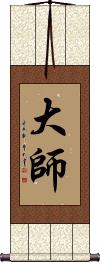
大師 is a way to title a great master, grand master, or great teacher.
This can be used in the context of martial arts or a Buddhist teacher. Thus, it can be used to title a living Buddha, Bodhisattva, or high-ranking monk.
Silent / Solitary
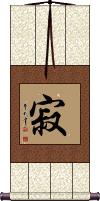
寂 means silent, solitary, quiet, calm, still, rest, or tranquil.
This also has a strong association with Buddhism where it can mean “entering into Nirvana.” In that context, this is sometimes used to refer to the passing of a Buddhist monk (he is silent, as he has entered Nirvana). For the living, this is about tranquility (especially of mind).
Some will also use this to mean “elegant simplicity.”
From Sanskrit, this can represent praśama, vivikta, śānti, or nibbāna (nirvāṇa).
Paramartha
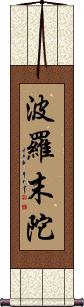
波羅末陀 is the Chinese and Japanese way to write the ancient Sanskrit word Paramārtha or परमार्थ which now means the highest truth, ultimate truth, ultimate reality, or fundamental meaning.
Paramārtha is the name of a famous Buddhist monk born in 499 CE. Paramārtha traveled the world (including Cambodia and territories that are now part of China) to spread the teachings of Buddhism by translating scriptures into the local languages so the truth could be understood by the masses.
So, we should all want to be a Paramārtha who brings the ultimate truth, knowledge, and enlightenment to others.
Fatal error: Cannot redeclare function foreignPrice() (previously declared in /home/gwest/web/chinesescrollpainting.com/public_html/includes/currencyconverter.php:22) in /home/gwest/web/orientaloutpost.com/public_html/includes/currencyconverter.php on line 22