Many custom options...


And formats...



Child in Chinese / Japanese...
Buy a Child calligraphy wall scroll here!
Personalize your custom “Child” project by clicking the button next to your favorite “Child” title below...
1. Child
2. Child of God
3. Spare the Rod, Spoil the Child
4. If you love your child, send them out into the world
5. Love Between Child and Parents
6. Love Gems / Fruit of Love / Children
8. Beloved Son / Beloved Child
9. Love Your Children, But Discipline Them Too
10. Baby
11. First Born
12. Riko / Yuriko / Noriko / Satoshi
13. God Daughter
14. Prince
15. Riko
16. Daddy’s Girl / Daddy’s Boy
17. Riko / Momoko
18. Kagune
19. Forever Family
20. Brotherly and Sisterly Love
Child
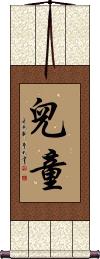
兒童 is how to write “child” in Chinese.
There are several ways to write child or offspring in Chinese, but this is the best form for calligraphy, or written (versus oral) form.
If children are essential to you, this might be the scroll you want. Or if you are a child at heart, this also works.
 In Japanese, they use a slightly-morphed version of the original Chinese first character. If you want the special Japanese version, please click on the Kanji image shown to the right, instead of the button above. Note: Japanese people would still be able to understand the Chinese version and vice versa.
See Also: Family
Child of God
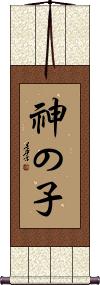
神の子 is “Child of God” in Japanese.
Child of God
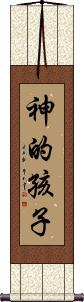
神的孩子 is “Child of God” in Chinese.
Spare the Rod, Spoil the Child
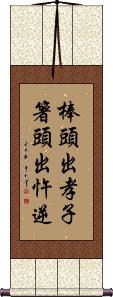
棒頭出孝子箸頭出忤逆 literally translates as:
A stick (or switch) produces filial sons; chopsticks produce disobedient [ones].
Figuratively, this means:
Strict discipline produces dutiful children, whereas indulgence produces disobedient ones.
This proverb is very similar to this English proverb:
“Spare the rod and spoil the child.”
If you love your child, send them out into the world
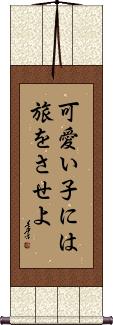
可愛い子には旅をさせよ is a Japanese proverb that means “If you love your children, send them out on a journey into the world.”
This is kind of similar to the western phrase, “Spare the rod and spoil the child.”
More literally, this reads, “Cute child, a journey granted.”
That “granted” could also be understood as “should be initiated.”
Note: Because this selection contains some special Japanese Hiragana characters, it should be written by a Japanese calligrapher.
Love Between Child and Parents
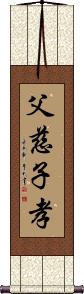
父慈子孝 is a Chinese proverb that means “benevolent father, filial son.”
Figuratively, this is the natural love between parents and children.
Love Gems / Fruit of Love / Children
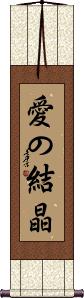
愛の結晶 is a Japanese word that means the crystals or gems of love.
Figuratively, it means the treasures you create with your love (namely, your children). Some will translate this as “fruit of love.”
It's also kind of a nickname for your beloved children.
God Son / God Child
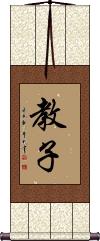
教子 is the title for a child which you have a sworn duty to raise should the child's parents die.
This title suggests it's talking about a son (male child), but this title is universal and can mean God Child (with no gender specified).
Beloved Son / Beloved Child
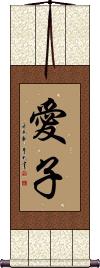
愛子 means “beloved son” in Chinese and Japanese.
While it could refer to a child in general (in Japanese), it's usually reserved or expected to be a title for a male child (in Chinese).
This can also be a given name in Japanese romanized as Aiko or Yoshiko.
Love Your Children, But Discipline Them Too
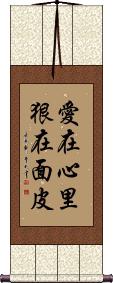
爱在心里狠在面皮 literally translates as “Love [your] children in [your] heart, [but] be stern [with them] in [your] manner.”
This is a little like saying “Love your child but don't spare the switch.”
Baby
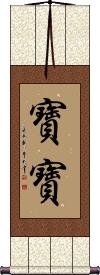
寶寶 is how Chinese people express “baby.”
The word is composed of the same character twice, and therefore literally means “double precious” or “double treasure.”
This would be a nice wall scroll to put either inside or by the door of your baby's room (not on the door, as wall scrolls swing around wildly when hung on doors that open and close a lot).
Baby
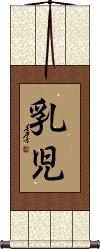
乳児 is a common two-Kanji way to write “baby” in Japanese.
This can also be translated as “infant” or “suckling baby.”
Baby
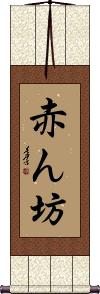
赤ん坊 is one way that Japanese people express “baby.”
First Born
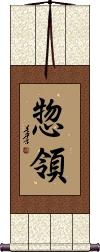
惣領 is a Japanese title for the eldest child, the oldest child, firstborn child, or child who carries on the family name.
In more ancient times, this was used to refer to the head of a warrior clan. It can also be a place name or given name “Souryou” or “Soryo” in Japanese.
Riko / Yuriko / Noriko / Satoshi
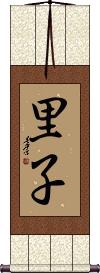
This can be the Japanese female given names Riko, Yuriko, Noriko, or Satoshi.
A little awkwardly, when pronounced as Satoko, this means foster child.
Literally, the characters mean “village child.”
God Daughter
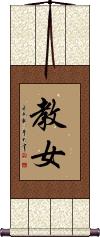
教女 is the title for a female child, which you have a sworn duty to raise should the girl's parents die.
The second character specifically designates that we are talking about a female child, thus the title God Daughter.
See Also: Family
Prince
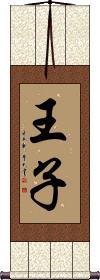
王子 is prince in Chinese characters and Japanese Kanji.
If you look at the meaning of each character, the first means king, and the second means son (or child). Thus, “King's Son,” “Son of the King,” or “King's Child” is the literal meaning of this title.
Riko
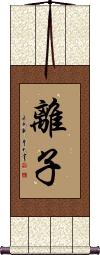
離子 is one of several Japanese female given names that romanize as Riko.
This one vaguely means independent child. Though it can also refer to an ion (a departing particle).
Daddy’s Girl / Daddy’s Boy
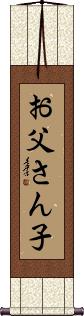
This modern Japanese word means Daddy’s Girl or Daddy’s Boy.
It refers to a child strongly attached to his/her father.
Note: Because this selection contains some special Japanese Hiragana characters, it should be written by a Japanese calligrapher.
Riko / Momoko
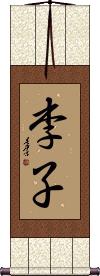
李子 is one of several Japanese female given names that romanize as Riko, Momoko, or Satoko.
This one is associated with a plum. It literally means “plum child.”
Kagune
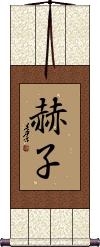
When 赫子 is pronounced as Kagune in the context of Tokyo Ghoul, this is a ghoul's predatory organ and functions as their weapon and claws.
赫子 actually means shining or awe-inspiring child and is also the female given name Kakuko in Japan.
Forever Family
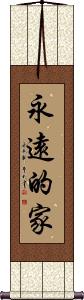
永遠的家 is a special phrase that we composed for a “family by adoption” or “adoptive family.”
It's the dream of every orphan and foster child to be formally adopted and find their “forever family.”
The first two characters mean forever, eternal, eternity, perpetuity, immortality, and/or permanence. The third character connects this idea with the last character which means “family” and/or “home.”
See Also: Family
Brotherly and Sisterly Love
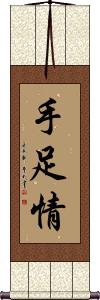
手足情 is the love between siblings.
When you love, protect, care for, and have a deep bond that only brothers or sisters can.
The actual translation is “Hand and Foot,” but the relationship between brothers or sisters is like that of hands and feet. They belong together and complete the body. Even though this says “hand and foot,” it will always be read with the brotherly and sisterly love meaning in Chinese.
Note: During the past 20 years, the “One child policy” in China is slowly making this term obsolete.
Never Forget Your First Resolution
Never Lose Your Beginner's Spirit
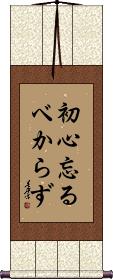
初心忘るべからず is an old Japanese proverb that suggests you try to never forget the enthusiasm you had as a child when you try new things (or even face the day-to-day). Basically, avoid having the mundane attitude that many people get with age.
You'll find this Japanese proverb translated in a few different ways. Here are some of them:
Don't forget your first resolution.
Never forget your childlike enthusiasm.
Forget not the beginner's mind.
Try never to lose your initial enthusiasm (freshness of attitude).
Note: This is sometimes written as 初心忘る可からず. The one shown above is used about 10x more often. There’s only one character difference between the two versions.
Note: Because this selection contains some special Japanese Hiragana characters, it should be written by a Japanese calligrapher.
Appreciation and Love for Your Parents
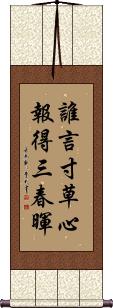
誰言寸草心報得三春暉 is the last line of a famous poem. It is perceived as a tribute or ode to your parents or mother from a child or children that have left home.
The poem was written by Meng Jiao during the Tang Dynasty (about 1200 years ago). The Chinese title is “You Zi Yin” which means “The Traveler's Recite.”
The last line as shown here speaks of the generous and warm spring sunlight which gives the grass far beyond what the little grass can could ever give back (except perhaps by showing its lovely green leaves and flourishing). The metaphor is that the sun is your mother or parents, and you are the grass. Your parents raise you and give you all the love and care you need to prepare you for the world. A debt that you can never repay, nor is repayment expected.
The first part of the poem (not written in the characters to the left) suggests that the thread in a loving mother's hands is the shirt of her traveling offspring. Vigorously sewing while wishing them to come back sooner than they left.
...This part is really hard to translate into English that makes any sense but maybe you get the idea. We are talking about a poem that is so old that many Chinese people would have trouble reading it (as if it was the King James Version of Chinese).
Fatal error: Cannot redeclare foreignPrice() (previously declared in /home/gwest/web/chinesescrollpainting.com/public_html/includes/currencyconverter.php:22) in /home/gwest/web/orientaloutpost.com/public_html/includes/currencyconverter.php on line 22