Many custom options...


And formats...



Dana: Almsgiving and Generosity in Chinese / Japanese...
Buy a Dana: Almsgiving and Generosity calligraphy wall scroll here!
Dana: Almsgiving and Generosity
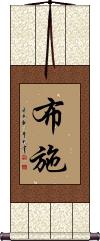
布施 is the Buddhist practice of giving known as Dāna or दान from Pali and Sanskrit.
Depending on the context, this can be alms-giving, acts of charity, or offerings (usually money) to a priest for reading sutras or teachings.
Some will put Dāna in these two categories:
1. The pure or unsullied charity, which looks for no reward here but only in the hereafter.
2. The sullied almsgiving whose object is personal benefit.
The first kind is, of course, the kind that a liberated or enlightened person will pursue.
Others will put Dāna in these categories:
1. Worldly or material gifts.
2. Unworldly or spiritual gifts.
You can also separate Dāna into these three kinds:
1. 財布施 Goods such as money, food, or material items.
2. 法布施 Dharma, as an act to teach or bestow the Buddhist doctrine onto others.
3. 無畏布施 Courage, as an act of facing fear to save someone or when standing up for someone or standing up for righteousness.
The philosophies and categorization of Dāna will vary among various monks, temples, and sects of Buddhism.
Breaking down the characters separately:
布 (sometimes written 佈) means to spread out or announce, but also means cloth. In ancient times, cloth or robs were given to the Buddhist monks annually as a gift of alms - I need to do more research, but I believe there is a relationship here.
施 means to grant, to give, to bestow, to act, to carry out, and by itself can mean Dāna as a single character.
Dāna can also be expressed as 檀那 (pronounced “tán nà” in Mandarin and dan-na or だんな in Japanese). 檀那 is a transliteration of Dāna. However, it has colloquially come to mean some unsavory or unrelated things in Japanese. So, I think 布施 is better for calligraphy on your wall to remind you to practice Dāna daily (or whenever possible).
Fatal error: Cannot redeclare function foreignPrice() (previously declared in /home/gwest/web/chinesescrollpainting.com/public_html/includes/currencyconverter.php:22) in /home/gwest/web/orientaloutpost.com/public_html/includes/currencyconverter.php on line 22