Many custom options...


And formats...



Daoism Taoism in Chinese / Japanese...
Buy a Daoism Taoism calligraphy wall scroll here!
Personalize your custom “Daoism Taoism” project by clicking the button next to your favorite “Daoism Taoism” title below...
3. Daw
4. Ethics / Ethical / Morality
6. Nature
7. The Tao or Dao of Being Human / Humanity
8. Tao / Dao of the Heart / Soul
9. Kodokan
10. Karate-Do
Daoism / Taoism
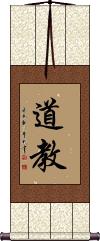
道教 is the title often used in both Chinese and Japanese to describe the beliefs or religion of Taoism / Daoism.
The first character is simply “dao” and the second character can be translated as “teachings,” “faith” or “doctrine.”
Daoism / Taoism
Literally: The Way or Road
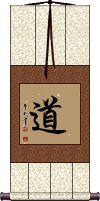
道 is the character “dao” which is sometimes written as “tao” but pronounced like “dow” in Mandarin.
道 is the base of what is known as “Taoism.” If you translate this literally, it can mean “the way” or “the path.”
Dao is believed to be that which flows through all things and keeps them in balance. It incorporates the ideas of yin and yang (e.g. there would be no love without hate, no light without dark, no male without female.)
The beginning of Taoism can be traced to a mystical man named
Lao Zi (604-531 BC), who followed, and added to the teachings of Confucius.
More about Taoism / Daoism here.
Note that this is pronounced “dou” and sometimes “michi” when written alone in Japanese but pronounced “do” in word compounds such as Karate-do and Bushido. It's also “do” in Korean.
Alternate translations and meanings: road, way, path; truth, principle province.
Important Japanese note: In Japanese, this will generally be read with the road, way, or path meaning. Taoism is not as popular or well-known in Japan so Daoist/Taoist philosophy is not the first thing a Japanese person will think of when they read this character.
See our Taoism Page
Lao Tzu / Laozi
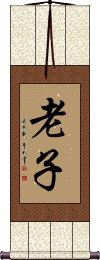
Depending on the romanization scheme you use, this man's name can be spelled Laozi, Lao Tzu, or Lao Tze. In older English usage, he was known as Laocius. He is believed to have lived around 500 B.C.
He was a Chinese philosopher, founder of Daoism/Taoism, credited with being the author of the sacred and wise book of Daoism/Taoism.
There is a theory that Lao Tzu's soul traveled to India and was reborn as the Buddha.
道 is the name Daw in Chinese (Mandarin).
This actually means the “Way” in Chinese (as in Taoism or Daoism), so there could be some confusion.
Ethics / Ethical / Morality
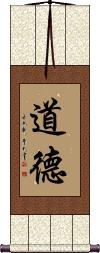
道德 is a Chinese, Japanese, and old Korean word that can also be defined as “moral principles,” morality, ethics, ethical, morals, or virtue.
The first character is the same that is associated with Daoism / Taoism. This word is also used to express morality, virtue, or simply morals.
 There is a slight deviation in the Japanese Kanji form. If you want the modern Japanese version, please click on the special Kanji shown to the right instead of the button above. Note that the traditional Chinese form is still readable and understood by Japanese people.
The Old Way / Old School
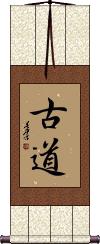
古道 is the Japanese word meaning “The Old Way.” The first character means old or ancient. The second character means “the way” and is the same character as used in Taoism / Daoism (Taoism literally means “the way”).
This second character can also be translated as “method,” as in a way of doing things.
古道 is sometimes Romanized as “Kodo,” though officially, the Romaji should be “Kodou.”
My Japanese-English dictionary further translates this word as the old road, ancient methods, ancient moral teachings, and the way of learning.
Note that this would be understood differently in Chinese. Most Chinese people would just read this as “The old road” without the other meanings derived in Japanese.
Nature
The natural world
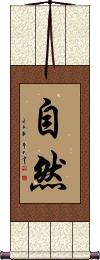
自然 is the simple way to express nature in Chinese, Japanese Kanji, and old Korean Hanja.
This can also be translated as “the natural world.”
In Japanese and Korean, this term is sometimes used to signify spontaneity or a spontaneous act.
In the context of Taoism or Daoism, this is a key concept that literally means “of its own” or “by itself” and thus naturally, natural, spontaneously, freely, or in the course of events.
Also known as known as ziran or tzu-jan
The Tao or Dao of Being Human / Humanity
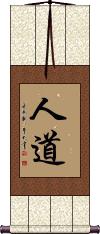
人道 is literally the “The Way of Being Human,” or “The Human Way.” It can also be translated as “humanity.”
人道 has a secondary meaning of “sidewalk” as in “the way for people to walk” (in Japanese and Korean only). But as calligraphy artwork, nobody will read it with that translation.
Please note that there are two ways to Romanize Dao or Tao (Daoism = Taoism). It's the same word in Chinese.
Tao / Dao of the Heart / Soul
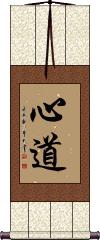
心道 means “The Way of the Heart” or “The Way of the Soul.” The first character means “heart” but can also mean soul, spirit, mind, or your essence. In this case, it is most accurately translated with the heart or soul meaning.
The second character is Dao as in Daoism. Please note, this is the same thing as Tao as in Taoism (just Romanized differently - it's always been the same in Chinese for about 2300 years.
Kodokan
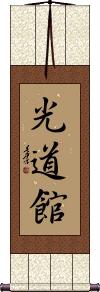
光道館 is Kodokan.
This is the title of an Aikido dojo, studio, or hall.
Be careful in selecting the correct Kodokan, as there are a few different titles that romanize as Kodokan.
Here's how the characters break down in meaning for this one:
1. Light / Bright
2. Way / Path (the Tao/Dao as in Taoism/Daoism)
3. Schoolroom / Building / Establishment / Mansion / Hall (of learning)
Altogether, you get something like “The Path of Light Establishment.”
Kodokan
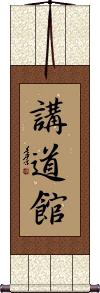
講道館 is a title that refers to a certain kind or school of Judo martial arts.
Here's how the characters break down in meaning for this one:
1. Mutual Assistance or Association. Can also refer to a lecture, speech, or explaining something (as in teaching).
2. Way / Path (the Tao/Dao as in Taoism/Daoism)
3. Schoolroom / Building / Establishment / Mansion / Small Castle / Hall (of learning)
Altogether, you get something like, “The Path of Mutual Learning Hall.”
More about Kodokan from the Institute of Kodokan.
Kodokan
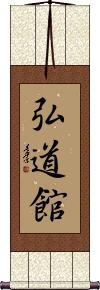
弘道館 is a Japanese title that romanizes as Kodokan.
There are a few martial arts titles that are romanized as Kodokan, so be careful to choose the correct one. This one kind of means “Great Way Hall.”
In the old Buddhist context, the 弘 Kanji can mean vast, great, to enlarge, spread abroad, or widely to proclaim.
The 道 part is the “Way,” as seen in many martial arts titles. It is the root character of Taoism/Daoism (romanized as Tao or Dao from Chinese, but Do in Japanese).
The 館 or hall part is implied to be a dojo or place of learning.
Karate-Do
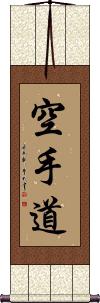
The literal meaning of 空手道 is “empty hand method” or “empty hand way.”
Credit is given that karate started in China but migrated and became refined and vastly popular in Japan.
Karate is a martial art that uses no blades or weapons other than the “natural weapons” God gave to humans (fists and feet). The last character somehow became optional, but the meaning of that character is “method” or “the way” as in Taoism / Daoism.
Karate-Do reached Korea, where it is known as 공수도 which can be romanized as “Kong Soo Do” or “Gong Su Do.”
Three Treasures of Chinese Medicine
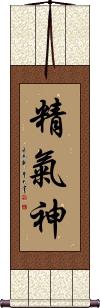
精, 氣, 神 are the characters jing, qi, and shen.
As a set, these three characters are known in English as the treasures of traditional Chinese medicine, the treasures of Qi Gong, or the three treasures of Taoism / Daoism.
Sometimes this set is titled 三寶 (sānbǎo) or “three treasures,” but here, we're writing each treasure out.
Here's how these characters are perceived in this context...
Jing: nutritive essence; refined; perfected; pure
Qi: vitality; energy; force; breath; vigor
Shen: spirit; soul; mind; being
To keep it simple, you can use “essence, vitality, and spirit” to define these.
Martial Arts / Budo
Way of the Warrior
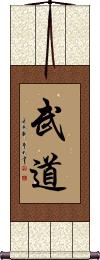
武道 is the very common Japanese way to say “Martial Arts.”
武道 is used mostly in Japanese dojos but is also understood in Chinese and Korean.
Some will use this title to mean chivalry (the conduct of a knight) or military art. The way this word is understood would depend on the context in which it is used.
The first character means “force,” “warlike,” or “essence of a warrior.”
The second character means “method,” “path,” and “the way.” It is the same character used to describe/mean the philosophy of Taoism / Daoism.
Some will also translate this as “The Way of the Warrior”; especially in the context of Korean martial arts.
Fatal error: Cannot redeclare foreignPrice() (previously declared in /home/gwest/web/chinesescrollpainting.com/public_html/includes/currencyconverter.php:22) in /home/gwest/web/orientaloutpost.com/public_html/includes/currencyconverter.php on line 22