Many custom options...


And formats...



Demon in Chinese / Japanese...
Buy a Demon calligraphy wall scroll here!
Personalize your custom “Demon” project by clicking the button next to your favorite “Demon” title below...
1. Demon
2. Demon Slayer
3. Red Demon
5. Ghost Demon
8. Daredevil Warrior / Soul of a Warrior
9. Fallen Angel
10. Ghost / Apparition / Phantom
11. Inuyasha
12. Akuma
13. Tanjiro Kamado
14. Rago
15. Tengu
Demon
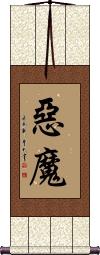
惡魔 is a common way to say demon, fiend, evil spirit, devil, or Satan in Chinese, Japanese Kanji, and old Korean Hanja.
This is a strange choice for a wall scroll, so consider this entry for reference only.
Demon Slayer
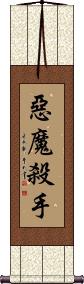
惡魔殺手 means Demon Slayer in Chinese.
The first word, 惡魔, means demon, fiend, evil māras, and can refer to the ancient demon enemies of Buddhism.
The second word, 殺手, means slayer, killer, murderer, hitman, or in the context of sports or video games, a formidable player.
Demon Slayer
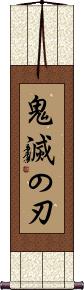
鬼滅の刃 means Demon Slayer in Japanese.
This term, 鬼滅の刃 or “Kimetsu no Yaiba,” is mostly used in the context of Japanese manga or anime.
Red Demon
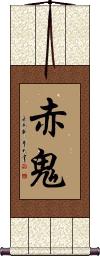
赤鬼 is the title of the red-horned demon or red ogre.
In the Buddhist context, these are the red demons of purgatory. These demons are unique, as one will have the head of a bull, another with that of a horse, etc.
Demon / Ghost / Apparition
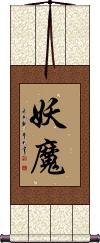
妖魔 means demon in Chinese and perhaps slanted toward ghost in Japanese.
Ghost Demon
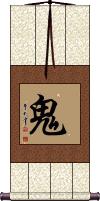
鬼 can mean ghost, ogre, demon, or “spirit of a deceased person,” in Chinese, Japanese Kanji, and old Korean Hanja.
In some context, it can also mean sly, crafty, ogre-like person (i.e. fierce, relentless, merciless, etc.)
This can also be the “ghost” constellation (one of the 28 mansions in Chinese folklore).
An extended list of meanings includes departed; dead; a disembodied spirit; dead person; evil being; hungry ghost.
Demon / Raksha
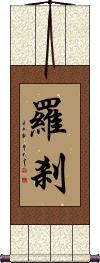
羅剎 is the Chinese version of demon that comes from the ancient Sanskrit word raksha, raksasa (rākṣasa), raksas (rakṣas), or raksasi (rākṣasī).
This title regards malignant spirits and demons. These demons are described in ancient texts as terrifying, with black bodies, red hair, and green eyes, and as devourers of men. FYI: Sometimes the second character is written in the form shown to the right.
Frightful Demon / Asura
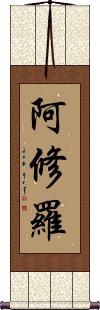
This demon title comes from the ancient Sanskrit word Asura.
阿修羅 is often used in Buddhism when describing various demons. Sometimes defined as “Fighting and battling a giant demon.”
In the context of Buddhism: This title originally meant a spirit, spirits, or even the gods (perhaps before 1700 years ago). It now generally indicates titanic demons, enemies of the gods, with whom, especially Indra, they wage constant war. They are defined as “not devas,” “ugly,” and “without wine.” There are four classes of asuras, separated according to their manner of rebirth. They can be egg-born, womb-born, transformation-born, and spawn- or water-born. Their abode is in the ocean, north of Sumeru but certain of the weaker dwell in a western mountain cave. They have realms, rulers, and palaces, as have the devas.
In terms of power, Asuras rank above humans but below most other deities. They live near the coastal foot of Mount Sumeru (on the northern side). Their domain is partially or wholly in the ocean.
Daredevil Warrior / Soul of a Warrior
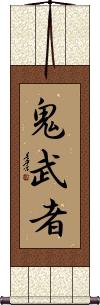
鬼武者 is an unusual title that can be translated two ways, daredevil warrior or demon warrior.
The most common is probably the daredevil warrior. However, the first character means demon, ghost, or soul of the departed. Therefore, it can mean the soul of a warrior or a demon warrior.
This title is Japanese only, and should not be used if your audience is Chinese.
Fallen Angel
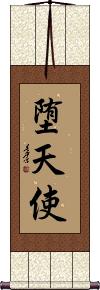
堕天使 is the Japanese title for a fallen angel.
This can also refer to a demon or Satan.
Ghost / Apparition / Phantom
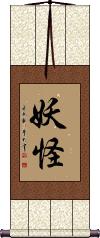
妖怪 is a Chinese, Japanese Kanji, and old Korean Hanja word that can be defined as a devil, ghost, apparition, phantom, specter/spectre, demon, monster, or goblin.
Inuyasha
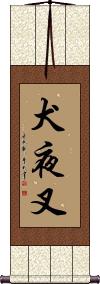
犬夜叉 is the title Inuyasha or Inu Yasha, a fictional character meaning “dog demon” from Japanese Manga.
Also known by Manga-lovers in China.
Akuma
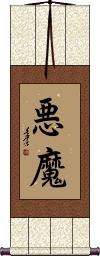
悪魔 is a Japanese word that means Devil, Demon, or Satan.
悪魔 is also the English/Japanese title for a character in Street Fighter.

 Note: In Japan, the Street Fighter is known as Gouki or Goki. This sort of means grand ghost, or great spirit. If you want this instead of the Akuma title, just click on the Goki Kanji to the right.
Tanjiro Kamado
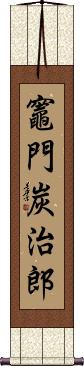
竈門炭治郎 is the name Tanjiro Kamado in Japanese.
Tanjiro Kamado is the main protagonist of Demon Slayer: Kimetsu no Yaiba.
Rago
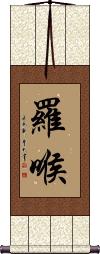
This is a Japanese personal name, Rago.
The meaning can be the intersection of the Moon's orbit with the ecliptic in Vedic astronomy (from Sanskrit Rāhu).
In Buddhist context, this can be, “the demon who is supposed to seize the sun and moon and thus cause eclipses.”
This is a variant of the Chinese 羅睺. It can also be written 羅護 or 羅虎. If you need the more ancient Chinese version, just let me know.
Tengu
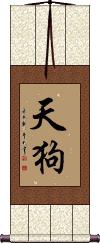
天狗 is the Japanese title for Tengu, which roughly translates as “heavenly dog.”
Tengu is a type of legendary creature found in Japanese folk religion and is also considered a type of Shinto god (kami) or yōkai (supernatural being).
The origin is Chinese, though this term is seldom used in Chinese anymore. It was a dog-like Chinese demon (Tiangou)
Although the title contains the word “dog,” the tengu are often depicted with human and bird-like characteristics. Sometimes they have large noses or beaks like birds.
Fatal error: Cannot redeclare foreignPrice() (previously declared in /home/gwest/web/chinesescrollpainting.com/public_html/includes/currencyconverter.php:22) in /home/gwest/web/orientaloutpost.com/public_html/includes/currencyconverter.php on line 22