Many custom options...


And formats...



Divine Spirit in Chinese / Japanese...
Buy a Divine Spirit calligraphy wall scroll here!
Personalize your custom “Divine Spirit” project by clicking the button next to your favorite “Divine Spirit” title below...
Divine Spirit
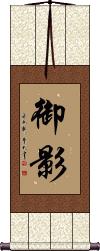
御影 is a Japanese word that means divine spirit or honorific language for “spirit of the dead.”
This can also refer to an image of a deity, buddha, royal, noble, etc.)
In the Buddhist context, it can mean (wooden) images of saints or deities.
御影 is also a Japanese name, Mikage.
Note: This is also a word in Chinese but not used very often in China (except perhaps by certain Buddhists).
Spirit / Spiritual Essence
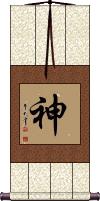
神 is the simplest way to write spirit in Chinese, Japanese Kanji, and old Korean.
This single character alone will conjure up ideas of the spiritual world. 神 can also be translated as “vital awareness” as in the fact that one must know they exist to exist (I think, therefore, I am).
Other translations include:
God, deity, mysterious, divine essence, lively, spiritual being, divinity, supernatural, soul, mind, nerves, and energy. In some extended context, it can mean genius or unusual.
Japanese romanizations vary a lot when this character is combined into other words. However, shin is the original pronunciation taken from Chinese into Japanese. You'll also see it romanized as kami, gami, jin, and a few others, depending on context.
Johrei / Jyorei
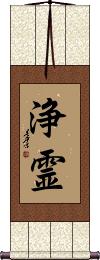
Jyorei or Johrei is a healing art that uses divine light to dissolve the spiritual impurities that are the source of all physical, emotional, and personal problems.
浄霊/浄靈 is a Japanese title that can refer to the purification of the spirit described above, but this is also the word for exorcism in Japanese.
Romanization variations include Jyorei, Johrei, Jourei and Jore. Regardless of romanization, the actual pronunciation is like "Joe Ray."
Grace from Heaven / Grace from God
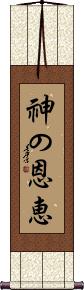
神の恩恵 means God's Grace in Japanese.
The first two characters act to create a word that means “divine,” “God's,” or “The Spirit's.”
The last two Kanji mean grace, favor/favour, blessing, or benefit.
Jin Shin Jyutsu
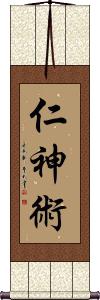
仁神術 is Jin Shin Jyutsu or Jin Shin Jutsu.
This is a practice of calming the mind and clearing the flow of Qi energy in the body. Jin Shin Jyutsu has some commonality with the practice of Reiki.
A good translation of 仁神術 would be “Benevolent Spirit Method.”
We can break that down into all of the possible meanings:
仁 = benevolence (esp. as a virtue of Confucianism), consideration, compassion, humanity, charity, kindness, or virtue.
神 = deity, soul, spirit, mysterious, psyche, god, divinity, spiritual powers, deva, divine, spiritual, or supernatural.
術 = way, method, means, art, trick, or plan. The correct romaji for this 術 Kanji should be “jutsu.” However, in martial arts, this is often written “jitsu” but in this case, “jyutsu” became common.
Yoga
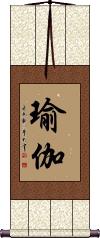
瑜伽 is probably the most common and universal title for Yoga.
In Chinese and Japanese, this is considered a Buddhist practice. 瑜伽 is really a loanword from an original Buddhist Sanskrit word.
Yoga can also be written 瑜誐 or 遊迦. The literal meaning is a yoke, yoking, union, especially an ecstatic union of the individual soul with a divine being or spirit and the individual soul with the universal soul.
Note: Yoga is sometimes written incorrectly as 瑜珈 in Chinese. Watch out for that.
Fatal error: Cannot redeclare foreignPrice() (previously declared in /home/gwest/web/chinesescrollpainting.com/public_html/includes/currencyconverter.php:22) in /home/gwest/web/orientaloutpost.com/public_html/includes/currencyconverter.php on line 22