Many custom options...


And formats...



Doctor in Chinese / Japanese...
Buy a Doctor calligraphy wall scroll here!
Personalize your custom “Doctor” project by clicking the button next to your favorite “Doctor” title below...
Doctor
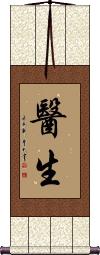
醫生 is the title used to refer to medical doctors or physicians in China.
Note: Sometimes, this same term is used in Korean, but not common.
The meaning is close to “healer [of] life” as the first character, 醫, can mean medicine, the healing art, healing, curing, medical, to cure, or to treat. The second character, 生, means birth or life.

 In Japan, they use a simplified version of the first character (医生 is also used as the Simplified Chinese version of Doctor). If you want this version, please click the characters to the right instead of the button above.
Doctor
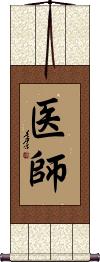
医師 is the most common title used to refer to medical doctors or physicians in modern Japanese Kanji.
Before WWII, this would be written 醫師 in Japan (same as Traditional Chinese).
Doctor
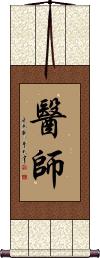
醫師 is the title used to refer to medical doctors or physicians in old Korean Hanja.
Notes:
Also means “doctor” in Chinese but is not the most commonly used title.
醫師 is the ancient/traditional form of doctor in Japanese (they simplified the first character to 医 in Japan after WWII).
Doctor
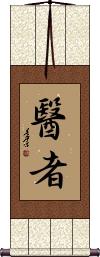
醫者 is a secondary title used to refer to medical doctors or physicians in Japanese Kanji.
Benevolent and Skilled Doctor
Short version
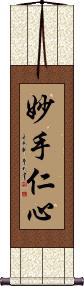
妙手仁心 is a phrase that celebrates the benevolence, skill, and service to his/her patients.
Here's a breakdown of the characters:
妙手 miào shǒu is an admirable skill in curing disease (when referring to doctors).
仁心 rén xīn kindheartedness, charity, benevolent heart.
Benevolent and Skilled Doctor
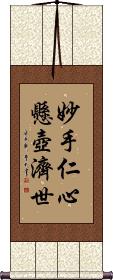
妙手仁心悬壶济世 is a phrase that celebrates the benevolence, skill, and service to his/her patients.
Here's a breakdown of the characters:
妙手 miào shǒu admirable skill in curing disease (when used in reference to doctors).
仁心 rén xīn kindheartedness, charity, benevolent heart.
悬壶济世 xuán hú jì shì practice medicine or pharmacy to help the people or the public.
Acupuncture
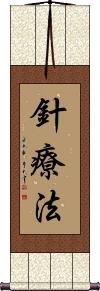
針療法 is one of two ways to write acupuncture in Chinese and Japanese.
The first character means “needle” or “pin.” The second character means “to treat” or “to cure.” The last character means “method” or “way.”
This is the only reasonable selection if your audience is Japanese. This is the formal way to express acupuncture in Chinese, so this version is universal in most of Asia (the best all-around choice in most cases).
Acupuncture
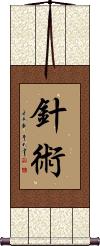
針術 is a way to write acupuncture in Chinese.
The first character means “needle” or “pin.”
The second character means “technique” or “method.”
This is theoretically a Japanese word as well but not commonly used.
Acupuncture and Moxibustion
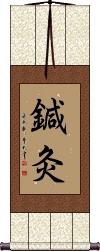
鍼灸 is the Chinese, Japanese Kanji, and old Korean Hanja word for acupuncture-moxibustion.
You May Learn from Victory, You Will Learn from Failure
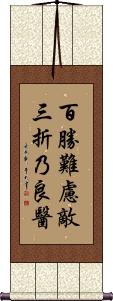
百胜难虑敌三折乃良医 is a Chinese proverb that literally translates as: [Even a general who has won a] hundred victories [may be] hard put to see through the enemy's [strategy], [but one who has] broken [his] arm three [times] [will] be a good doctor.
Figuratively, this means: One cannot always depend on past successes to guarantee future success but one can always learn from lessons drawn from failure.
See Also: Failure - Mother of Success | Experience - Mother of Success | Fall Down 7 Times Get Up 8 | Hard Knocks
Fatal error: Cannot redeclare foreignPrice() (previously declared in /home/gwest/web/chinesescrollpainting.com/public_html/includes/currencyconverter.php:22) in /home/gwest/web/orientaloutpost.com/public_html/includes/currencyconverter.php on line 22