Many custom options...


And formats...



Dog in Chinese / Japanese...
Buy a Dog calligraphy wall scroll here!
Personalize your custom “Dog” project by clicking the button next to your favorite “Dog” title below...
1. Dog
2. Akita Dog / Akitainu / Akita Inu
5. Devil Dog
6. Tengu
8. Snoopy
10. Inuyasha
11. Badger
12. Love the House and Its Crow
Dog
Year of the Dog / Zodiac Sign
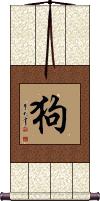
狗 is the character for dog, canine, or hound in Chinese.
If you were born in the year of the dog, you . . .
Are strong-willed
Loyal to your friends and mate.
Never compromise when you think you are right.
Note: Can be pronounced, and means dog in Japanese but feels like a very old word (see our other dog if you need a Japanese dog).
See also our Chinese Zodiac page.
Dog
(another version)
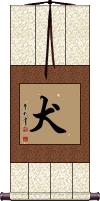
犬 is another way to write dog in Chinese and Japanese.
Just like we have words like dog, hound, pooch, and canine in English. However, this is NOT the character used to express “Year of the Dog.”
Although it is the most common way to say/write “dog” in Japanese.
See also our Chinese Zodiac page.
Akita Dog / Akitainu / Akita Inu
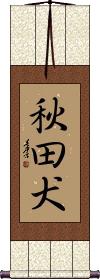
鞦田犬 is the Japanese title of the breed of dog known as an Akita.
Technically, the title above means “Akita hound” or “Akita Dog.” The literal translation of these characters is “autumn field dog.”
Note: This title is Japanese only. In China, this breed of dog is referred to as "The Japanese breed" (literally: Japanese hound).
Chinese title: 


Fu Dog / Foo Dog
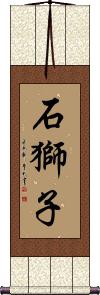
While known in the west as fu dogs or foo dogs, these are actually guardian lions.
These are the lion statues traditionally placed at the entrance of Chinese imperial palaces, imperial tombs, temples, and high-ranking officials' homes. These days, you are more likely to see them at the entrance to a fancy Chinese restaurant.
石獅子 means “stone lion(s).”
Inugami / Dog Spirit
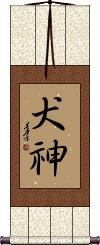
犬神 is the title Inugami, meaning dog spirit or dog god in Japanese.
In some cases, this is an evil spirit of a dog, but it depends on the context.
Devil Dog
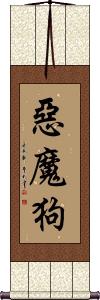
惡魔狗 is Devil Dog, the nickname of Marines in Chinese.
Tengu
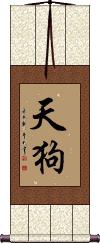
天狗 is the Japanese title for Tengu, which roughly translates as “heavenly dog.”
Tengu is a type of legendary creature found in Japanese folk religion and is also considered a type of Shinto god (kami) or yōkai (supernatural being).
The origin is Chinese, though this term is seldom used in Chinese anymore. It was a dog-like Chinese demon (Tiangou)
Although the title contains the word “dog,” the tengu are often depicted with human and bird-like characteristics. Sometimes they have large noses or beaks like birds.
There’s No Place Like Home
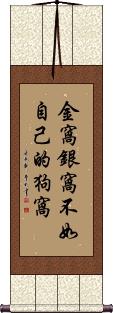
金窝银窝不如自己的狗窝 is a Chinese slang proverb that means “Golden house, [or a] silver house, not as good as my own dog house.”
It's basically saying that even a house made of gold or silver is not as good as my own home (which may only be suitable for a dog but at least it's mine).
Snoopy
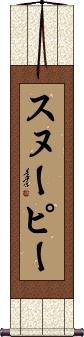
スヌーピー is how to write the name Snoopy (comic strip pet dog) in Japanese Katakana.
Note: Because this title is entirely Japanese Katakana, it should be written by a Japanese calligrapher.
Snoopy
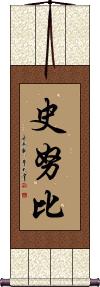
This is the most common way to write the name Snoopy (comic strip pet dog) in Mandarin Chinese.
Pug / Pekingese
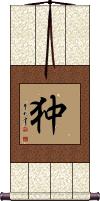
狆 is the shortest way to title the Pekingese, Japanese Spaniel, or Pug breed of dog. This title is a little ambiguous.
狆 is also sometimes romanized as “Chung.”
Inuyasha
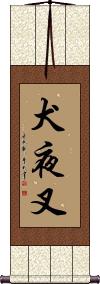
犬夜叉 is the title Inuyasha or Inu Yasha, a fictional character meaning “dog demon” from Japanese Manga.
Also known by Manga-lovers in China.
Badger
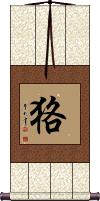
狢 is a Japanese word that means badger or “raccoon dog” (Nyctereutes procyonoides).
I have included the Chinese and Korean pronunciations above. However, this character is rarely used character in modern Chinese and Korean.
Love the House and Its Crow
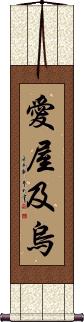
愛屋及烏 is the Chinese idiom, “Love the house and its crow.”
It speaks to the fact that if you are involved in a relationship with somebody, you are also in a relationship with everyone connected to that person. In English, we say, “Love me, love my dog.”
Love the Flower, Love the Pot also
Love Me, Love My Dog
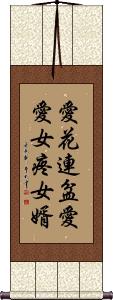
This proverb, 爱花连盆爱爱女疼女婿, literally translates as “If one loves a flower, [one will] love its pot; [if one really] loves [one's] daughter, [one will also] love [one's] son-in-law.”
Figuratively, is similar to the English proverbs:
Love me, love my dog.
Love for a person extends even to the crows on his roof.
The Buddha is in Each Sentient Being
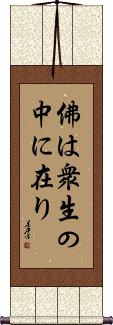
佛は衆生の中に在り is “Butsu wa shujo no naka ni ari” and means that the Buddha (potential for Buddhahood) exists in all beings in the universe.
So yes, your dog has the potential to be a Buddha (but only in a future reincarnation as a human). But all things, from the tiny cricket to the humpback whale have Buddha nature within them. If one takes the time to look and contemplate, one will see the Buddha in all things.
In Japan, sometimes the Buddha character is written 仏 instead of 佛, so you might see the whole phrase written as 仏は衆生の中に在り.
Note: Because this selection contains some special Japanese Hiragana characters, it should be written by a Japanese calligrapher.
Fatal error: Cannot redeclare function foreignPrice() (previously declared in /home/gwest/web/chinesescrollpainting.com/public_html/includes/currencyconverter.php:22) in /home/gwest/web/orientaloutpost.com/public_html/includes/currencyconverter.php on line 22