Many custom options...


And formats...



Five Precepts in Chinese / Japanese...
Buy a Five Precepts calligraphy wall scroll here!
Personalize your custom “Five Precepts” project by clicking the button next to your favorite “Five Precepts” title below...
Five Precepts
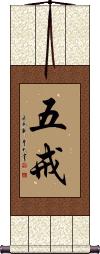
五戒 is the title or name for the five precepts of Buddhism.
These are prohibitions against killing, theft, sexual misconduct, lying, and intoxication.
Also phrased as commandments against murder, stealing, adultery, false speech, and consuming intoxicating liquors.
These five precepts or “pañca-veramaṇī” apply to the Buddhist laity as well as monks and nuns. The observance of these five ensures rebirth in the human realm.
Five Precepts
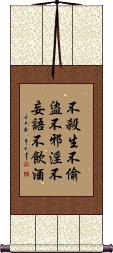
不殺生不偷盜不邪淫不妄語不飲酒 is the full list of the five precepts of Buddhism in Chinese.
There are many ways to translate or express these.
The following is one basic way:
1. Do not kill/murder.
2. Do not steal.
3. Do not commit adultery and/or sexual misconduct.
4. Do not lie or speak falsehoods.
5. Do not become intoxicated (with drugs/alcohol).
Here is another take from my favorite magazine: Lion's Roar: Five Precepts
Reiki Precepts by Usui Mikao
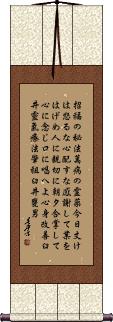
These are the precepts of Reiki that are attributed to Usui Mikao.
Here is a breakdown of the characters and a rough translation:
招福の秘法, 萬病の霊薬。
Invite blessings of [the] secret method, 10,000 illnesses of spiritual medicine.
今日丈けは: 怒るな, 心配すな, 感謝して, 業をはげめ, 人に親切に。
At least for today: Do not be angry, do not worry, be grateful, work with diligence, and be kind to people.
朝夕合掌して, 心に念じ, 口に唱へよ, 心身改善。
Morning [and] evening perform gassho (join hands), [with your] heart/mind in silent prayer, [with your] mouth chant, [thusly] mind [and] body [will] reform/improve.
臼井靈氣療法! -肇祖, 臼井甕男。
Usui Reiki Ryōhō! -Founder, Usui Mikao.
The middle portion of this is often titled, “The Five Principles of Reiki” and makes a nice calligraphy selection by itself. The Japanese text presented here can be considered the more verbose version.
Note: Because this selection contains some special Japanese Hiragana characters, it should be written by a Japanese calligrapher.
4. Right Action / Perfect Conduct
Samyak Karmanta / Samma Kammanta
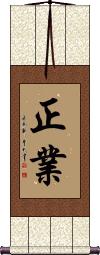
正業 is one of the Noble Eightfold Paths of Buddhism. Right Action, along with Right Speech and Right Living, constitute the path to Virtue.
The five precepts of Right Action are...
1. Refrain from destroying living beings (no murder or any form of taking a life).
2. Refrain from stealing.
3. Refrain from sexual misconduct (adultery, rape, etc.).
4. Refrain from false speech (lying or trickery).
5. Refrain from intoxicants that lead to heedlessness (no drugs or alcohol).
This concept can be summarized as “Avoidance of actions that conflict with moral discipline.”
Note: In Japanese, when read by a non-Buddhist, this will mean “the right job/vocation.”
This term is exclusively used by devout Buddhists. It is not a common term, and is remains an unknown concept to most Japanese and Chinese people.
See Also: Buddhism | Enlightenment | Noble Eightfold Path
Ten Commandments
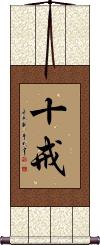
十戒 means Ten Commandments or Ten Precepts.
In the Buddhist context, these are prohibitions consisting of five commandments for the layman:
1. Not to destroy life 不殺生 Pāṇātipātāveramaṇi.
2. Not to steal 不倫盜 Adinnādānāver.
3. Not to commit adultery 不婬慾 Abrahmacaryaver.
4. Not to lie 不妄語 Musāvādāver.
5. Not to take intoxicating liquor 不飮酒 Suramereyya-Majjapamādaṭṭhānāver.
The ten commandments for the monk are the preceding five plus:
6. Not to eat food outside of regulated hours 不非時食 Vikāla-Bhojanāver.
7. Not to use garlands or perfumes 不著華鬘好香塗身 Mālā- Gandha-Vilepana-Dhāraṇa-Maṇḍana-Vibhūṣanaṭṭhānā.
8. Not to sleep on high or broad beds (chastity) 不坐高廣大牀 Uccāsayanā-Mahāsayanā.
9. Not to take part in singing, dancing, musical or theatrical performances 不歌舞倡伎不往觀聽 Nacca-Gīta-Vādita-Visūkadassanāver.
10. To refrain from acquiring uncoined or coined gold, or silver, or jewels 不得捉錢金銀寶物 Jātarūpa-Rajata-Paṭīggahaṇāver.
These original Buddhist commandments date back to about 2500 years ago. The English definitions above are followed by Chinese characters and original Pali pronunciation.
Under the Māhayāna Buddhism, these ten commands for the monk were changed, to accord with the new environment of the monk, to the following: not to kill, not to steal, to avoid all unchastity, not to lie, not to slander, not to insult, not to chatter, not to covet, not to give way to anger, to harbor no skepticism.
Fatal error: Cannot redeclare function foreignPrice() (previously declared in /home/gwest/web/chinesescrollpainting.com/public_html/includes/currencyconverter.php:22) in /home/gwest/web/orientaloutpost.com/public_html/includes/currencyconverter.php on line 22