Many custom options...


And formats...



Forgiveness in Chinese / Japanese...
Buy a Forgiveness calligraphy wall scroll here!
Personalize your custom “Forgiveness” project by clicking the button next to your favorite “Forgiveness” title below...
1. Forgiveness
3. Forgiveness
4. Forgive
6. Forgive
9. Forgive Yourself / Release Yourself
12. God Forgive Me
Forgiveness
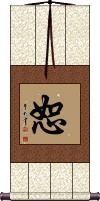
恕 means to forgive, show mercy, absolve, or excuse in Chinese and Korean Hanja (though mostly used in compound words in Korean).
恕 incorporates the pictogram of a heart at the bottom, and a woman and a mouth at the top. The heart portion has the most significance, as it is suggested that it is the heart's nature to forgive.
In Asian culture, as with most other cultures, forgiveness is an act of benevolence and altruism. In forgiving, you put yourself in someone else's shoes and show them the kindness that you would want them to show you. Confucius referred to this quality as “human-heartedness.”
Begging Forgiveness
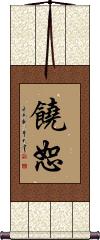
饒恕 is a Chinese word that is a kind of forgiveness that you would beg for like a servant begging a master.
This can also be the forgiveness that a person would beg from the king or God.
This word suggests that this is forgiveness for something really bad (a terrible crime or sin).
Forgiveness (from the top down)
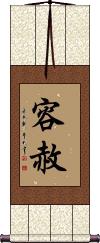
容赦 is the kind of forgiveness that a king might give to his subjects for crimes or wrong-doings.
容赦 is a rather high-level forgiveness. Meaning that it goes from a higher level to a lower (not the reverse).
Alone, the first character can mean “to bear,” “to allow,” and/or “to tolerate,” and the second can mean “to forgive,” “to pardon,” and/or “to excuse.”
When you put both characters together, you get forgiveness, pardon, mercy, leniency, or going easy (on someone).
See Also: Benevolence
Forgive
Deep heartfelt forgiveness
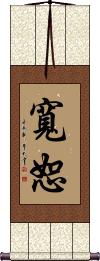
寛恕 is a word of Chinese origin means forgive or forgiveness.
寬恕 is a deep kind of forgiveness from the bottom of your heart.
In a religious context, this is the kind of forgiveness that you beg God for and that God grants you.
In Korean Hanja, this can also be defined as forbearance or leniency.
In Japanese Kanji, beyond forgiveness, this can also mean magnanimity or generosity.
While we don't actively recommend Asian tattoos, this would be the forgiveness title that is best for a tattoo in most cases.
 Note: The first character can also be written in the form shown to the right (especially in Japanese). If you have a preference, please let us know in the "special instructions" when you place your order.
Please Forgive Me
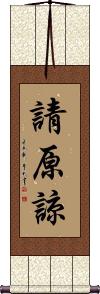
If you are looking for forgiveness, 請原諒 is what you would say to ask/beg for it.
Note: This is a strange thing to write on a wall scroll for Chinese people - but you can bend the rules if you want in the west.
Forgive
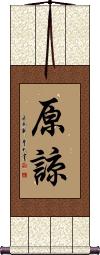
This two-character word means “forgive” in Chinese.
It can also be defined as “to pardon” or “to excuse.” 原諒 is a kind of general forgiveness.
Forgive
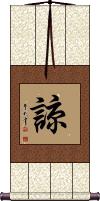
This single character means “forgive” in Chinese.
In Korean, this kind of means forgive but also has slightly different definitions of considering, excuse, faithful or believe.
Forgive and Forget
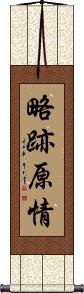
略跡原情 is a Chinese proverb that means “to overlook past faults,” or “forgive and forget.”
It's more literally, “Abridge or make small the scars from your past emotions.” You should let it go.
The character breakdown:
略 (lüè) abbreviation; omission; abridge.
跡 (jī) ruins; scar; traces.
原 (yuán) former.
情 (qíng) feeling; emotion.
Forgive and Forget
Confucian Proverb
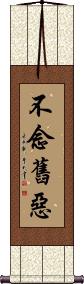
不念舊惡 is a Chinese proverb that can be translated as “Do not recall old grievances,” or more simply as “Forgive and forget.”
The character breakdown:
不 (bù) not; no; don't.
念 (niàn) read aloud.
舊 (jiù) old; former.
惡 (è) wicked deeds; grievances; sins.
This proverb comes from the Analects of Confucius.
Forgive and Forget
Water Under the Bridge
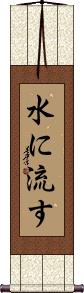
水に流す is a Japanese proverb that suggests that “water continues to flow.”
It's similar to our English phrase, “Water under the bridge.” The perceived meaning is, “Forgive and forget.”
I have also seen this translated as “Don't cry over spilled milk.”
Note: Because this selection contains some special Japanese Hiragana characters, it should be written by a Japanese calligrapher.
Forgive Yourself
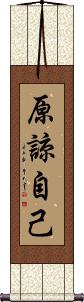
原諒自己 is how to write “forgive yourself” in Chinese.
The first two characters mean “to excuse,” “to forgive,” or “to pardon.”
The last two characters mean “self” (reflexive pronoun), “yourself,” or “oneself.”
Forgive Yourself / Release Yourself
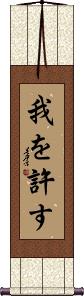
我を許す is how to write “forgive yourself” in Japanese.
The first two characters mean “regarding myself.”
The last two characters mean “to forgive,” “to excuse (from),” “to pardon,” “to release,” “to let off,” “to permit,” “to allow,” and/or “to approve.”
Note: Because this selection contains some special Japanese Hiragana characters, it should be written by a Japanese calligrapher.
Please Forgive Me
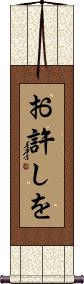
お許しを is how to write “Please Forgive Me,” in Japanese.
Often, Japanese Christians will add “God” (Kamisama) in front of this.
Note: Because this selection contains some special Japanese Hiragana characters, it should be written by a Japanese calligrapher.
Forgive Me of My Sins
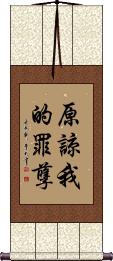
原諒我的罪孽 is a religious phrase, which means exactly what the title suggests.
See Also: Christian
God Forgive Me
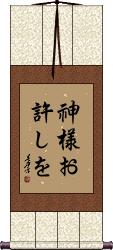
神様お許しを is how to write “God Forgive Me” in Japanese.
There is an essence of humble begging or “please” implied in this phrase.
Note: Because this selection contains some special Japanese Hiragana characters, it should be written by a Japanese calligrapher.
Fatal error: Cannot redeclare foreignPrice() (previously declared in /home/gwest/web/chinesescrollpainting.com/public_html/includes/currencyconverter.php:22) in /home/gwest/web/orientaloutpost.com/public_html/includes/currencyconverter.php on line 22