Many custom options...


And formats...



Giant in Chinese / Japanese...
Buy a Giant calligraphy wall scroll here!
Personalize your custom “Giant” project by clicking the button next to your favorite “Giant” title below...
Giant
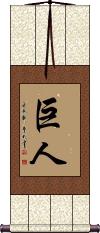
巨人 can mean giant or great person (great man or woman) in Chinese, Japanese Kanji, and old Korean Hanja.
巨人 is also the short name of the Tokyo Giants baseball team.
Sometimes the Japanese female name Mito.
Giant Panda
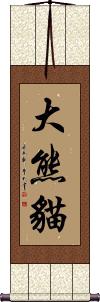
大熊貓 is how to write “giant panda” in Chinese.
大熊貓 is specific to the “giant panda,” which has black and white fur. Not to be confused with other types of smaller pandas in China.
The literal meaning of these characters is “great/big bear cat.” Chinese do think of pandas as “cat-like bears.”
Note: In Japanese, they only express Giant Panda in Katakana, which is ジャイアント パンダ” (Jaianto Panda). So we have not included that for wall scroll orders.
Leviathan
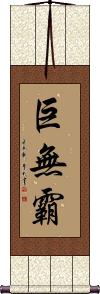
巨無霸 means giant or leviathan in Chinese.
Kun
Sea Creature
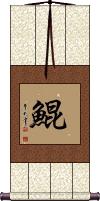
A 鲲 (Kun) is a famous sea monster, often associated or used interchangeably with a 鵬 (Peng).
鯤 is comparable to Leviathan or Jonah's whale.
In Chinese mythology, the Kun is a giant fish said to be able to turn into a bird.
鯤 and the mythological creature is also known in Japanese and Korean. However, in some contexts, this character can refer to fry (fish babies).
Panda Bear
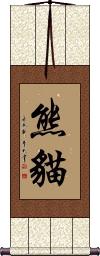
熊貓 is how to write “panda” in Chinese.
熊貓 is kind of a generic term that is applied to all pandas. When most people think of panda bears, they are really thinking of the “giant panda,” which has black and white fur.
The literal meaning of these characters is “bear cat.” Chinese do think of pandas as “cat-like bears.”
Frightful Demon / Asura
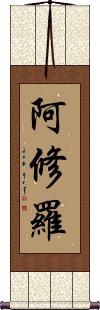
This demon title comes from the ancient Sanskrit word Asura.
阿修羅 is often used in Buddhism when describing various demons. Sometimes defined as “Fighting and battling a giant demon.”
In the context of Buddhism: This title originally meant a spirit, spirits, or even the gods (perhaps before 1700 years ago). It now generally indicates titanic demons, enemies of the gods, with whom, especially Indra, they wage constant war. They are defined as “not devas,” “ugly,” and “without wine.” There are four classes of asuras, separated according to their manner of rebirth. They can be egg-born, womb-born, transformation-born, and spawn- or water-born. Their abode is in the ocean, north of Sumeru but certain of the weaker dwell in a western mountain cave. They have realms, rulers, and palaces, as have the devas.
In terms of power, Asuras rank above humans but below most other deities. They live near the coastal foot of Mount Sumeru (on the northern side). Their domain is partially or wholly in the ocean.
Fatal error: Cannot redeclare function foreignPrice() (previously declared in /home/gwest/web/chinesescrollpainting.com/public_html/includes/currencyconverter.php:22) in /home/gwest/web/orientaloutpost.com/public_html/includes/currencyconverter.php on line 22