Many custom options...


And formats...



Great Ambitions in Chinese / Japanese...
Buy a Great Ambitions calligraphy wall scroll here!
Personalize your custom “Great Ambitions” project by clicking the button next to your favorite “Great Ambitions” title below...
2. Great Aspirations / Ambition
3. Realize Your Ambitions / Ride on the Crest of Success
4. Realize Your Ambitions / Embrace Your Ambition
6. Do not fear poverty; Fear low ambitions
7. Heroic Spirit / Great Ambition
9. Without a big net, how can you catch fish?
10. Ambition
Great Ambitions
Brave the wind and the waves
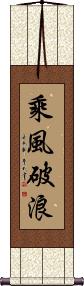
乘風破浪 is a Chinese proverb that represents having great ambitions.
The British might say “to plough through.” Another way to understand it is “surmount all difficulties and forge ahead courageously.”
This can also be translated as “braving the wind and waves,” “to brave the wind and the billows,” “to ride the wind and crest the waves,” or “to be ambitious and unafraid.”
Literally, it reads: “ride (like a chariot) [the] wind [and] break/cleave/cut [the] waves,” or “ride [the] wind [and] slash [through the] waves.”
乘風破浪 is a great proverb to encourage yourself or someone else not to be afraid of problems or troubles, and when you have a dream, just go for it.
There is an alternate version, 長風破浪, but 乘風破浪 is far more common.
Great Aspirations / Ambition
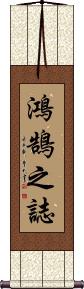
鴻鵠之誌 is a Chinese proverb that implies that having grand ambitions also means that others will not understand your great expectations and ideas.
Though the actual words come from a longer saying of Confucius, which goes, “The little swallows living under the eaves wouldn't understand the lofty ambitions of a swan (who flies far and wide).”
This Confucius quote has led to this idiomatic expression in China that means “think big.” What you'd be saying is “The lofty ambitions of a swan.”
Note that Chinese people sometimes refer to the little swallow as one who does not “think big” but is, instead, stuck in a rut or just leading a mundane life. Therefore, it's a compliment to be called a swan but not a good thing to be called a swallow.
Great Aspirations / Ambition
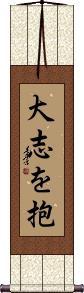
大志を抱 is a single Japanese word that kind of reads like a short proverb.
It suggests that you should have “high aims,” “ambitions,” or “aspirations” in your life.
Realize Your Ambitions / Ride on the Crest of Success
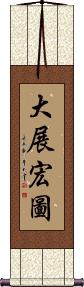
大展宏圖 is a four-character proverb used in Chinese to mean “realize your ambitions” or “exhibit your ambition and success.”
It's used to talk about someone with great career ambitions. Almost literally, it expresses the idea of someone unfolding a great career like a map or a set of blueprint plans.
Very literally translated, these four characters mean “Great unfolding of a huge map” or “Great exhibition of a colossal plan.”
Realize Your Ambitions / Embrace Your Ambition
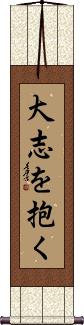
大志を抱く is a Japanese proverb that suggests you should embrace, pursue, and realize your ambitions.
The first part means ambitions or aspirations.
The last part means to embrace or to hold in your arms.
Here's the character breakdown:
大志 (taishi) ambition; aspiration.
を (o) particle
抱く (idaku) to embrace; to hold in the arms (e.g. a baby); to hug; to harbor/harbour; to bear (e.g., a grudge); to entertain (e.g., suspicion); to sleep with; to sit on eggs.
Note: Because this selection contains some special Japanese Hiragana characters, it should be written by a Japanese calligrapher.
Boys be Ambitious
Quote from William S. Clark in Japan
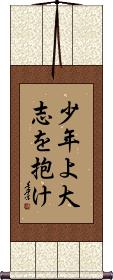
少年よ大志を抱け was a sort of motto or proverb invoked by William Clark after being hired by the Emperor of Japan in 1876 to establish a university in Hokkaido, Japan.
This phrase has been famous across all generations of Japan since that time.
More about William S. Clark's adventures in Japan.
Note: Because this selection contains some special Japanese Hiragana characters, it should be written by a Japanese calligrapher.
Do not fear poverty; Fear low ambitions
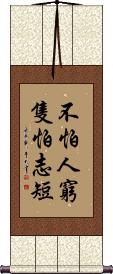
不怕人窮隻怕志短 is a Chinese proverb that literally translates as: It is not poverty that is to be feared; It is low ambition.
Figuratively, this means: It is not poverty but a lack of lofty aspiration that is to be regretted.
Heroic Spirit / Great Ambition
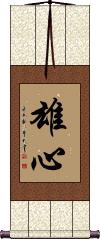
雄心 are the Chinese characters and Japanese Kanji for great ambition, lofty aspiration, or heroic spirit.
Great Expectations
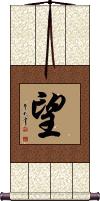
望 holds the ideas of ambition, hope, desire, aspiring to, expectations, looking towards, to gaze (into the distance), and in some contexts, full moon rising.
望 is one of those single characters that is vague but in that vagueness, it also means many things.
望 is a whole word in Chinese and old Korean but is seldom seen alone in Japanese. Still, it holds the meanings noted above in all three languages.
Without a big net, how can you catch fish?
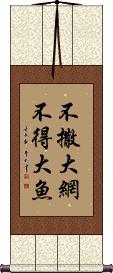
不撒大網不得大魚 is a Chinese proverb that literally translates as: [if one does] not cast a big net, [one can] not get big fish.
Figuratively, this means: One cannot make great accomplishments without making great efforts or taking great pains.
This is sort of the fishing version of, “No pain, no gain.”
Ambition
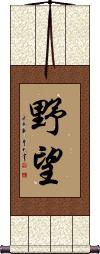
Ambitious / To Improve Oneself
Advance and Progress
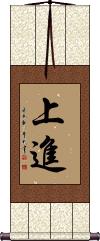
上進 is a Chinese and Japanese Kanji word that means to advance, to make progress, to do better, to be ambitious, to improve oneself, or to move forward.
This can refer to a single person, general things (such as a work project), or a whole country.
In Japanese, this is sometimes used as the given name Joushin.
Far-Reaching / Ambitious
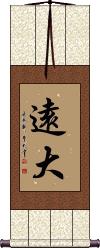
遠大 is a Chinese, Japanese Kanji, and old Korean Hanja word that means far-reaching, broad, ambitious, and/or promising.
Progress / Ambition
This Chinese and Japanese word means to make progress, to do better, ambition to improve oneself, to move forward, to advance.
This should be romanized as Joushin but is often romanized as Joshin from Japanese. It can also be a given name in Japanese.
Fear not long roads; Fear only short ambition
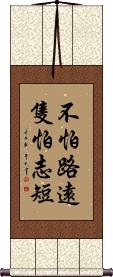
不怕路遠隻怕志短 is a Chinese proverb that literally translates as “Fear not long roads; fear only short ambition,” or “Don't fear that the road is long, only fear that your will/ambition/aspiration is short.”
Figuratively, this means: However difficult the goal is, one can achieve it as long as one is determined to do so.
Others may translate the meaning as “Don't let a lack of willpower stop you from pressing onward in your journey.”
Fatal error: Cannot redeclare function foreignPrice() (previously declared in /home/gwest/web/chinesescrollpainting.com/public_html/includes/currencyconverter.php:22) in /home/gwest/web/orientaloutpost.com/public_html/includes/currencyconverter.php on line 22