Many custom options...


And formats...



Not what you want?
Try other similar-meaning words, fewer words, or just one word.
Great Wisdom in Chinese / Japanese...
Buy a Great Wisdom calligraphy wall scroll here!
Personalize your custom “Great Wisdom” project by clicking the button next to your favorite “Great Wisdom” title below...
1. Great Wisdom
2. Great Wisdom
4. Great Lotus Wisdom - Samadhi Wisdom
5. Great Illumination of Wisdom
Great Wisdom
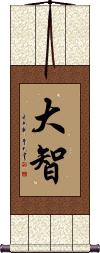
大智 is a Zen Buddhist title that means supreme wisdom, great wisdom, Buddha-wisdom, omniscience, or transcendental wisdom.
Great Wisdom
Prajñā
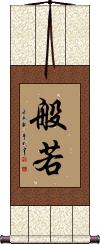
般若 means great wisdom or wondrous knowledge.
In the Buddhist context, this is prajna or prajñā, to know, to understand, to have the wisdom required to attain enlightenment.
Since this is a wisdom that transcends the realm of logic, the pure, absolute wisdom beyond the reach of words and concepts, it is not obtained through learning but is realized for the first time through a religious experience.
Door of Great Wisdom
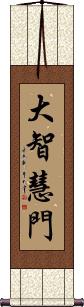
大智慧門 is the title for “The Great Wisdom Door,” or “The Gate to Great Wisdom.”
This refers to a portal to all wisdom and knowledge in Buddhism.
Great Lotus Wisdom - Samadhi Wisdom
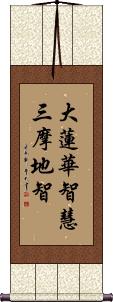
大蓮華智慧三摩地智 is the title for “The wisdom of the great lotus, samādhi-wisdom.”
This is also the penetrating wisdom of Amitābha.
Great Illumination of Wisdom
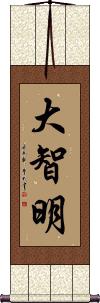
大智明 is a Zen Buddhist title that means the great illumination of wisdom.
This refers to wisdom so bright that it shines through obviously to all in its presence.
Wisdom from Hard Knocks
The school of hard knocks
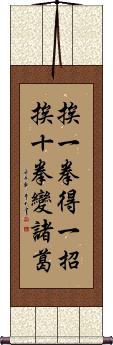
挨一拳得一招挨十拳變諸葛 is a Chinese proverb that literally translates as: Receive one blow, [and one] learns a lesson; Receive ten blows, [and one] becomes a great Zhuge [Liang].
You must first understand that a man named Zhuge Liang was one of the great strategists and philosophers in Chinese history. He's known as a man of great wisdom.
Figuratively, this phrase means:
One can learn much from failure or “hard knocks.”
An Open Book Benefits Your Mind
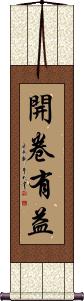
There are several ways to translate this ancient proverb. Translated literally and directly, it says, “Open roll has/yields benefit.”
To understand that, you must know a few things...
First, Chinese characters and language have deeper meanings that often are not spoken but are understood - especially with ancient texts like this. Example: It's understood that the “benefit” referred to in this proverb is to the reader's mind. Just the last character expresses that whole idea.
Second, Chinese proverbs are supposed to make you think and leave a bit of mystery to figure out.
Third, for this proverb, it should be noted that roll = book. When this proverb came about (about two thousand years ago), books were rolls of bamboo slips strung together. The first bound books like the ones we use today did not come about until about a thousand years after this proverb when they invented paper in China.
開卷有益 is a great gift for a bookworm who loves to read and increase their knowledge. Or for any friend that is or wants to be well-read.
Some other translations of this phrase:
Opening a book is profitable
The benefits of education.
Light / Bright and Promising Future
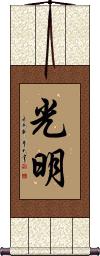
光明 is a nice way to say “light” in Chinese and old Korean Hanja.
This is because the word also suggests a bright future or refers to someone who is very promising (great future potential).
The first character means light or bright.
The second character means bright and clear (in this context).
This word appears in most Japanese dictionaries, but it is not the most common Japanese Kanji word for light (more commonly used for the name Mitsuharu).
In old Korean Hanja, this can also mean brightness or brilliance.
In the context of Buddhism, this means “Light emanating from a Buddha or Bodhisattva, symbolizing their wisdom and compassion.”
Fatal error: Cannot redeclare function foreignPrice() (previously declared in /home/gwest/web/chinesescrollpainting.com/public_html/includes/currencyconverter.php:22) in /home/gwest/web/orientaloutpost.com/public_html/includes/currencyconverter.php on line 22