Many custom options...


And formats...



Guan Yu in Chinese / Japanese...
Buy a Guan Yu calligraphy wall scroll here!
Personalize your custom “Guan Yu” project by clicking the button next to your favorite “Guan Yu” title below...
1. Guan Yu
4. Guan Shi Yin: Protector Of Life
5. Goddess of Mercy and Compassion
Guan Yu
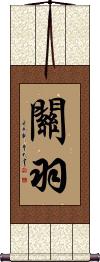
關羽 is the name Guan Yu, Army General for the Kingdom of Shu.
He is also known as Guan Gong (like saying Duke Guan or Sir Guan)
He was immortalized in the novel, “Romance of the Three Kingdoms.”
He was a fearsome fighter, also famous for his virtue and loyalty. He is worshiped by some modern-day soldiers and has the title “Warrior Saint” in China. Some believe he offers safety and protection for military servicemen.
Guan Yu lived until 219 A.D.
Guan Gong / Warrior Saint
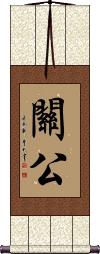
關公 is a Chinese title, Guan Gong, that means Lord Guan (The warrior saint of ancient China).
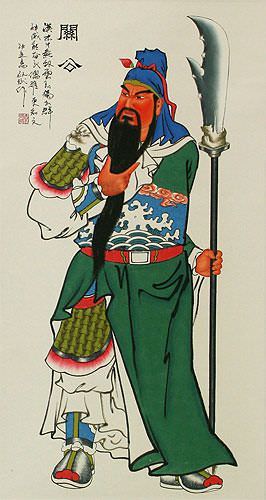 While his real name was Guan Yu / 關羽, he is commonly known by the title of Guan Gong (關公).
Some Chinese soldiers still pray to Guan Gong for protection. They would especially do this before going into battle. Statues of Guan Gong are seen throughout China.
Guan / Kwan / Seki
Surname
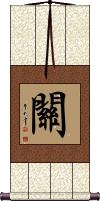
關 is a surname in three languages.
In Chinese, it romanizes as Guan.
In Korean, it's Kwan (or Gwan).
In Japanese it's Seki.
The meaning of the character is mountain pass; to close; to shut; to turn off; barrier; frontier.
Guan Shi Yin: Protector Of Life
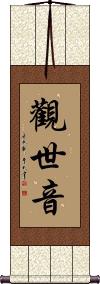
觀世音 is an alternate title for Guanyin, the Bodhisattva of Compassion or Goddess of Mercy.
觀世音 is the Buddhist bestower of children, the protector of life and all in distress (especially of those at sea).
Goddess of Mercy and Compassion
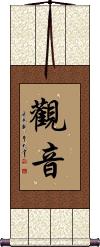
觀音/観音 is the Buddhist deity known as the Goddess of Mercy or Bodhisattva of Compassion.
In Chinese, the proper name of this being is Guan Yin. There is some debate as to whether Guan Yin is female. The argument comes from some scripture that suggests Buddhist deities take on the male form. Others say that Guan Yin has no sex. And still, others are okay with the female representation of Guan Yin.
This bodhisattva is also known or Romanized in the following ways:
Mandarin Chinese: Guan Yin, Kuan Yin, Kwan Yin.
Japanese: Kannon, Kwannon.
Sanskrit: Bodhisattva Avalokitesvara.
Korean: Gwan-eum.
Vietnamese: Quan Âm.
Thai: Kuan Eim.
English: Bodhisattva of Mercy and Salvation, Goddess of Compassion, Buddha of Mercy, et al.
Note: The first character has a slight variation in Japanese. If your audience is specifically Japanese, you may want to select that version.
See Also: Buddhism | Goddess | Namo Amitabha | Bodhisattva
Warrior Saint / Saint of War
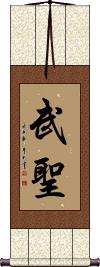
This Chinese title, Wusheng, means Saint of War.
武聖 is usually a reference to Guan Yu (關羽), also known as Guan Gong (關公).
Some Chinese soldiers still pray to Wusheng for protection. They would especially do this before going into battle.
Goddess of Compassion
Long or more formal Japanese version of this title
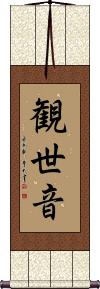
観世音 is the more extended and more formal Japanese version of Bodhisattva of Compassion or Guan Yin.
In Japanese, this is pronounced Kanzeon. The Chinese version is a bit more common in Asia, but in Japanese, they use a slight variation of the first character. Choose this version only if your intended audience is specifically Japanese.
Goddess of Compassion
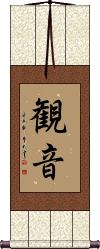
観音 is the specifically Japanese version of Bodhisattva of Compassion or Guan Yin.
In Japanese, this is pronounced Kannon and occasionally spelled Kwannon. The Chinese version is a bit more commonly seen in Asia. However, in Japanese, there is a slight variation with the first character.
Some time ago, a camera company in Japan named their company after this Buddhist deity. That camera company is still known as Canon (they chose a “C” instead of a “K” when they Romanized this name).
The Great Path has No Gate
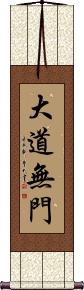
大道無門 is a Buddhist proverb that means “The Great Way has no entrance,” “The Great Way is gateless,” or “The Great Path lacks a gate.”
This can be translated in many other ways.
This concept was authored within a long sacred text by 無門慧開 (known as Wúmén Huìkāi in Chinese or Mumon Ekai in Japanese). He was a Chinese Chan Master (in Japanese, a Zen Master) who lived between 1183 and 1260 AD. His most famous work was a 48-koan collection titled “The Gateless Barrier” or “The Gateless Gate” (無門關 Wú Mén Guān in Chinese, or 無門関 Mu Mon Kan in Japanese). This calligraphy title is a notable line from this collection.
I like this reference to the source of this proverb: The Gateless Gate 無門關
Goddess of Mercy and Compassion
This is the long or more formal version of this title
觀世音 is the longer and perhaps more formal title for the Buddhist deity known as the Goddess of Mercy or Bodhisattva of Compassion.
The longer title of this bodhisattva is Romanized in the following ways:
Mandarin Chinese: Guanshi Yin, Kuan-shih Yin.
Japanese: Kanzeon.
Sanskrit: Bodhisattva Avalokitesvara.
Korean: Gwan-se-eum.
Vietnamese: Quan Thế Âm.
Thai: Prah Mae Kuan Eim.
English: Bodhisattva of Mercy and Salvation, Goddess of Compassion, Buddha of Mercy, et al.
Please view our more common and shorter version, “Guan Yin” before you make a decision. Also, note that the first character has a slight variation in Japanese. If your audience is specifically Japanese, you may want to select that version.
Fatal error: Cannot redeclare foreignPrice() (previously declared in /home/gwest/web/chinesescrollpainting.com/public_html/includes/currencyconverter.php:22) in /home/gwest/web/orientaloutpost.com/public_html/includes/currencyconverter.php on line 22