Many custom options...


And formats...



Happiness Contentment in Chinese / Japanese...
Buy a Happiness Contentment calligraphy wall scroll here!
Personalize your custom “Happiness Contentment” project by clicking the button next to your favorite “Happiness Contentment” title below...
Happiness / Contentment
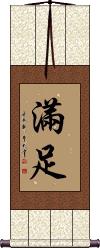
滿足 is the kind of happiness that involves being satisfied and content.
This can also suggest the actions of “to satisfy,” and “to meet the needs of.”
Other single-word definitions include satisfaction, contentment, sufficient, enough, adequate, full, or complete.
 In Japanese, the Kanji for this word is an alternate Chinese form. You can see and select this version at the right (recommended only if your audience is specifically Japanese).
See Also: Satisfaction | Contentment | Pleasure | Well-Being
Happiness / Contentment
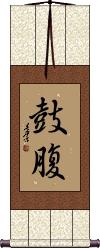
鼓腹 means happiness and contentment in Japanese Kanji.
The first Kanji represents your internal beat or drum.
The second Kanji represents your mind and body.
Together, it suggests that your internal rhythm or beat is regular, soothing, and at the proper tempo.
See Also: Satisfaction | Pleasure | Well-Being
Happiness / Joyful / Joy
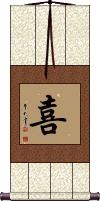
喜 is the Chinese, Japanese Kanji, and Korean Hanja for the kind of happiness known in the west as “joy.”
喜 can also be translated as rejoice, enjoyment, delighted, pleased, or “take pleasure in.” Sometimes it can mean “to be fond of” (in a certain context).
If you write two of these happiness/joy characters side by side, you create another character known in English as “double happiness,” which is a symbol associated with weddings and happy marriages.
There is another version of this character that you will find on our website with an additional radical on the left side (exactly same meaning, just an alternate form). The version of happiness shown here is the commonly written form in China, Japan and South Korea (banned in North Korea).
See Also: Contentment | Happiness | Joy
Contentment
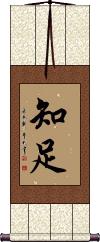
知足 means content with one's situation or to know contentment (hence happiness).
From the Zen Buddhist context, Chisoku or 知足 (knowing what’s enough) means always to know and be
satisfied with one’s lot.
Human pain and suffering are born of greed, and that greed arises because we do not know what’s enough.
The Chinese philosopher, Menzi (372-289 BCE) said, “to nourish the mind, there is nothing better than to make the desires few.”
This relays the idea that the best method to cultivate the mind is to have little desire.
Happy
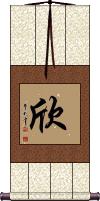
欣 is the type of happiness that you feel on the inside. It is the feeling of being released and delighted as well as being in a state of contentment. 欣 is more the internal happiness that perhaps only shows by the smile on your face. It can also be translated as “to take pleasure in” or “to rejoice.”
Note: 欣 is often used in compound words - especially in Korean Hanja.
As Japanese Kanji, this is so rare, that most Japanese people are not aware of its existence.
See Also: Happiness
Fatal error: Cannot redeclare foreignPrice() (previously declared in /home/gwest/web/chinesescrollpainting.com/public_html/includes/currencyconverter.php:22) in /home/gwest/web/orientaloutpost.com/public_html/includes/currencyconverter.php on line 22