Many custom options...


And formats...



Harmony Balance in Chinese / Japanese...
Buy a Harmony Balance calligraphy wall scroll here!
Personalize your custom “Harmony Balance” project by clicking the button next to your favorite “Harmony Balance” title below...
Harmony / Balance
Cho Wa
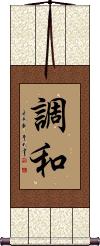
調和 is one of the several ways to express harmony in Chinese and Japanese.
Note: The first character means harmony but also suggests a musical meaning. It can also describe warriors marching in perfect cadence (in step) or to regulate something.
The second character carries the meaning of harmony and peace by itself.
Together, these characters create a word that can be defined as harmonious, to mediate, to reconcile, to compromise; mediation, temper, to mix, blend, blended, season, seasoning (getting the flavors of the food in balance), to placate, or be in harmonious proportion.
The meaning varies depending on the context. However, when hanging as a wall scroll, this will refer to the person (you) being balanced and in harmony while rational and under control simultaneously.
Harmony / Balance
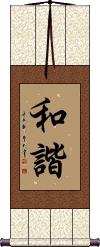
Life in Harmony / Balanced Life
Harmonious Life
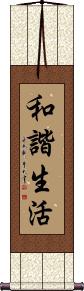
This 和諧生活 title suggests that you have, or want to get your life in balance.
The first two characters regard the idea of balance, harmony, and peace.
The second two characters mean “life.” More specifically this refers to your livelihood, career, and the daily activities that comprise your life or living. Some would translate those two characters as “one's daily existence.”
Note: We have a couple of titles for this idea. This version is more of a noun, thus "The Balanced Life" verses a verb form like "Balancing [Your] Life."
Life in Harmony / Balanced Life
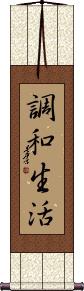
調和生活 is a Japanese title that suggests that you have, or want to get your life in balance.
The first two Kanji mean harmonious or in harmony.
The second two Kanji mean “life.” More specifically this refers to your livelihood, career, and the daily activities that comprise your life or living.
Nature in Balance / Balanced Nature
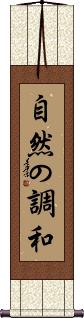
自然の調和 means “nature in harmony” in Japanese.
The first two Kanji mean nature (as in mother nature or the natural world).
The middle Hiragana is a possessive article that connects the two ideas.
The last two Kanji mean “in harmony” or “in balance.”
Peace / Peaceful
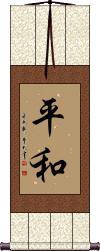
平和 is the Japanese and Korean order of these characters used most often to express the idea of peace, tranquility, and harmony.
It's just the reverse order of the Chinese. In this order in Chinese, it means takes the “mild” definition rather than “peace.” In Korean, the combination keeps the same meaning in either order.
The second character also means balance, so there is an element of harmony and balance along with peace.
Peace of Mind
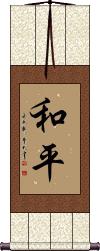
和平 is the Chinese order for these two characters, which means peace but can also be translated as amicability, specifically, or mildness. 和平 is often translated as a simple way to say “peace of mind.” This combination is used in Korean Hanja to mean “peace and harmony.”
Alone, the first character means peace and harmony.
The second character means balance when read by itself.
Note: 和平 are often seen in the opposite order in Japanese with the same meaning (You'll sometimes find them in this order in Japan, so either way is OK).
Fatal error: Cannot redeclare function foreignPrice() (previously declared in /home/gwest/web/chinesescrollpainting.com/public_html/includes/currencyconverter.php:22) in /home/gwest/web/orientaloutpost.com/public_html/includes/currencyconverter.php on line 22